 by
by Quick question. If something happened to you tomorrow, would your house go straight to your kids, or would it get stuck in a courtroom for the next eight months while lawyers sort out the paperwork?
That single question is exactly why the transfer on death deed has quietly become one of the most searched estate planning tools in America. It sounds complicated, it isn’t, and once you understand how it works, it might be the simplest decision you make all year for your family’s future.
In this blog, we’re breaking down exactly what a transfer on death deed is, whether it needs to be notarized with online notary Florida, how the rules change depending on which state your property sits in, and where it can go wrong if you’re not careful.
What Is a Transfer on Death Deed?
A transfer on death deed, sometimes called a beneficiary deed, is a legal document that lets a property owner name someone to inherit their real estate the moment they pass away, without that property ever touching probate court.
Here’s what makes it different from a regular deed. A standard deed transfers ownership the day it’s signed and recorded. A transfer on death deed does nothing while you’re alive. You keep full control.
You can sell the house, refinance it, rent it out, or change your mind about the beneficiary entirely. The transfer only activates the moment you die, and even then, your beneficiary has to file a short affidavit with the county before the property legally becomes theirs.
Roughly 32 states plus Washington, D.C. currently recognize some version of this deed, and Missouri was the first state to introduce it back in 1989. Since then, it’s spread across the country precisely because it solves one very expensive, very frustrating problem: probate.
Does a Transfer on Death Deed Need to Be Notarized?
Yes. In every state that recognizes it, a transfer on death deed must be signed in front of a notary public to be legally valid. Several states, including Illinois and California, also require two witnesses in addition to notarization. Skip the notarization step, and the deed is void, meaning your property falls back into probate exactly like you were trying to avoid.
This is the part people underestimate. A transfer on death deed isn’t like a casual home document you can fill out and forget about.
It carries the same legal weight as a will in several states, which is exactly why courts require it to go through the same formal execution process, signature, notarization, and often witnesses, before the county recorder will even accept it.
If you’re wondering why notarization matters so much here, think about it from the county’s perspective.
They’re recording a document that will one day transfer real property without a judge ever reviewing it. Document notarization is the built-in safeguard that confirms the signer was who they claimed to be, was mentally competent, and wasn’t being pressured into signing.
Also Read – Home Title Theft in 2026: How Scammers Steal Deeds?
What Should a Transfer on Death Deed Form Include?
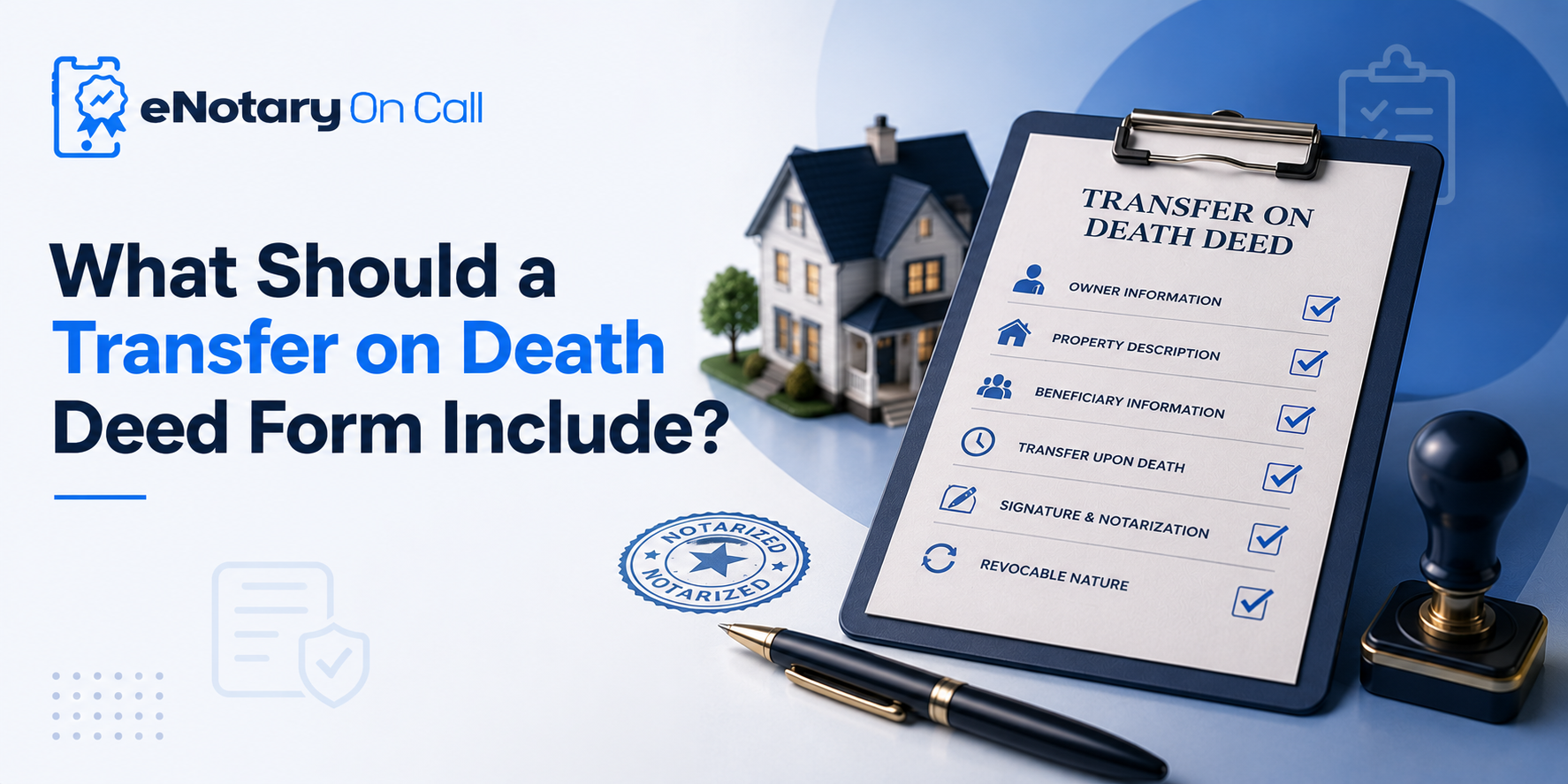
A transfer on death deed form isn’t complicated, but small mistakes on it cause real problems later. At minimum, your form needs:
- The full legal name of the current owner (the transferor)
- A complete legal description of the property, not just the street address
- The full legal name of the beneficiary or beneficiaries, never vague terms like “my children”
- A clear statement that the transfer takes effect only at the owner’s death
- The owner’s notarized signature, and witness signatures where the state requires them
- Language confirming the deed is revocable
One of the most common reasons a transfer on death deed gets rejected at the county recorder’s office is using only the street address instead of the full legal description pulled from the current deed.
Courts and title companies need that exact legal description, or the transfer can be challenged later.
Transfer on Death Deed Texas: What You Need to Know?
Transfer on death deed Texas rules come from the Texas Real Property Transfer on Death Act, which took effect in 2015 and lives in Texas Estates Code Chapter 114.
A Texas transfer on death deed must be signed in front of a notary and recorded with the county clerk before the owner’s death, or it has no legal effect at all.
Texas actually removed its witness requirement back in 2019, so today, notarization alone is enough on the signature side, though the deed still needs a precise legal description of the property to hold up.
One detail Texas homeowners often miss: a transfer on death deed cannot be created using a power of attorney. The actual property owner has to sign it personally.
Transfer on Death Deed California: What You Need to Know?
A transfer on death deed California residents use is officially called a Revocable Transfer on Death Deed, authorized under California Probate Code Sections 5600 through 5696 since 2016. California’s version comes with some of the strictest execution rules in the country.
The deed must be signed, notarized, witnessed by two people present at the same time, and recorded with the county recorder within 60 days of document notarization, or it becomes completely void with no grace period.
That 60 day recording deadline trips up more Californians than any other requirement, since many people notarize quitclaim deed and then simply forget to file it in time. California also limits this tool to residential property with one to four units, or a condominium, so larger properties don’t qualify.
Transfer on Death Deed Illinois: What You Need to Know?
Illinois calls its version a Transfer on Death Instrument, or TODI, under the Illinois Residential Real Property Transfer on Death Instrument Act, effective since January 2012.
A transfer on death deed Illinois owner uses must be signed by the owner, attested by two credible witnesses, and notarized, all in the same signing session.
Illinois has one strict rule worth remembering: a beneficiary or their spouse cannot serve as a witness on the document. If they do, that beneficiary’s share can be voided even if everything else about the deed is correct.
As of 2022, Illinois also expanded TODIs beyond just residential property to cover any real estate interest the owner has the legal power to transfer.

Transfer on Death Deed Georgia: What You Need to Know?
Georgia is the newest state on this list. A transfer on death deed Georgia property owner can use only became available on July 1, 2024, under O.C.G.A. Section 44-17-1 and following. Before that date, Georgia had no TOD deed option at all.
The Georgia deed must be signed by the owner in front of a notary and two witnesses. After the owner passes away, the beneficiary has to file an affidavit with the Superior Court in the property’s county within nine months of the death, along with a copy of the death certificate.
Miss that nine month window, and the property reverts back to the deceased owner’s estate, which usually means probate anyway.
Because Georgia’s law is still so new, title companies and courts haven’t fully tested every edge case yet, so working with an estate planning attorney here is especially worthwhile.
Transfer on Death Deed Florida: Why the Rules Are Different?
Here’s something that surprises a lot of people searching for a transfer on death deed Florida option: Florida does not authorize transfer on death deeds for real estate at all. Florida law only permits TOD designations for motor vehicles, not homes or land.
Instead, Florida property owners typically rely on an enhanced life estate deed, better known as a Lady Bird deed, to accomplish a similar result.
A Lady Bird deed lets you keep full control of the property during your lifetime, including the right to sell or mortgage it, and automatically passes it to your named beneficiary at death without probate, all while still being notarized like a standard deed.
If you own property in Florida and were hoping to record a TOD deed, a Lady Bird deed, joint tenancy, or a revocable trust are your realistic alternatives.
Also Read – Power of Attorney for Elderly Parents: Types and Notarization!
Transfer on Death Deed vs. Will vs. Trust: Which Fits Your Situation?
A lot of people assume a transfer on death deed replaces the need for a will or trust entirely. It doesn’t. It’s a targeted tool for one specific asset, real estate, not a complete estate plan.
A will still governs everything else you own, bank accounts without beneficiaries, personal belongings, and any property not covered by a TOD deed, but it has to go through probate.
A living trust covers multiple assets, can manage property during incapacity, and offers more structure for complex families, but it costs more to set up and requires actively retitling assets into the trust’s name.
If your estate plan already includes a will or trust, many people choose to notarize will and trust online documents alongside their transfer on death deed to keep everything current and legally sound at the same time.
Reviewing all three together with an estate planning attorney is the safest way to make sure they don’t accidentally conflict with each other, since in most states a will cannot override a properly recorded TOD deed.
How to Notarize Your Transfer on Death Deed Online?
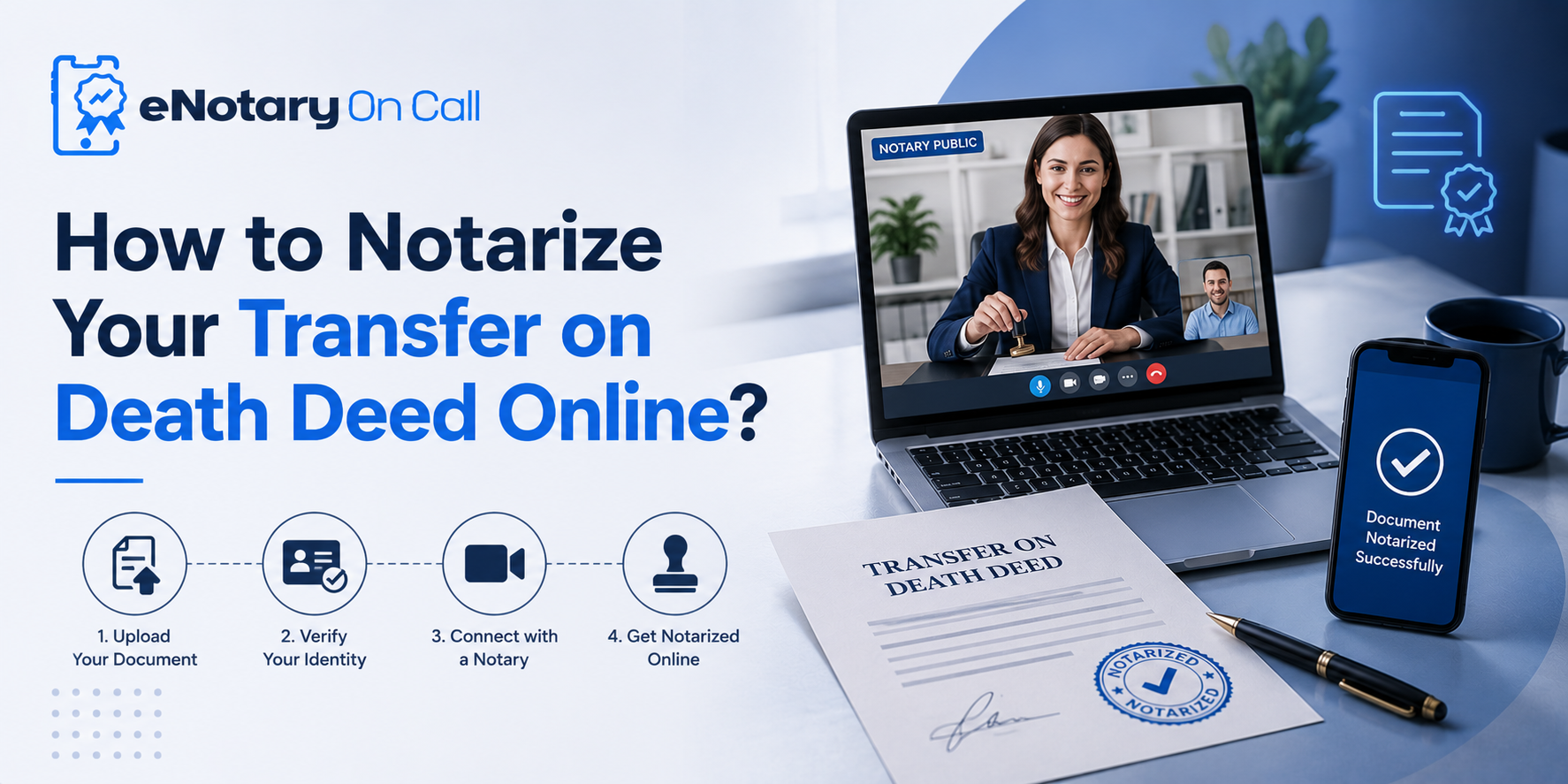
Since every valid transfer on death deed requires notarization, and often witnesses too, choosing how you get it notarized actually matters.
This is where a remote online notary makes the entire process significantly easier, especially if you’re dealing with an aging parent who can’t easily travel, a property in another state, or simply a busy schedule that doesn’t leave room for an in-person appointment.
Online notary services like eNotary On Call let you complete the entire signing process over a live, recorded video session with a licensed notary, without leaving your home.
The platform verifies your identity through biometric checks and government ID analysis, connects you with a certified notary in minutes, and provides a digitally sealed, court-admissible document the moment your session ends.
This matters even more when you consider how many other estate documents pair with a TOD deed. Through the same kind of remote online notary session, you can also notarize quitclaim deed online paperwork if you’re adjusting how a property is titled before setting up your TOD deed, or notarize power of attorney online if you need someone to manage your affairs during incapacity.
eNotary On Call supports all of these document types through one secure, MISMO-certified, SOC 2 Type II compliant platform, with every session recorded and stored for years afterward in case a beneficiary or court ever needs to verify how the document was executed.
For Texas and Illinois residents specifically, where state law requires the notary to confirm the owner’s identity and, in Illinois’s case, watch two witnesses sign in the same session, a structured remote online notary platform actually creates a cleaner audit trail than a rushed in-person signing at a bank counter.
Also Read – Apostille vs Notarization: Key Differences and When You Need?

Conclusion
A transfer on death deed genuinely is one of the simplest tools available for keeping a home out of probate, but simple doesn’t mean casual. Every state that allows it treats the signing process seriously, which is exactly why notarization, and in some states witnesses, are non-negotiable requirements rather than optional extras.
Whether your property is in Texas, California, Illinois, Georgia, or you’re exploring Lady Bird deed alternatives in Florida, getting the execution right the first time is what actually protects your family from probate court later. Pair that with proper notarization through a reliable, verified platform, and you’ve closed the two biggest gaps that cause TOD deeds to fail: incomplete paperwork and improper signing.
Ready to notarize your transfer on death deed, will, trust, or power of attorney without leaving your living room?
Book a session with eNotary On Call and get a certified notary in minutes, backed by verified identity checks, encrypted records, and support available around the clock.
FAQs
1. Can eNotary On Call notarize a transfer on death deed?
eNotary On Call can notarize a wide range of real estate and estate-planning documents, including deeds, through a live, identity-verified video session with a licensed notary, available in states that permit remote online notarization.
2. Do I need to be in the same state as my notary to use eNotary On Call?
No. eNotary On Call connects you with certified notaries across multiple states, including Florida and Texas, and can help residents of states with limited remote notary access connect with an out-of-state notary where legally permitted.
3. How long does it take to notarize a document with eNotary On Call?
Most sessions are completed in under fifteen minutes, including identity verification, the live video signing, and receiving your sealed, downloadable document.
4. Does eNotary On Call keep a record of my notarized transfer on death deed?
Yes, every session is recorded and securely stored on encrypted cloud infrastructure for several years, giving you a verifiable record if the deed’s execution is ever questioned later.
5. Can I notarize a will, trust, or power of attorney through the same platform?
Yes, eNotary On Call supports online notarization for wills, trusts, powers of attorney, and quitclaim deeds, alongside transfer on death deeds, all through one account.
6. Is online notarization as legally valid as an in-person notary for a TOD deed?
Yes, in any state that permits remote online notarization, a session completed through a certified platform carries the same legal weight as an in-person notarization.
7. What happens if my transfer on death deed isn’t notarized?
It’s void. An unnotarized transfer on death deed has no legal effect, and the property will pass through probate according to your will or state intestacy law instead.
8. Can I revoke a transfer on death deed after it’s notarized and recorded?
Yes, you can revoke it at any time while you’re alive and mentally competent, typically by recording a new deed or a signed, notarized revocation form with the county.