

 by
by Setting up a power of attorney for elderly parent care is one of those tasks families put off until a hospital call forces the issue. You are not alone in this.
According to the 2025 AARP and National Alliance for Caregiving report, 63 million Americans, nearly 1 in 4 adults, now provide care for an aging or ill loved one, a jump of 20 million in just ten years.
Many of those caregivers live in a different city or state than mom or dad, which is exactly why more families now notarize power of attorney online instead of dragging a parent to a bank branch.
This blog walks you through the types of POA, notarization rules, and how to get power of attorney for elderly parents entirely from your laptop.
What Does a Power of Attorney for an Elderly Parent Let You Do?

A power of attorney (POA) is a legal document in which your parent (the “principal”) authorizes you (the “agent” or “attorney-in-fact”) to act on their behalf.
Depending on how the power of attorney form for elderly parent is drafted, you can pay their bills, manage bank accounts, sell or maintain property, file taxes, talk to Medicare and insurance companies, and make medical decisions if they cannot.
One thing a POA does not do: it does not take away your parent’s rights. They can keep managing their own affairs and can revoke the document at any time while mentally competent.
The 4 Types of POA: Which One Fits Your Situation?
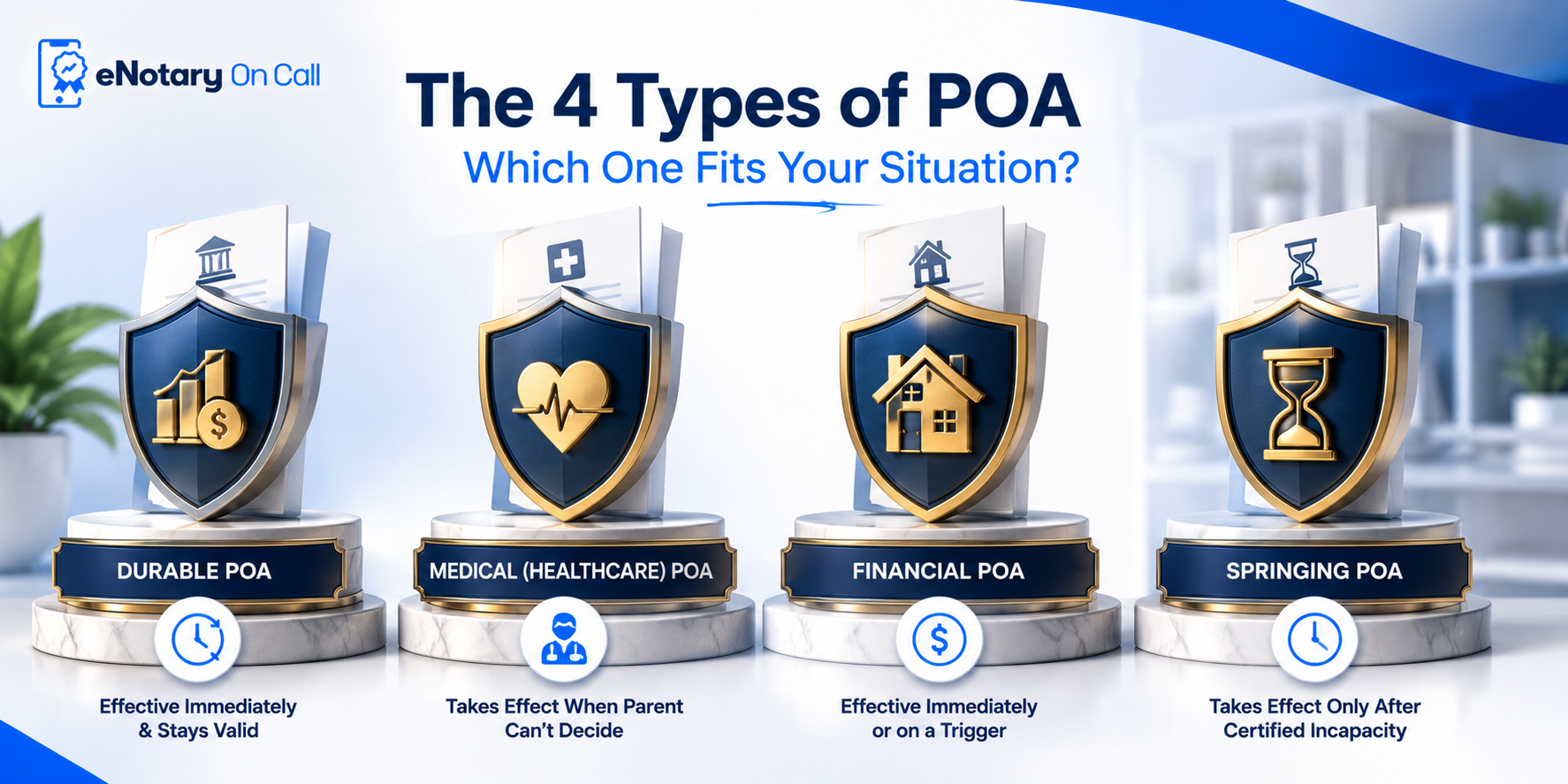
The following are the types:
| Type | What It Covers | When It Takes Effect | Best For |
| Durable POA | Financial and legal matters, stays valid after incapacity | Immediately upon signing | Most families; the default choice |
| Medical (Healthcare) POA | Treatment decisions, doctors, facilities | When a physician declares the parent unable to decide | Hospital and end-of-life planning |
| Financial POA | Banking, real estate, taxes, benefits | Immediately or on a trigger event | Parents who need help with money only |
| Springing POA | Same scope as durable, but dormant | Only after certified incapacity | Parents hesitant to hand over control now |
A quick note on Medical POA vs Living Will, because families confuse these constantly. A medical POA names a person to make decisions for your parent. A living will states your parent’s own wishes in writing, like whether they want life support.
The practical answer to the Medical POA vs Living Will question is that most estate attorneys recommend both: the living will speaks, and the medical POA agent enforces it. If you only pick one, understand that Medical POA vs Living Will is not either-or; they cover different gaps.
A financial power of attorney for elderly parent is the document banks care about most. Without it, you cannot legally move money, even to pay their mortgage from their own account.
Also Read – Do I need a Notary for a Power of Attorney?
Does a POA Need to Be Notarized?

In most states, yes, and skipping this step is the fastest way to get the document rejected. Requirements vary:
| State | Notarization | Witnesses |
| Florida | Required | Two witnesses required |
| Texas | Required for durable POA | Not required for statutory durable POA |
| New York | Required | Two witnesses required |
| California | Notary or two witnesses | Two if no notary |
| Pennsylvania | Required | Two witnesses required |
A power of attorney form Florida for elderly parent is among the strictest in the country: Florida Statute 709.2105 demands two subscribing witnesses plus a notary. Texas keeps it simpler; the statutory durable POA needs notarization only, while the Texas medical POA can be signed before two witnesses or a notary.
Good news for families: as of 2026, 49 states plus Washington D.C. have enacted permanent remote online notarization (RON) laws, and documents notarized this way carry the same legal weight as in-person notarizations.
That means you can notarize POA online through a state-commissioned online notary without anyone leaving home. RON Platforms like eNotary On Call connect your parent with a commissioned notary over secure video, verify identity through government ID checks and knowledge-based authentication, and apply a tamper-evident digital seal, typically in under 15 minutes.
Also Read – Healthcare POA vs Financial POA Explained: Fast Solutions
What If You Live in a Different State Than Your Parent?

This is where remote online notarization genuinely changes the game. Say you are in Dallas and your mom is in Miami. An Online Notary Texas commission or an online notary Florida commission both work over video, so your mom signs from her living room while you observe on the same call.
Texas has allowed RON since 2018, and Florida’s online notary law took effect January 1, 2020, so both states have mature, well-tested systems. eNotary On Call maintains notaries commissioned for Online Notary Texas sessions and online notary Florida sessions alike, so the document is executed under the correct state’s rules no matter where the family is scattered.
Remote Witnesses: Which States Allow?
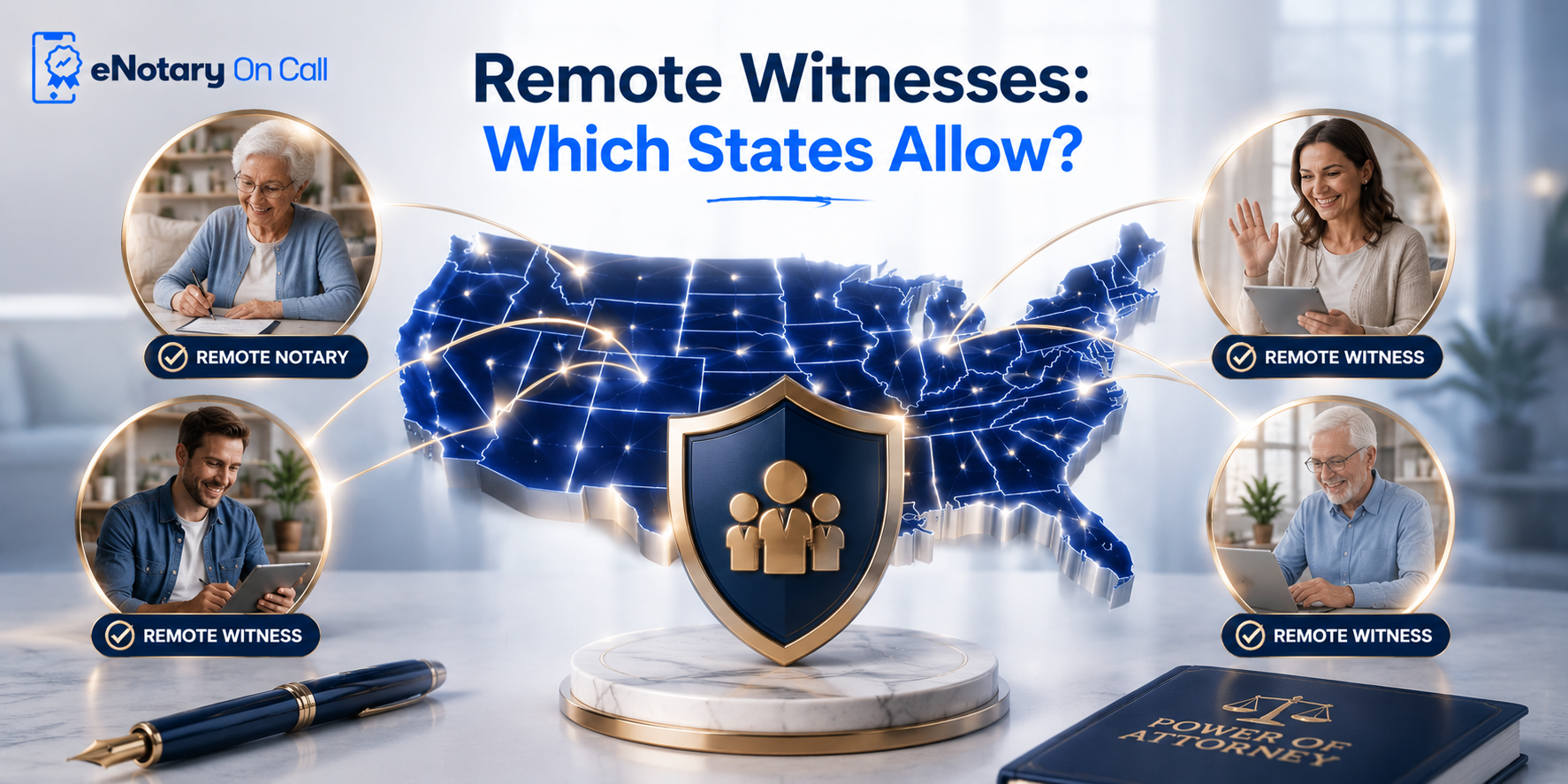
Witness rules lag behind notary rules. Florida explicitly permits remote witnessing through an approved RON provider, which is why a power of attorney form Florida for elderly parent can be fully executed online, witnesses included.
Texas does not need witnesses for its statutory durable POA, so an Online Notary Texas session alone completes it.
Other states, like New York, generally still expect witnesses to be physically present, so check your state statute or ask the platform before booking.
Common Mistakes Families Make with POA

- Using an outdated form. States revise POA statutes. A form downloaded in 2012 may not satisfy current law, and banks will reject it.
- Choosing the wrong type. A general POA that is not durable dies the moment your parent becomes incapacitated, which is exactly when you need it.
- Bank pushback. Some banks prefer their own POA forms. Deliver the notarized POA to your parent’s bank now, not during a crisis.
- Only one agent, no backup. If the sole agent dies or becomes unavailable, the POA is useless. Always name a successor.
- Forgetting the medical side. Families sort out the financial power of attorney for elderly parent needs and never sign a healthcare directive. Revisit the Medical POA vs Living Will discussion and complete both.
Also Read – Power of Attorney vs Authorized Signer: The Guide for 2026
POA vs Guardianship vs Living Trust: Quick Comparison
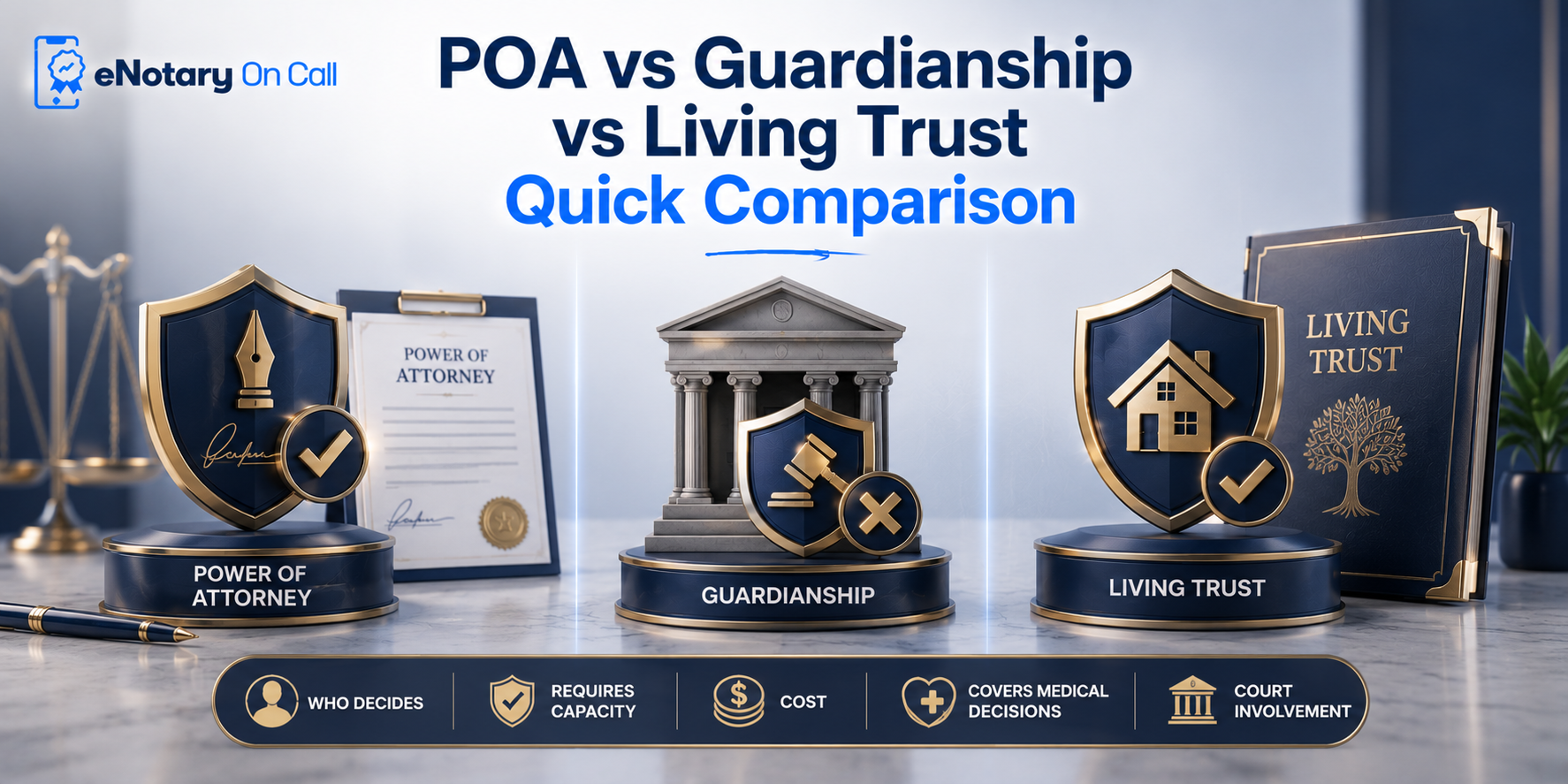
| POA | Guardianship | Living Trust | |
| Who decides | Parent chooses agent | Court appoints guardian | Parent names trustee |
| Requires capacity | Yes | No (used after incapacity) | Yes |
| Cost | $0 to a few hundred dollars | Often $3,000+ plus ongoing court oversight | $1,500 to $3,000+ |
| Covers medical decisions | Yes, with medical POA | Yes | No |
| Court involvement | None | Continuous | None |
Ready to finish this in one evening?
Book a secure video session with eNotary On Call, get your parent’s POA notarized online in minutes, and cross the biggest item off your caregiving checklist.
FAQs
1. How to get power of attorney for elderly parents who live in another state?
Use the POA form for the parent’s state of residence, then notarize POA online through a RON platform like eNotary On Call. The signed, digitally sealed document is legally valid nationwide.
2. How to obtain power of attorney for elderly parents with early dementia?
Act quickly and document capacity. If a physician confirms your parents still understand the document, they can sign. If not, consult an elder law attorney about guardianship.
3. Can siblings share power of attorney?
Yes. Parents can name co-agents who act jointly or independently. Independent authority is more practical; joint authority requires every signature on every action.
4. Can a parent revoke a POA?
Yes, at any time while mentally competent, by signing a written revocation and notifying banks and agents.
5. Will banks accept an online-notarized POA?
Yes. RON documents carry the same legal standing as in-person notarizations, and federal agencies including Fannie Mae and Freddie Mac accept them. Delivering the POA to the bank early prevents friction later.
6. How much does it cost?
DIY with state forms plus online notarization typically runs $25 to $75. Attorney-drafted POA packages range from $200 to $500. Guardianship, the alternative when you wait too long, often costs thousands.
7. Do I need an affidavit of residency with a POA?
Not always, but assisted-living facilities, schools, and DMVs frequently request an affidavit of residency alongside a POA, and both can be notarized in one online session.