
 by
by The debate around apostille vs notarization confuses thousands of Americans every single week, and honestly, it is not their fault. Both involve official stamps, both make documents “legal,” and both sound like something a notary should handle. But mix them up, and your paperwork can get rejected overseas, costing you weeks of delays and hundreds of dollars in resubmission fees.
Here is the short version. Notarization verifies who signed a document. An apostille verifies the official who certified it, so the document can be used in another country. One is domestic, the other is international, and sometimes you genuinely need both.
Let’s break down the difference between apostille and notarized document requirements, what each one costs, and exactly when you need one, the other, or both.
Apostille vs Notarization: The Quick Answer
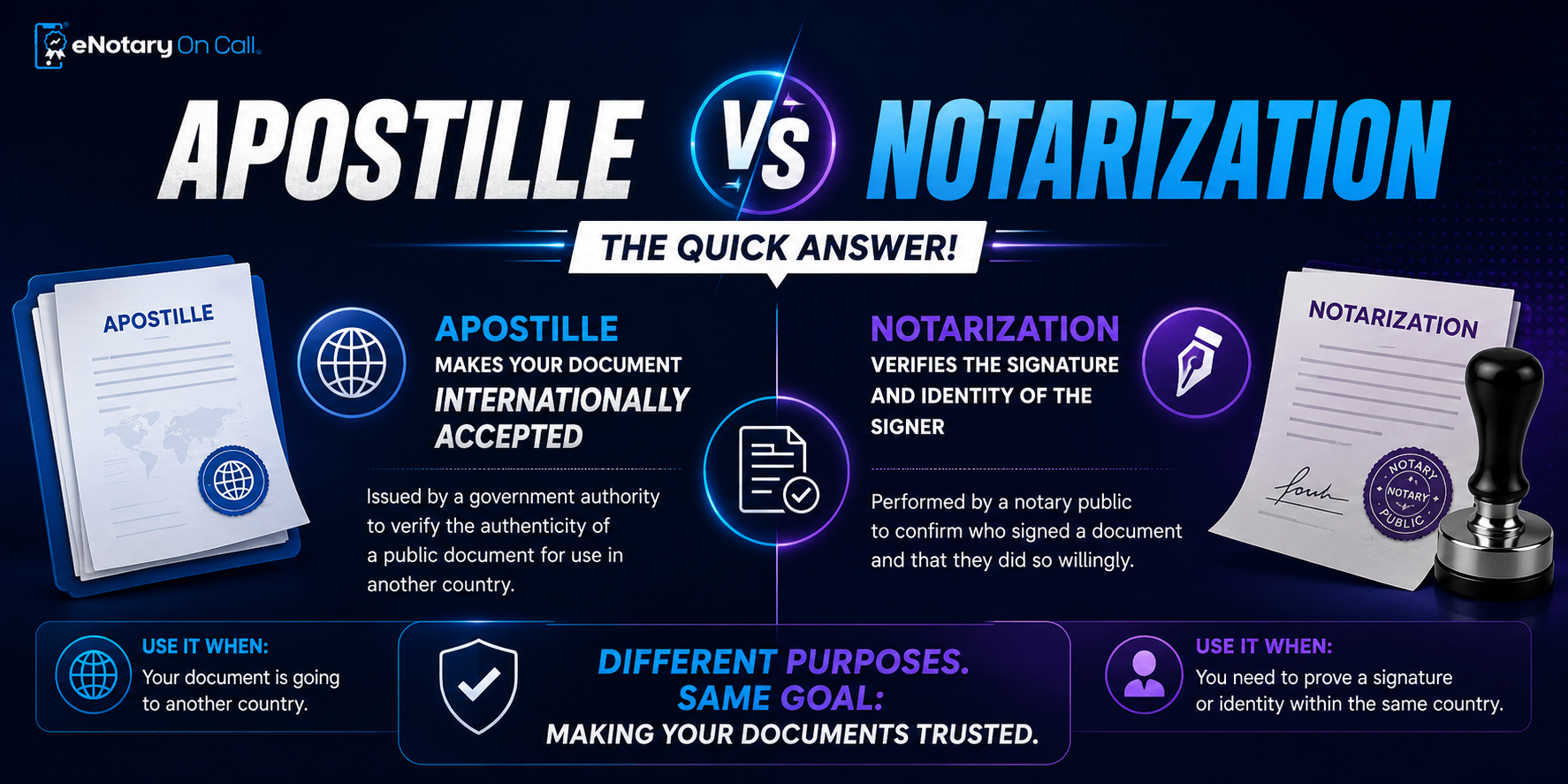
Notarization is the act of a commissioned notary public verifying a signer’s identity and willingness before witnessing a signature, and it is primarily valid for use inside the United States.
An apostille is a government-issued certificate, typically from a Secretary of State, that authenticates the notary’s or official’s signature so the document is accepted in the 120+ countries that belong to the Hague Apostille Convention.
A notary cannot issue an apostille, and many documents headed abroad need notarization first, then an apostille on top.
That single paragraph answers about 80 percent of the apostille vs notary questions we see. The remaining 20 percent is where people lose money, so keep reading.
What Document Notarization Does?
A notary public is a state-commissioned official whose job is fraud prevention. During a notarization, the notary:
- Verifies your identity using government-issued ID
- Confirms you are signing willingly and are aware of what you are signing
- Witnesses the signature or administers an oath
- Completes a notarial certificate and applies their seal
That is it. A notary does not validate whether the content of your document is true or legally sound. Common notarized documents include powers of attorney, an affidavit of residency, loan packages, parental consent forms, and business agreements.
Traditionally this meant driving to a bank or UPS store. Today, an online notary service like eNotary On Call connects you with a commissioned notary over secure audio-video in minutes, and remote online notarization (RON) is now legally authorized in the majority of US states.
Whether you need an online notary Texas residents can use at midnight or an online notary Florida snowbirds can reach from abroad, the notarization itself carries the same legal weight as an in-person stamp.
What an Apostille Does?
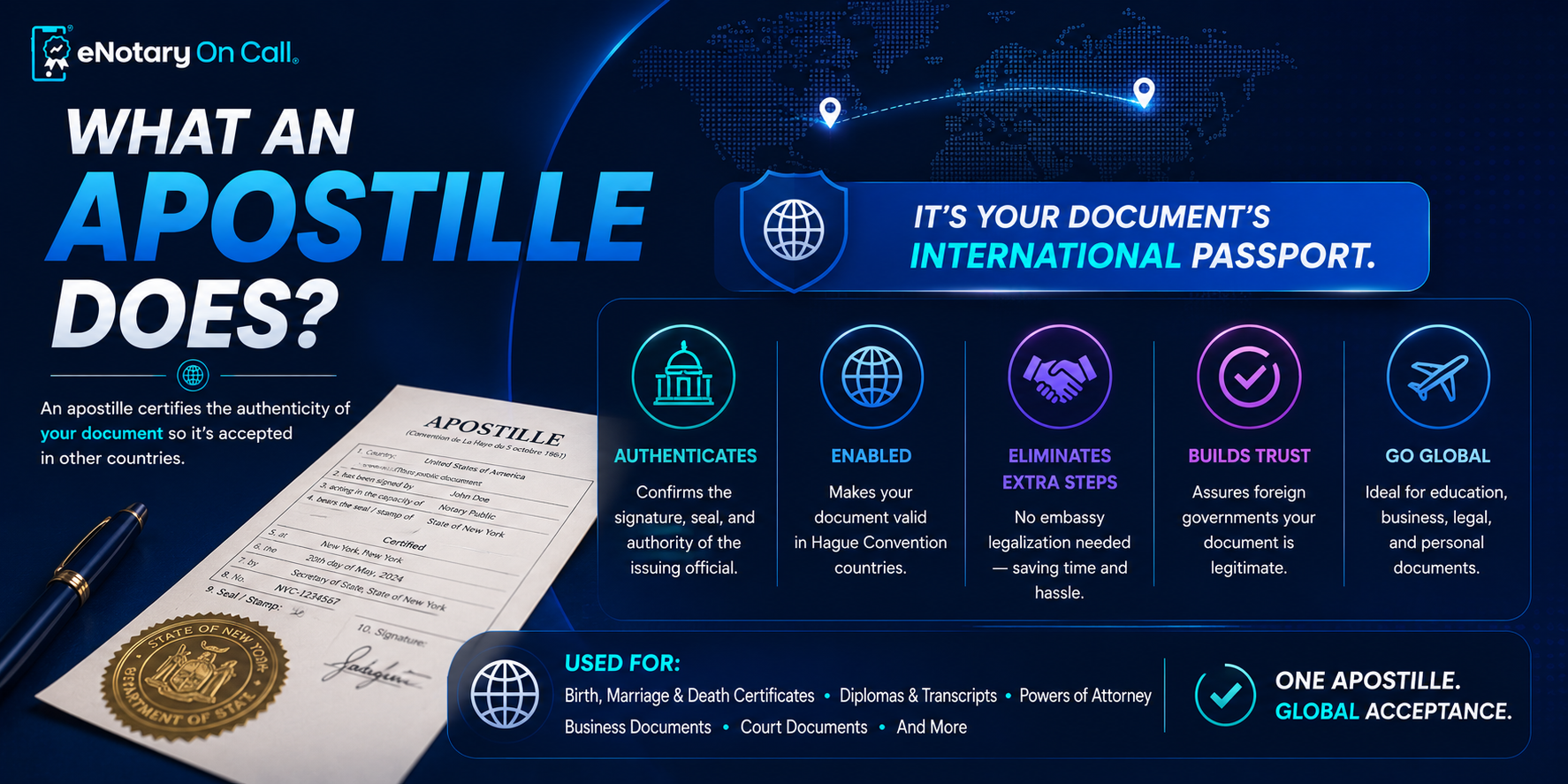
An apostille is a standardized certificate created under the Hague Convention of October 5, 1961. It authenticates the signature, seal, and capacity of the public official on your document, usually the notary or the state registrar, so foreign authorities do not have to verify American officials themselves.
Some quick market context, because the scale here surprises people:
- As of mid-2026, the HCCH status table lists 130 contracting parties to the Apostille Convention, comfortably past the 120+ mark, including recent heavyweight additions like China (in force 2024) and Canada (2024), with Vietnam set to take effect in September 2026.
- State apostille fees in the USA range from roughly $1 in Michigan to $25 in New Jersey, with most states charging $10 to $20 per document.
- Federal documents like FBI background checks are apostilled by the US Department of State for $20 per document, and mailed federal requests can take up to five weeks.
If your destination country is not a Hague member, you will need the longer consular legalization route instead, which often takes four to eight weeks.
Difference Between Apostille and Notarized Document: Side-by-Side
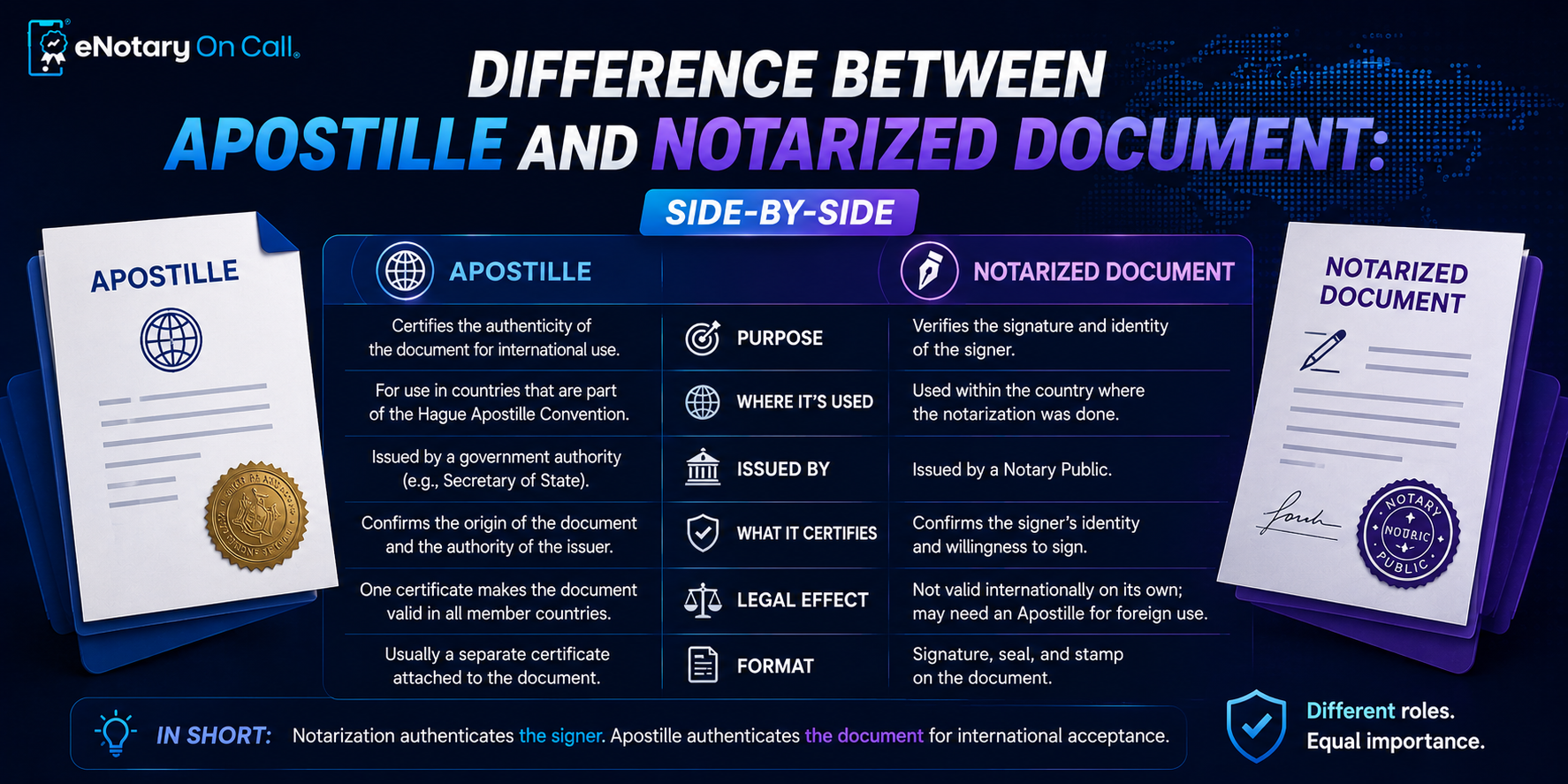
The following are the differences:
| Factor | Notarization | Apostille |
| Purpose | Verifies signer identity, deters fraud | Authenticates the official’s signature for foreign use |
| Issued by | Commissioned notary public | Secretary of State (state docs) or US Dept. of State (federal docs) |
| Where valid | Primarily within the USA | 120+ Hague Convention countries |
| Typical cost | $5 to $15 in person; around $25 via an online notary service | $1 to $25 state fee; $20 federal |
| Processing time | Minutes | Same day (walk-in states like Texas) to 5+ weeks (federal mail) |
| Examples | Affidavit of residency, POA, consent forms | Birth certificates, FBI checks, notarized POAs going abroad |
That table is the difference between apostille and notarized document handling in a nutshell. Notarization is a step. An apostille is a certification of that step, layered on top for international recognition.
Can a notary apostille a document?
Absolutely not. Notaries notarize. Only a designated competent authority, which in the US means your state’s Secretary of State for state-level documents or the US Department of State for federal documents, can issue an apostille.
Texas law, for example, states that the Office of the Texas Secretary of State is the only agency in the state that can issue apostilles for Texas public records. Florida says the same, routing all apostille and notarial certifications through its Division of Corporations in Tallahassee.
So if a “notary” offers to apostille a document directly, they are either describing a courier service (they notarize, then submit to the state on your behalf) or they are misleading you.
What a reputable online notary service such as eNotary On Call actually does is handle the notarization step correctly the first time, which matters enormously, because a bad notarial certificate is the number one reason states reject apostille requests.
Documents That Need Notarization First, Then an Apostille
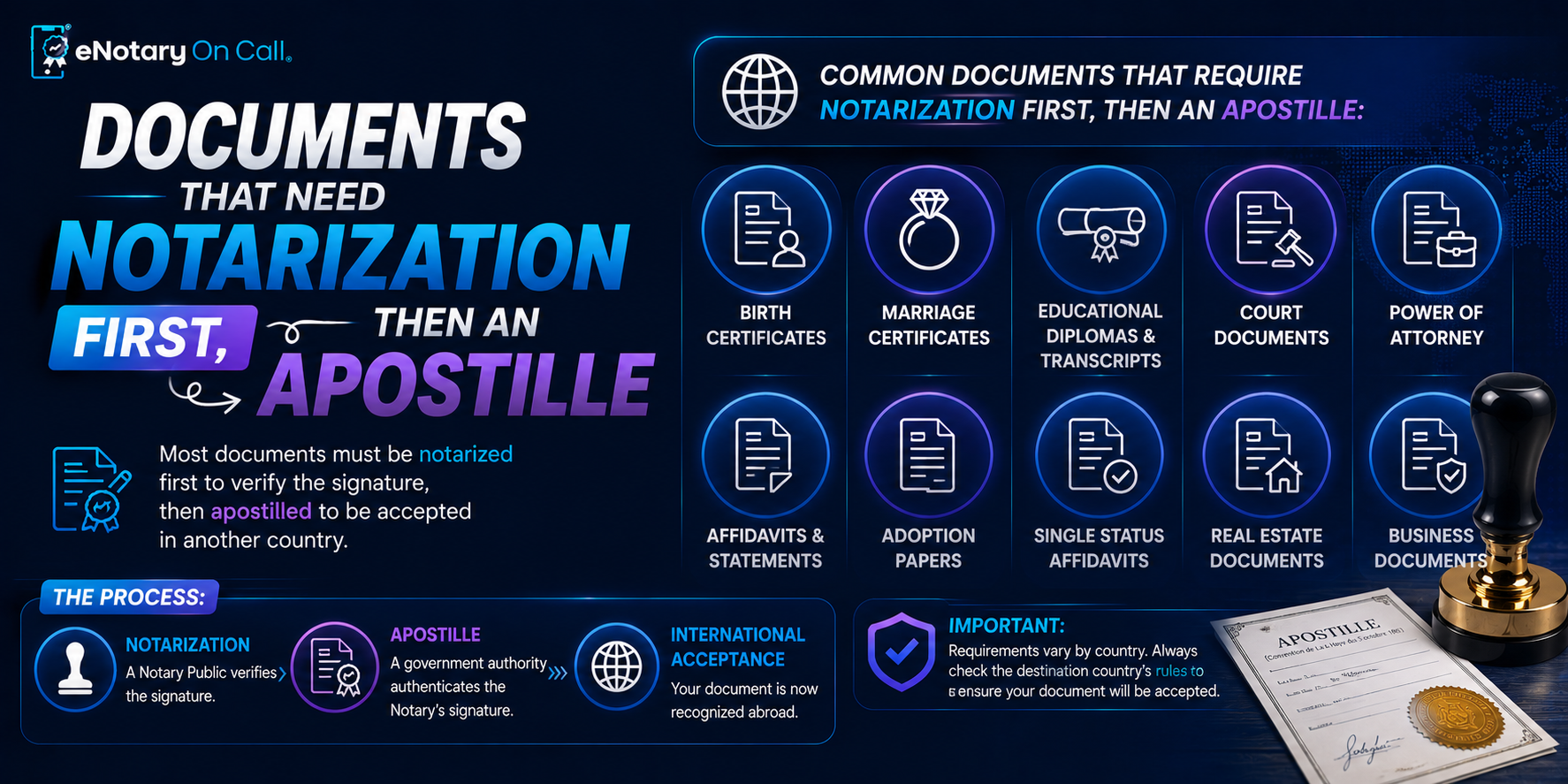
These private documents are not “public records” until a notary’s signature makes them verifiable, so the sequence is notarize first, apostille second:
- Power of attorney for property, banking, or family matters abroad
- Affidavit of residency for foreign schools, visas, or tax authorities
- Corporate documents like board resolutions and agreements not on file with the state
- Parental consent letters for a child traveling internationally
- Certified translations, where the notary witnesses the translator’s signature
This is exactly where the phrase notarize apostille forms online comes from in search data. People want to notarize apostille online in one smooth flow: complete the RON session from home, then send the notarized output to the Secretary of State.
With eNotary On Call, you can finish the notarization portion in under 15 minutes, day or night, before starting the state filing.
Documents That Should NEVER Be Notarized Before an Apostille
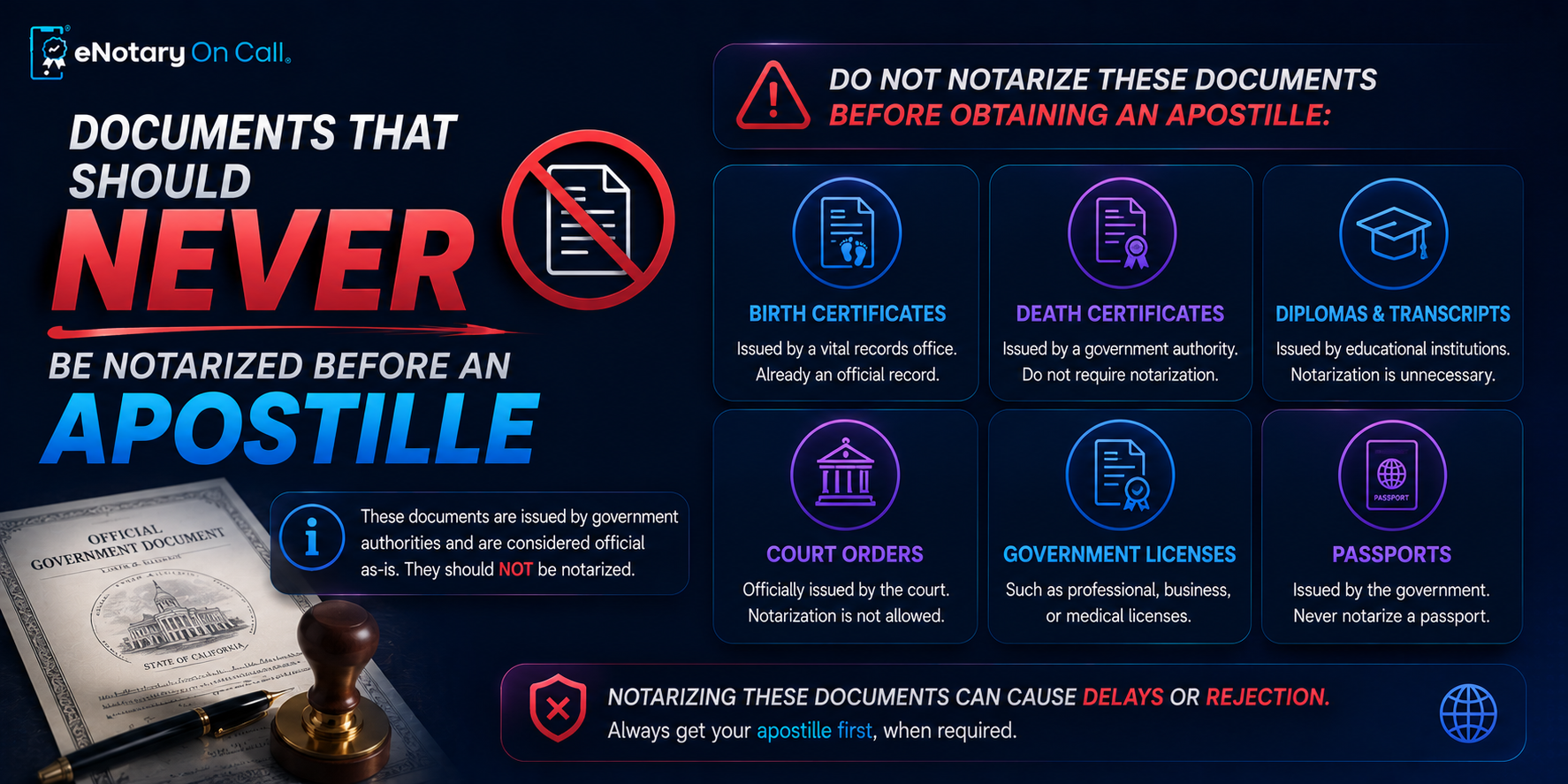
Here is the expensive mistake. Do not notarize vital records. Ever.
Birth certificates, death certificates, and marriage certificates are recordable public documents. The apostille authenticates the state registrar’s signature already on them.
Texas explicitly warns that recordable documents cannot be notarized or turned into certified copies by a notary, and Florida rejects vital records that do not come straight from its Bureau of Vital Statistics.
Notarizing a photocopy of your birth certificate will get your request bounced, and you lose the state fee plus shipping both ways. One rejection can easily add $100+ to your total cost.
The same rule applies to court documents, school transcripts certified by a registrar, and anything already carrying an official government seal.
Step-by-Step: Getting a US Document Ready for International Use
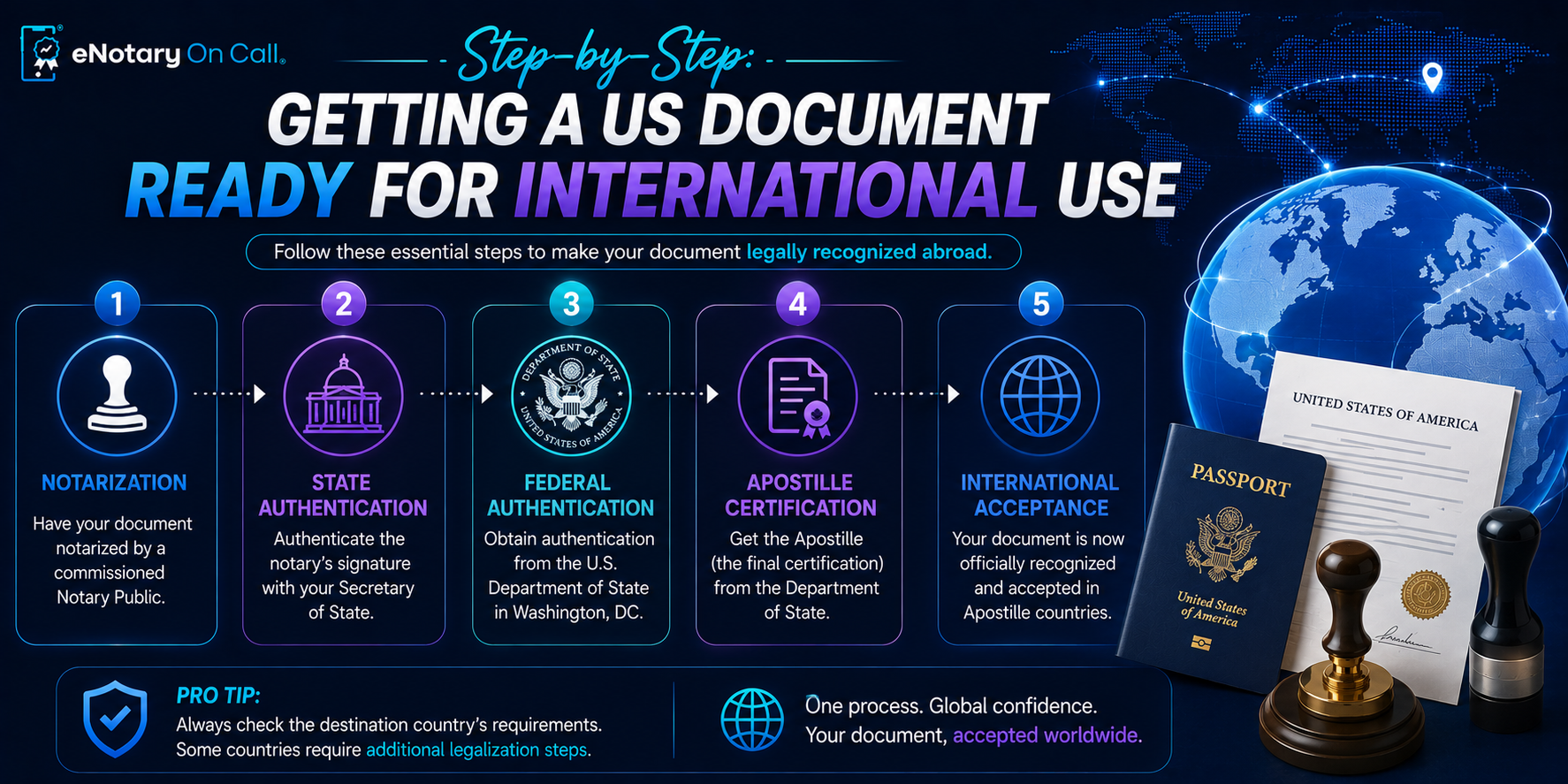
- Confirm the destination country is a Hague member. Check the HCCH status table. Member? Apostille. Non-member? Consular legalization.
- Identify your document type. Vital record or court document: order a fresh certified copy (many states require copies under three to five years old). Private document: it needs notarization first.
- Get it notarized correctly. Wrong wording, an expired commission, or a missing seal means rejection. A professional online notary service verifies the certificate language during the session.
- Submit to the right authority. State documents go to that state’s Secretary of State (Texas charges $15 per document, Florida charges $10 for notarized documents and $20 for court-certified ones). Federal documents like FBI checks go to the US Department of State.
- Check translation rules. Countries like Mexico, Germany, and Japan often require a certified translation, and that translation itself may need notarization.
Following apostille requirements USA rules in this order saves the two most common failure points: notarizing what should not be notarized, and skipping notarization on what requires it.
Can Remotely Notarized Documents Get an Apostille?
Mostly yes, but it varies by state, and this is where knowing your local rules pays off.
Texas officially accepts RON documents for apostille if you include the notarization ledger (date, time, document description, signer info) and a notarial certificate stating the document was notarized via two-way audio-visual communication. So yes, a session with an online notary Texas platform can absolutely feed into a Texas apostille when packaged properly.
Florida authorized RON back in 2020 and apostilles properly executed Florida notarizations, which means an online notary Florida session works for apostille purposes too, provided the certificate wording follows Chapter 117 of the Florida Statutes.
Other states are still tightening their e-apostille and RON acceptance rules, and true electronic apostilles (e-apostilles) are an emerging topic we will cover in a dedicated follow-up post. For now, the safe play: use an online notary service that understands apostille-bound documents.
Conclusion
The apostille vs notarization decision comes down to geography and document type. Domestic and private: notarize. International and public: apostille. International and private: notarize, then apostille, and never notarize a vital record.
Getting the notarization right is the half you fully control. eNotary On Call makes that half effortless with secure, legally compliant remote notarization available 24/7, whether you are searching for an online notary Texas trusts, an online notary Florida families rely on, or apostille requirements USA guidance for any of the other 48 states. Notarize your document tonight, and have it on the Secretary of State’s desk tomorrow.
Ready to get started?
Book your session with eNotary On Call and check the first box on your apostille journey in minutes.
FAQs
1. Do I need an apostille or notarization?
Ask one question: where will the document be used? Inside the US only, notarization is usually enough. Going to a Hague Convention country, you need an apostille, and if it is a private document like a POA or affidavit of residency, you need notarization first and then the apostille. So “do I need an apostille or notarization?” often has a third answer: both, in that order.
2. Can a notary apostille a document?
No. Only the Secretary of State (state documents) or the US Department of State (federal documents) issues apostilles. A notary’s role ends at the notarization.
3. What is the difference between apostille and notarized document costs?
Notarization typically runs $5 to $15 in person or about $25 through RON. Apostilles cost $1 to $25 at the state level and $20 federally, before shipping.
4. How long does an apostille take?
Same day if you walk into offices in states like Texas, California, or Massachusetts. Around five business days by mail in Florida. Federal apostilles by mail can stretch to five weeks.
5. Can I notarize apostille online in one step?
Not literally, since they are two separate acts by two separate authorities. But you can notarize apostille online in sequence: complete a RON session through eNotary On Call, then submit the compliant output to your Secretary of State.
6. Does a federal document like an FBI background check go to my state?
No. Federal documents skip the state entirely and go to the US Department of State’s Office of Authentications.