 by
by Home title theft is one of those crimes you don’t think about until it happens to you and by then, someone may have already sold your house without you knowing. In 2026, the FBI warns home title theft surge cases are climbing fast, fueled by AI-generated fake IDs and forged quitclaim deeds.
The good news? The same technology criminals exploit is also being used to shut them down starting with remote online notarization (RON).
Let’s break down exactly how this scam works, answer how common is home title theft?, and cover how to protect your home title with online notary Florida and how to protect your home from title theft going forward before a fraudster gets to you first.
What Is Home Title Theft (Deed Fraud)?
Home title theft also called deed fraud is when a criminal forges your signature on a property deed, gets it fraudulently notarized, and records it with the county to make themselves the legal owner of your home. Once that fake deed is on record, they can sell your property, take out loans against it, or rent it to unsuspecting tenants.
So, is home title theft real? Yes the FBI’s Boston Division issued an official warning about it, and its Internet Crime Complaint Center (IC3) logged 12,368 real estate fraud complaints in 2025 alone. It’s not a hypothetical scare tactic. It’s a documented, growing crime.
How Scammers Forge Deeds: The 4-Step Playbook
Deed thieves follow a surprisingly consistent playbook. Here’s how it usually goes down.
1: Target selection
Fraudsters comb public records for easy marks: vacant land, second homes, homes owned free-and-clear (no lender watching), and properties owned by elderly homeowners or deceased owners whose heirs never transferred title.
2: Fake IDs and AI-generated documents
Next, they build a fake identity for you. The FBI’s 2025 IC3 report flagged 22,000+ AI-related fraud complaints tied to $893 million in losses. Criminals now use AI to produce convincing fake driver’s licenses, deepfakes, and cloned voices to impersonate owners.
3: Forged notarizations and stolen notary seals
A deed isn’t recordable without a notarization. So scammers either forge a notary’s signature and stamp outright, use a stolen or counterfeit notary seal, or fool a rushed in-person notary with a high-quality fake ID.
This is the weakest link in the whole chain and the exact point where modern deed fraud prevention tools strike back (more on that below).
4: Filing fraudulent quitclaim deeds at the county recorder
Finally, they file the forged document almost always a quitclaim deed, because it’s cheap, fast, and rarely scrutinized.
County recorders don’t verify signatures; they record what’s submitted. In one Michigan case, a fraud ring filed fraudulent quitclaim deeds to steal 30+ properties before getting caught.
Real Estate Fraud by the Numbers (2025–2026)
How common is home title theft? Here’s what verified data shows:
| Statistic | Figure | Source |
| Real estate fraud losses (2025) | $275.1 million | FBI IC3 2025 Report |
| Real estate fraud complaints (2025) | 12,368 | FBI IC3 2025 Report |
| Increase vs. 2024 ($173M) | ~59% jump in losses | FBI IC3 |
| Real estate fraud losses, 2019–2023 | $1.3 billion / 58,000+ victims | FBI Boston Division |
| AI-related fraud complaints (2025) | 22,000+ / $893M in losses | FBI IC3 |
| Losses by victims 60+ (all fraud, 2025) | $7.75 billion (up 59%) | FBI IC3 |
| Title companies hit by seller impersonation attempts (2023) | 28% | Industry survey via FBI Boston |
| Typical legal cost to undo a fraudulent deed | $5,000–$100,000+ | Industry estimates |
To be fair, no federal agency tracks title theft as its own category. But is home title theft a real problem? Ask the victims spending up to two years in court reclaiming a home that was never legally sold. The FBI warns home title theft surge activity is exactly why it went public with its alert.
Signs of Home Title Theft: 7 Warning Signs Your Title May Be Compromised
The most common signs of home title theft include:
- You stop receiving your property tax bill (the address of record was changed)
- Mail arrives addressed to someone you’ve never heard of
- You get mortgage or loan statements for loans you never took out
- Notice of default or foreclosure appears out of nowhere
- Your home shows up for sale or for rent online without your knowledge
- Utility bills change names or new accounts open at your address
- A tenant, buyer, or contractor shows up claiming rights to your property
Catch even one of these signs of home title theft early, and you can freeze the scam before money changes hands.
How Remote Online Notarization (RON) Blocks Deed Fraud?
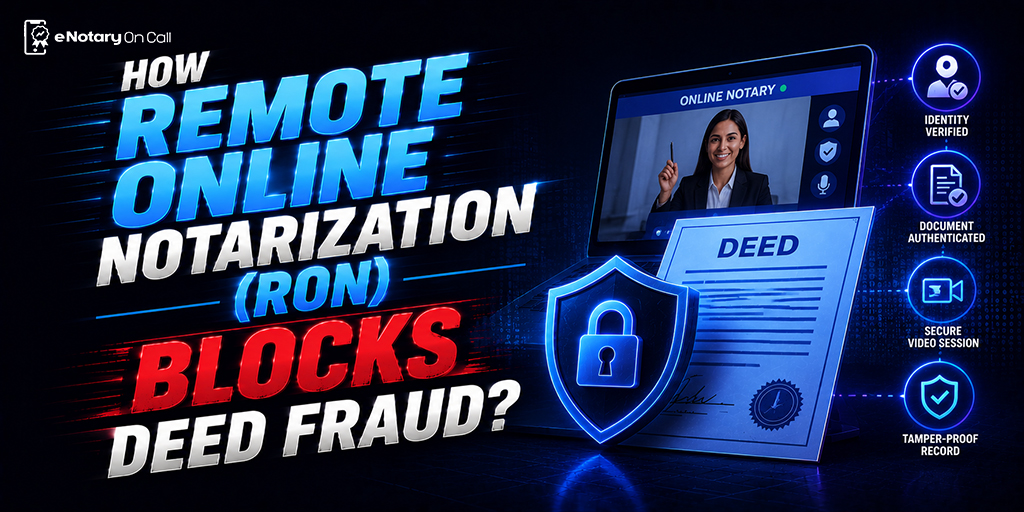
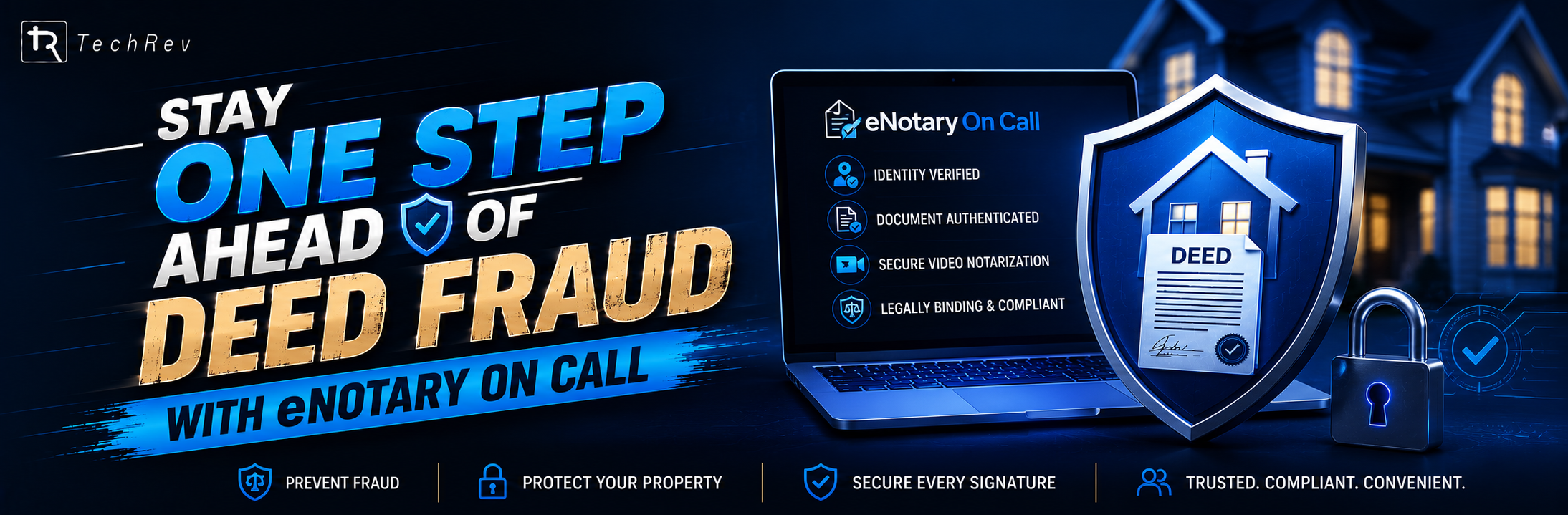
Here’s what most homeowners miss: the notarization step is where deed fraud lives or dies. And RON is dramatically harder to fool than a rushed walk-in notarization at a shipping store. That’s why RON platforms like eNotary On Call have become a frontline layer of deed fraud prevention.
1. Multi-factor identity verification (KBA + credential analysis + biometrics)
Before a RON session even starts, the signer must pass:
- Knowledge-Based Authentication (KBA) timed, dynamically generated questions pulled from decades of public records
- Credential analysis AI-powered scanning that authenticates the security features of a government-issued ID and flags forgeries
- Biometric/liveness checks facial comparison matching the live person on camera to the ID (Florida even allows biometric verification in place of KBA)
A fake plastic ID might slip past a distracted human. Beating all three digital layers is a different story.
2. Recorded video sessions = permanent evidence trail
Every RON session is recorded and stored for 5–10 years depending on the state. If anyone ever challenges a deed, there’s a literal video of who signed it, when, and on what ID. A paper journal entry offers no such proof.
3. Tamper-evident digital seals
RON documents carry cryptographic, tamper-evident seals that alter one character after notarization and the seal visibly breaks. A rubber stamp can be stolen; a digital certificate can’t be photocopied.
Whether you need to notarize quitclaim deed online for a legitimate family transfer, or notarize an affidavit of residency, power of attorney, or trust document, platforms like eNotary On Call connect you with a commissioned online notary Florida or online notary Texas in minutes with every fraud-prevention layer above built in.
RON vs. In-Person Notarization: Which Is Harder to Fake?
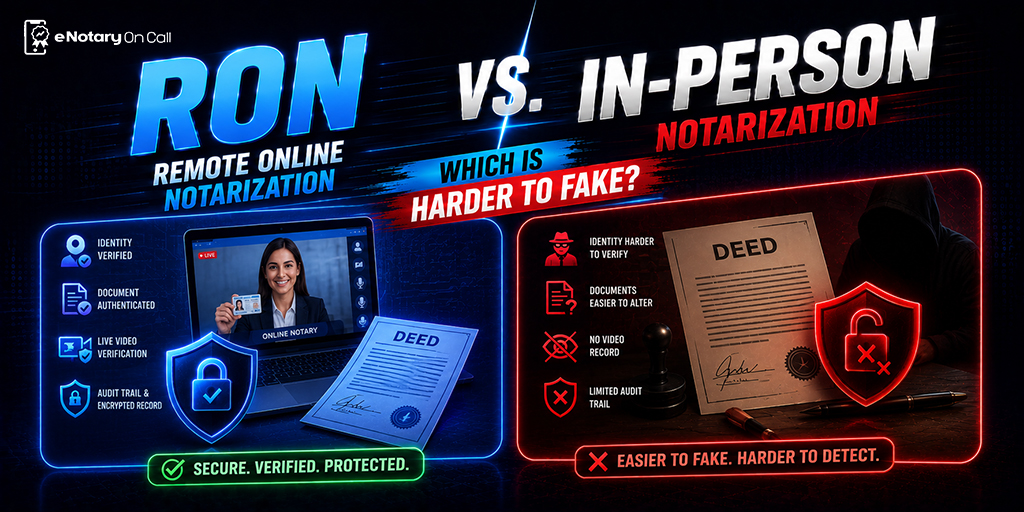
| Security Factor | In-Person Notarization | Remote Online Notarization (RON) |
| ID verification | Visual check by human | AI credential analysis + KBA + biometrics |
| Evidence of the signing | Journal entry (sometimes) | Full audio-video recording, kept 5–10 years |
| Document integrity | Ink stamp (can be counterfeited) | Tamper-evident digital seal |
| Stolen seal risk | Physical stamps get stolen | Digital certificates are encrypted |
| Audit trail | Minimal | Timestamps, IP address, session metadata |
As of 2026, 49 states plus D.C. have permanent RON laws (California’s full authorization arrives in 2030), so whether you’re using an online notary Texas commission or an online notary Florida commission, remotely notarized deeds are legally recognized nationwide.
How to Protect Your Home Title: Prevention Checklist!
Wondering how to protect your home from title theft? Do these five things:
- Sign up for your county’s free title alert program; most recorders now email you if any document is filed against your property.
- Check your property records 2–3 times a year at your county recorder or assessor’s website.
- Guard your personal data deed fraud almost always starts with identity theft.
- Watch vacant or inherited property closely; these are prime targets.
- Use RON for your own property documents. When you notarize quitclaim deed online through a verified platform like eNotary On Call whether via an online notary Florida session or an online notary Texas session you create a recorded, biometric-verified paper trail. It’s deed fraud prevention built into the document itself.
That’s really the core of how to protect your home title: monitor the record, protect your identity, and make your legitimate documents as fraud-proof as possible.
What to Do If You’re a Victim of Deed Fraud?
- Get a certified copy of the fraudulent deed from your county recorder.
- File a police report and report the crime to the FBI at ic3.gov.
- Notify your title insurance company immediately.
- Hire a real estate attorney to file a quiet title action voiding the forged deed.
- Gather proof of ownership and occupancy tax bills, utility records, and a notarized affidavit of residency proving you live at and own the property. (You can notarize an affidavit of residency online in about 15 minutes.)
- Alert the credit bureaus and place a fraud freeze, since deed fraud and identity theft travel together.
Conclusion
Home title theft thrives on weak identity checks and unmonitored records.
Close both gaps set up county alerts today, and the next time you need to notarize quitclaim deed online or any property document, do it through a secure RON platform like eNotary On Call, where every signature is verified, recorded, and fraud-resistant by design.
FAQs
1. Is home title theft real?
Yes, is home title theft real? Absolutely. The FBI officially warned about rising quitclaim deed fraud, and victims reported $275 million in real estate fraud losses in 2025 alone.
2. How common is home title theft?
Less common than the scary TV ads suggest, but growing. Roughly 12,000+ real estate fraud complaints reach the FBI annually, and 28% of title companies reported seller impersonation attempts in a single year. Low odds catastrophic consequences and the reason the FBI warns home title theft surge trends are worth watching.
3. Is home title theft a real problem?
For victims, yes is home title theft a real problem? Painfully so. Undoing a forged deed typically costs $5,000–$100,000 in legal fees and can take up to two years of litigation.
4. How to protect your home title?
Enroll in county title alerts, review property records regularly, and protect your personal information. That’s also exactly how to protect your home from title theft in the first place plus using secure remote online notarization for your own deed documents.
5. Is title lock insurance worth it?
Title lock services only monitor records, something most counties do for free. They don’t prevent or reverse fraud. An owner’s title insurance policy plus free county alerts covers most homeowners better.
6. Does online notarization prevent forgery?
It makes forgery dramatically harder. Multi-factor identity proofing, recorded video sessions, and tamper-evident seals mean a fraudster must beat AI credential analysis, biometrics, and a live notary on camera with everything preserved as evidence.