A clerk rejects your filing and the notice says almost nothing useful. Court documents follow rules most people never read until a deadline forces them to, and those rules decide which papers need a signature, which need a sworn oath before a notary, and which get struck outright.
Searching legal notaries near me, public notary near me, or notary services near me helps only after you know which category your document falls into. A Remote online notary in USA session covers the sworn ones. Here’s how the rest break down.
What Are the Main Types of Court Documents?
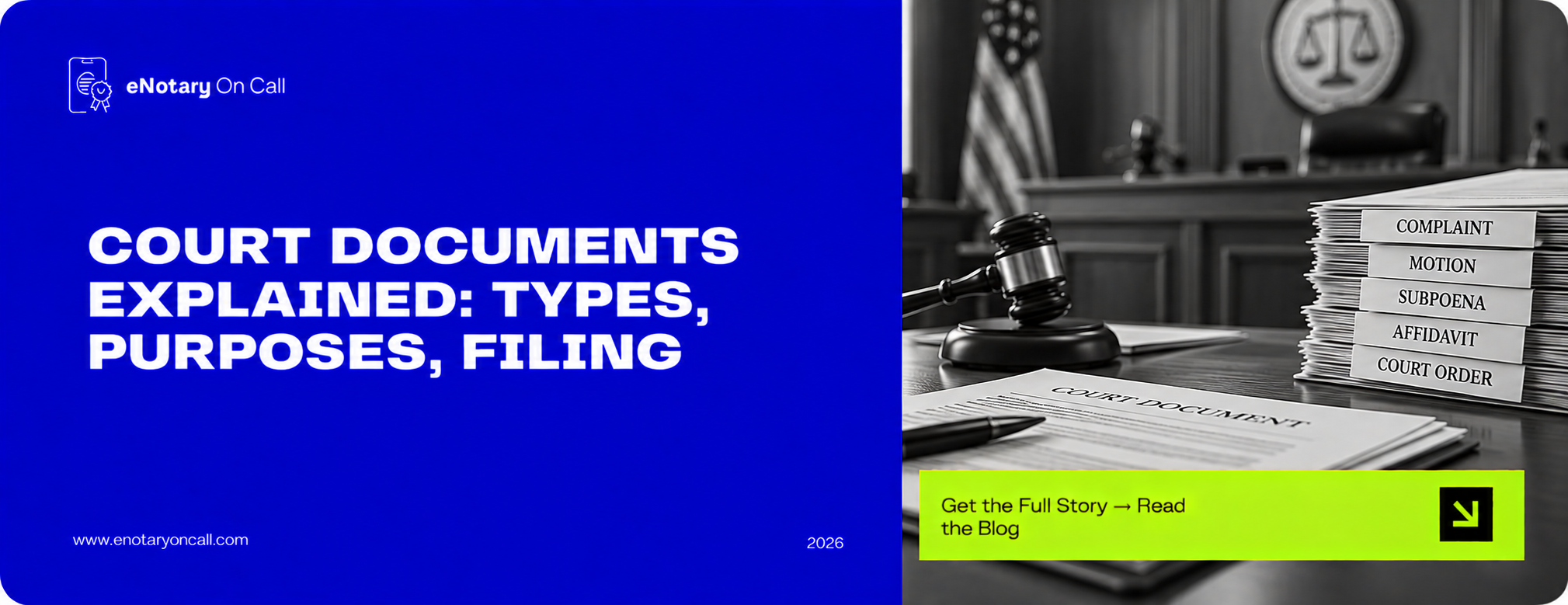
Court documents fall into six groups: pleadings that start or answer a case, motions that ask the court to act, discovery that exchanges evidence, sworn statements, orders and judgments issued by the court, and notices that inform parties.
Pleadings: What Starts and Answers a Case
A petition or complaint opens a case. An answer responds to it. Miss the response deadline and you risk a default judgment.
Deadlines differ sharply between systems. In federal court, a defendant must serve an answer within 21 days after being served with the summons and complaint, or within 60 days after a waiver request was sent, stretching to 90 days when the request went to a defendant outside the United States.
Texas uses a distinctive clock. The citation directs the defendant to file a written answer on or before 10:00 a.m. on the Monday next after 20 days from the date of service, and the citation itself must warn that a default judgment may follow if you miss it.
Motions, Signatures, and the Rule That Gets Papers Struck
Federal Rule of Civil Procedure 11(a) governs the paperwork basics for every pleading, written motion, and other paper. Each must be signed by at least one attorney of record, or personally by an unrepresented party, and must state the signer’s address, email address, and telephone number.
Two consequences follow. First, the court must strike an unsigned paper unless the omission is promptly corrected after being called to the party’s attention. Second, and this surprises people, pleadings and other papers need not be verified or accompanied by an affidavit unless a rule or statute specifically says otherwise.
So notarisation isn’t a blanket requirement. It applies where a rule, statute, or official form demands it.
Sworn Documents: Where the Notary Comes In
Family law shows this clearly. Florida’s instructions for the Family Law Financial Affidavit, Form 12.902(b), tell filers to sign the form before a notary public or deputy clerk.
Residency proof works the same way. Either party must have lived in Florida for at least six months before filing for dissolution, and Form 12.902(i), the Affidavit of Corroborating Witness, must be signed in the presence of a notary public or deputy clerk by someone who knows you met that requirement.
That makes Affidavit of residency notarization a routine step in Florida divorce filings, not an optional extra.
For those documents, review what qualifies under Florida notary services, then complete the signing through an online notary Florida session. Affidavit notarization follows the same path in most states: the notary administers the oath, watches you sign, and completes the certificate.
Filing Requirements That Trip Filers Up
- Signature block details: Address, email, and phone belong on the paper itself under Rule 11(a).
- Correct form version: Courts publish approved forms and reject outdated ones.
- Service rules: Filing and serving are separate obligations with separate rules.
- E-filing portals: Florida directs filers to Rule of General Practice and Judicial Administration 2.525 for electronic filing procedures.
- Original versus copy: Some clerks still want the original sworn document on file.
Documents That Sit Beside a Case File
Litigation rarely travels alone. Property disputes involve loan paperwork, where a Loan Document Notary seals the security instrument and affidavits, and parties increasingly Notarize loan documents online to keep closings moving.
Family matters often require someone to Notarize power of attorney online so a relative can act during proceedings. Parties living abroad Notarize US Documents for filings back home.
Texas matters call for a Remote online notary in Texas session, which starts on the online notary Texas page.
When the Deadline Falls on a Weekend?
Court paperwork has a habit of surfacing on a Friday night. Remote online notarization in weekends keeps that from costing you a filing date, and a Notary Near Me on Sunday search produces a live notary instead of a voicemail.
US Notary Services work identically at midnight and midday, which matters when your answer is due Monday morning.
How to Notarize Court Documents in 4 Easy Steps?
- Verify Identity: Confirm your identity using a government-issued ID and facial recognition.
- Upload Document: Upload the document you need notarized as a PDF, image, or other format.
- Connect with Notary: Join a secure live video session with a certified notary, available 24/7.
- Get Notarized: Receive your fully executed, court-admissible document instantly in your inbox.
See everything covered by eNotary On Call’s online notary services.
Conclusion
Court documents divide into pleadings, motions, discovery, sworn statements, orders, and notices, and each carries its own signature and filing requirements.
Check whether yours must be verified, confirm the deadline, and get the sworn ones notarised early. eNotary On Call handles that part in minutes. Start your notarization now.
FAQs
1. Does every court document need notarising?
No. Only documents a rule, statute, or official form requires to be sworn, such as affidavits and verified petitions.
2. Can eNotary On Call tell me which form to file?
No. Notaries can’t give legal advice. Ask the clerk’s office or an attorney which form your case needs.
3. Will the court accept an electronically notarised affidavit?
Many courts and clerks do, though acceptance varies by jurisdiction and some still request paper originals. Confirm with the clerk where you’re filing before your session, and ask whether they want it uploaded through the e-filing portal or delivered in person.
4. Can a witness who lives in another state sign the affidavit?
Yes. A corroborating witness joins the same video session from anywhere, verifies identity separately, and signs while the notary watches, which removes the travel problem when relatives live far from the filing county.