
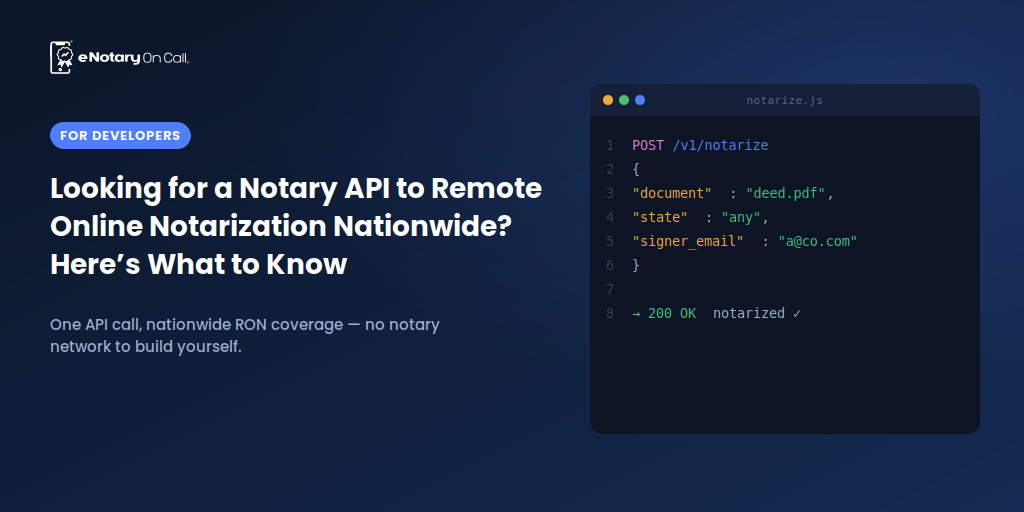
In 2026, the Businesses are increasingly moving document workflows online. From real estate and lending to legal services, healthcare, insurance, and financial services, companies need a faster way to get documents signed and notarized without sending customers to a physical notary office.
Nowadays, most of the business now looking for a reliable company that provides API Integration.
Earlier, for documentation, businesses often referred customers to a third party. Instead of asking customers to leave your website or application to find a notary, businesses can integrate online notarization directly into their existing digital workflow. Customers can upload documents, verify their identity, connect with a commissioned notary through secure audio-video technology, complete the notarization, and receive their completed documents all within a streamlined digital experience.
For businesses looking to offer online notarization to customers across the United States, choosing an API with broad nationwide coverage, strong security, and state-aware compliance is essential.
What Is a Notary API?
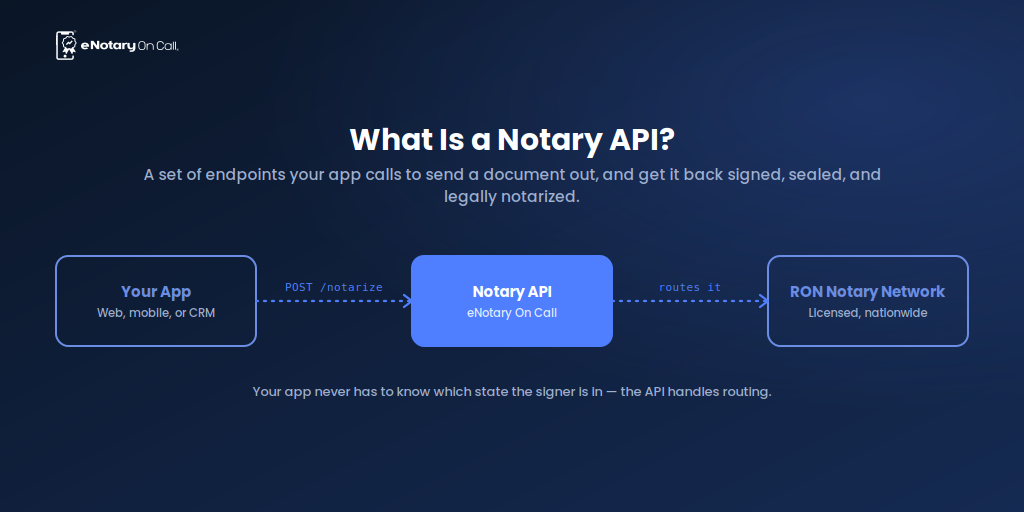
A Notary API is a technology interface that allows businesses to connect their applications, websites, or internal systems with an online notarization platform. Rather than building an entire notarization infrastructure from scratch, a business can use an API to connect its existing workflow to services such as:
- Document upload
- Signer identity verification
- Notary assignment
- Live audio-video notarization
- Electronic signatures
- Digital notarial seals
- Audit trails
- Document completion and delivery
- Transaction and status management
This allows notarization to become part of the customer’s existing journey instead of creating another disconnected step.
For example, a mortgage company could allow a borrower to complete the notarization process directly from its loan-closing workflow. A law firm could integrate notarization into its client portal. A real estate platform could trigger a notarization session after a document is ready for signing.
Why Businesses Need a Nationwide RON API
Traditional notarization creates friction for digital businesses. A customer may need to download a document, find a local notary, schedule an appointment, travel to an office, complete the notarization, scan the document, and upload it again. For businesses processing hundreds or thousands of documents, these extra steps can create delays and additional administrative work.
A RON API can bring the notarization step directly into the digital workflow.
-
Create a Better Customer Experience
Customers increasingly expect important services to be available online. An integrated notarization experience allows users to complete the required steps without leaving the application they are already using. This can reduce unnecessary switching between platforms and make the overall document workflow easier to complete.
-
Reduce Manual Work
Businesses can automate portions of the notarization workflow instead of coordinating every transaction manually. Depending on the API capabilities, businesses can initiate transactions, pass document information, track status, and receive completed documents through their own systems.
-
Support High-Volume Notarization
Organizations such as title companies, lenders, legal practices, financial institutions, and enterprise platforms may process large numbers of notarized documents. An API-based approach makes it easier to incorporate notarization into repeatable workflows rather than handling each transaction as a separate manual process.
-
Serve Customers Across State Lines
One of the biggest considerations when choosing a RON API is geographic coverage. RON laws and platform requirements are not identical across the United States. The National Notary Association maintains state-specific information about RON platforms and notes that some states require platforms to meet particular approval or registration requirements.
For that reason, businesses should not simply ask whether an API is “online.” They should ask whether the provider has the appropriate infrastructure, notary network, and compliance processes to support the states and transactions they serve.
Does Remote Online Notarization Work in All 50 States?
This question requires an important distinction. A business may want to offer a nationwide online notarization experience to customers, but that does not mean every state has identical RON laws or that every platform can operate in exactly the same way in every jurisdiction.
As of 2026, most U.S. states have enacted permanent RON legislation, but state requirements continue to differ. Some jurisdictions have specific platform approval or registration requirements, while others have different rules governing notaries and technology.
For businesses, the better question is: Can the RON provider support my customers nationwide while managing the state-specific requirements applicable to each notarization?
That distinction is especially important for enterprises operating across multiple states.
What Should You Look for in a Remote Online Notary API?
Not every API offers the same capabilities. Before selecting a provider, businesses should evaluate several important factors.
State and Regulatory Compliance
Compliance should be one of the first considerations. A provider should have processes designed around applicable RON laws, notary commissioning requirements, identity verification standards, electronic records, and transaction requirements. Because requirements can change, businesses should also confirm how the provider monitors regulatory updates.
Identity Verification
Identity verification is a fundamental part of a secure RON workflow. A strong platform should provide mechanisms for verifying the signer’s identity before the notarial act. Depending on the applicable requirements, this may involve credential analysis, knowledge-based authentication, or other approved verification methods.
Live Audio-Video Communication
RON generally requires the signer and notary to communicate through an approved audio-video technology. An API should therefore connect the business workflow to the actual online notarization session rather than simply providing electronic signature functionality.
Secure Document Handling
Notarized documents often contain highly sensitive personal, legal, financial, or business information. Look for security controls covering document transmission, storage, access, and completed transaction records.
Audit Trails and Records
A complete audit trail can provide an important record of the notarization transaction. Depending on the platform and applicable requirements, records may include information about the signer, identity verification, notary, transaction, electronic signatures, and audio-video session.
Easy Integration
The API should work with the technology your business already uses.
Depending on your application, integration may involve:
- REST APIs
- Webhooks
- SDKs
- Document management systems
- Customer portals
- CRM platforms
- Loan or real estate platforms
- Enterprise applications
The goal is to make notarization feel like a natural part of your workflow rather than a separate technology stack.
How a RON API Can Fit Into Your Existing Workflow
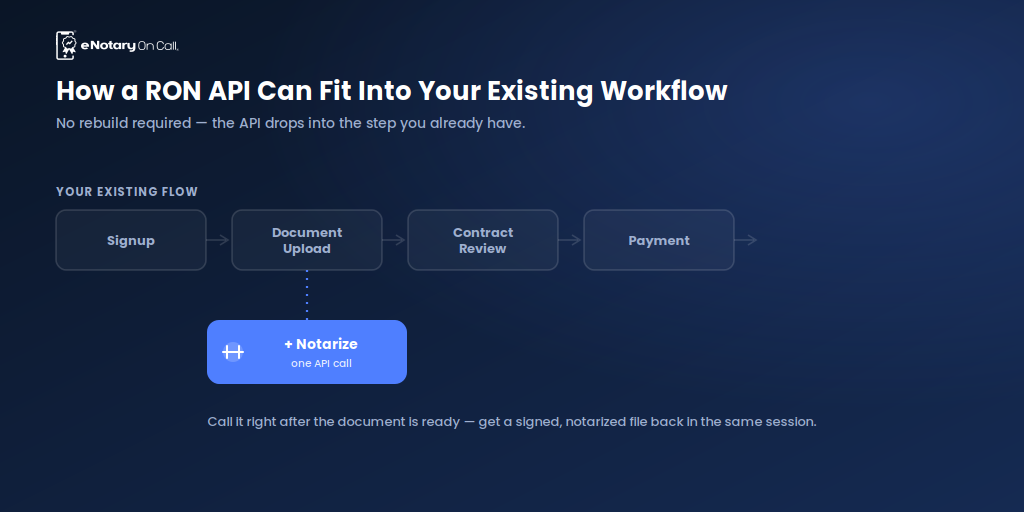
A typical API-powered notarization workflow can look like this:
Step 1: Create a Notarization Request
Your application sends the required transaction information to the notarization platform through the API.
Step 2: Upload or Transfer the Document
The document is securely transferred into the notarization workflow.
Step 3: Verify the Signer
The signer completes the required identity verification steps.
Step 4: Connect With a Remote Notary
The signer enters a secure audio-video session with an eligible commissioned notary.
Step 5: Complete the Notarial Act
The signer signs or acknowledges the document as directed by the notary, and the notary completes the applicable notarial act.
Step 6: Complete the Digital Document
The electronic signature and notarial seal are applied according to the applicable requirements.
Step 7: Return the Completed Document
The business can receive the completed notarized document and update its own workflow based on the transaction status.
This type of integration can help eliminate repetitive manual steps while keeping the customer inside the business’s existing digital experience.
Who Can Benefit From a Notary API?
A RON API can be particularly useful for organizations where notarization is part of a larger transaction.
Real Estate and Title Companies
Real estate transactions often involve documents that require notarization. Integrating RON can help title companies and real estate platforms incorporate notarization into digital closing workflows.
Mortgage and Lending Companies
Lenders can integrate notarization into digital document workflows, helping borrowers complete required notarization steps without arranging a separate physical appointment.
Law Firms
Law firms can incorporate remote notarization into client workflows involving eligible legal documents, affidavits, powers of attorney, and other notarizable records.
Financial Services
Banks, financial institutions, and fintech companies may use notarization as part of account, authorization, lending, or transaction workflows.
Healthcare Organizations
Healthcare-related organizations may encounter documents requiring notarization, depending on the document and applicable requirements. An integrated workflow can simplify the process for eligible transactions.
Enterprise Software Platforms
SaaS companies that manage documents, contracts, transactions, or customer onboarding can add notarization as an embedded capability instead of requiring customers to use a separate service.
Why Embedded Notarization Is the Future of Digital Document Workflows?
The value of an API is not simply that it makes notarization available online. The bigger advantage is integration. When notarization becomes part of an existing application, businesses can create a more connected workflow:
- Create Your Document
- Send It for Signature
- Verify Your Identity
- Connect With a Notary
- Complete the Notarization
- Receive Your Completed Document
Instead of making customers navigate multiple systems, businesses can bring these steps together. This can improve workflow visibility, reduce manual intervention, and create a more consistent experience for customers.
Why Choose eNotary On Call for Online Notarization Integration?
eNotary On Call provides a digital platform designed to support remote online notarization. Its platform includes identity verification, secure audio-video communication, electronic notarization, and audit-trail capabilities.
For businesses, the opportunity is to move notarization closer to where the transaction already happens. Whether your organization operates in real estate, legal services, financial services, lending, healthcare, or another document-intensive industry, an integrated online notarization workflow can help reduce friction for customers and internal teams.
The platform also maintains a dedicated business environment and API/backend infrastructure, making it suitable for organizations evaluating technology-based notarization workflows.
What Makes a Good Nationwide Notary API?
Before choosing a provider, ask these questions:
- Does the provider support the states where my customers operate?
- How does the provider handle state-specific RON requirements?
- Does it provide secure identity verification?
- Can customers connect with a live commissioned notary online?
- Does it support electronic signatures and digital notarial seals?
- Are audio-video sessions and required transaction records maintained?
- Can completed documents be returned automatically?
- Does the API support webhooks or status updates?
- Can the solution scale for high-volume transactions?
- Is technical and customer support available when needed?
- Can the provider integrate with my existing application or workflow?
The right answers can help determine whether a provider is suitable for a simple integration or a nationwide enterprise deployment.
Build Remote Notarization Into Your Business Workflow
Remote online notarization has changed how individuals and businesses complete documents. But for companies, simply offering a link to an online notary may not be enough.
A notary API can bring notarization directly into your existing customer journey, helping businesses create a smoother, more automated, and scalable document workflow. If your business needs to provide online notarization to customers across the United States, look for a provider that combines technology, security, notary availability, and state-specific compliance capabilities.
eNotary On Call can help businesses bring remote online notarization closer to the point where documents are created, signed, and completed.
Frequently Asked Questions
1. What is a RON API?
A Remote Online Notarization API allows a business application or website to connect with an online notarization platform so customers can complete eligible notarization transactions digitally.
2. Can I integrate online notarization into my website?
Yes. An API-based solution can allow businesses to connect their website, application, or customer portal with an online notarization workflow, depending on the provider’s available integration capabilities.
3. Can customers use online notarization from another state?
In many cases, the signer does not need to be physically located in the same state as the notary. However, the specific transaction must comply with applicable laws and requirements. Businesses should confirm the rules applicable to their use case.
4. Is RON legal in all 50 states?
RON legislation and implementation differ by state. Most states have adopted permanent RON laws, but not every state has identical requirements, and some states have specific platform approval or registration rules.
5. What industries use RON APIs?
Real estate, mortgage and lending, legal services, financial services, insurance, healthcare, and enterprise SaaS platforms can all benefit from integrating online notarization into eligible workflows.
6. Why should a business use an API instead of sending customers to a notary website?
An API can keep the notarization experience connected to your existing application or workflow. This can reduce platform switching, improve automation, and give businesses greater visibility into transaction status.