 by
by Are you fully prepared to handle the legal paperwork required when a loved one passes away? Have you ever considered who legally holds the power to make final arrangements? Dealing with a family loss is an incredibly emotional experience. The last thing any grieving family needs is a complicated legal battle over end of life decisions. This is exactly where Disposition Authorization Forms come into play.
Recent studies from legal planning associations reveal that nearly 60 percent of adults do not have any end of life plans in place.
Furthermore, the traditional probate court process can consume up to 8 percent of an estate’s total value and drag on for 9 to 18 months.
By understanding Disposition Authorization Forms, you can bypass much of this stress. In this blog, we will break down what Disposition Authorization Forms are, how different state affidavits work, and why using eNotary On Call and online notary Texas is the absolute best way to handle your legal paperwork securely and instantly.
So, without any further ado, let’s get started!
What is a Disposition Authorization Form?
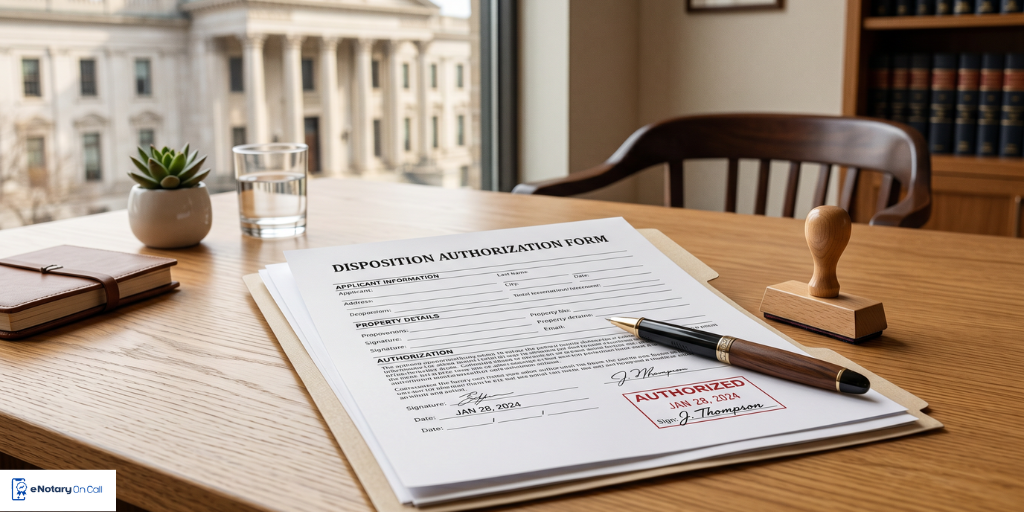
At its core, a disposition authorization form is a legally binding document that allows an individual to clearly state their wishes regarding the handling of their bodily remains after death. It also legally designates a trusted agent to carry out these specific instructions.
Without Disposition Authorization Forms, families often face confusing legal hurdles. By completing Disposition Authorization Forms in advance, you eliminate the guesswork for your relatives. Getting your Disposition Authorization Forms notarized through best RON platforms like eNotary On Call ensures they are legally recognized without any disputes.
Key Statistics on Estate Planning and Probate
To understand why these documents are so important, let us look at some real world data regarding estate management –
- Over 60 percent of Americans pass away without a basic will or estate plan.
- The average cost of a traditional funeral in the United States currently exceeds $8,500, making immediate access to funds critical.
- Filing small estate documents can reduce legal processing times from an average of 12 months down to just 3 to 4 weeks.
- Best RON platforms like eNotary On Call reduce document processing wait times by up to 80 percent compared to finding a traditional in person notary.
Some Important Parts of the Form
If you are drafting one of these authorizations, you need to ensure all details are accurate. A standard form will include the following vital sections –
- Personal Identification – The full legal name, address, and demographic data of the individual.
- Appointed Agent Information – Contact details for the person legally authorized to enforce the document.
- Specific Directives – Explicit choices regarding burial, anatomical donation, or cremation.
- Financial Allocations – Instructions on which funds will pay for the arrangements.
- Notary Verification Block – A mandatory section where a professional from eNotary On Call can legally stamp and verify the signatures.
How Do You Handle Funeral and Life Insurance Paperwork?

When you are coordinating with a funeral home, you will suddenly find yourself facing a mountain of specialized legal documents. It can feel overwhelming, but knowing exactly which forms you need can save you both time and money.
Here is a quick breakdown of the three most common documents you will encounter –
- Cremation Authorization Form – Legally required to give the facility permission to proceed with cremation.
- Funeral Assignment Form – Used to pay for funeral costs directly through a life insurance policy.
- Life Insurance Claim Affidavit – A sworn statement required to prove you are the legal beneficiary of a policy.
How Do You Bypass Probate with Small Estate Documents?
If your loved one left behind modest assets, you probably do not need to endure a lengthy and expensive probate trial. Legal data shows that traditional probate can consume up to 8 percent of an estate’s total value and take anywhere from 9 to 18 months to finalize.
Instead of waiting a year, you can utilize a Small Estate Affidavit. A Small Estate Affidavit is an incredibly powerful legal shortcut designed to save families time and money.
Using a Small Estate Affidavit allows rightful heirs to claim bank accounts, vehicles, and personal items directly from institutions.
Here is why legal experts recommend taking this route –
- Massive Cost Savings – You avoid paying thousands of dollars in probate attorney fees.
- Faster Processing – Financial matters are resolved in 3 to 4 weeks instead of 12 months.
- Less Court Involvement – You communicate directly with banks rather than sitting in a courtroom.
Also Read – Affidavit of Heirship vs. Probate: What’s the Difference?
State-by-State Guide to Estate Affidavits

Every state sets its own financial limits and rules for these documents. Below is a helpful tabular breakdown of key states, followed by detailed explanations.
| State Jurisdiction | Document Type | Maximum Estate Value | Unique Requirement |
| California | California small estate affidavit | $184,500 | 40 day waiting period required |
| Illinois | Illinois small estate affidavit | $100,000 | Affiant must pay outstanding debts |
| Texas | Texas small estate affidavit | $75,000 | Must be approved by a probate judge |
| Florida | small estate affidavit Florida | Varies by case | Only for funeral and medical expenses |
How Do You File a Small Estate Affidavit in California?
Managing inherited assets on the West Coast does not always require a long and expensive court battle. If your loved one left behind a modest inheritance, state laws allow you to bypass traditional probate by using a specific small estate affidavit california.
Filing a small estate affidavit in California is the fastest way to claim personal property.
Before you begin the process, here are the mandatory rules for using a California small estate affidavit in 2026 –
- Maximum Value Limit – The total value of the deceased person’s personal property must be under 184,500 dollars.
- Mandatory Waiting Period – You must wait exactly 40 days after the date of death to submit the california small estate affidavit.
- Excluded Property Types – A California small estate affidavit cannot be used to transfer physical real estate, such as a family house or vacant land.
Once your paperwork is accurately filled out, it must be legally witnessed. When you prepare an affidavit of small estate California, banks require a certified notary signature or online notary in Texas to confirm your identity and prevent fraud.
Also Read – How to Become an Online Notary in California?
How Do You File a Small Estate Affidavit in Illinois?
Families settling estates under 100,000 dollars need a small estate affidavit in Illinois. A small estate affidavit Illinois requires you to swear to pay all remaining debts first. Filing a small estate affidavit in Illinois means taking full responsibility for fair fund distribution.
The Illinois small estate affidavit process helps you avoid busy courtrooms. However, an Illinois small estate affidavit is invalid if the estate includes real estate. To succeed with an Illinois small estate affidavit, follow strict guidelines.
Key rules for an il small estate affidavit –
- Debt Priority – The small estate affidavit signer must pay outstanding funeral costs first.
- Absolute Accuracy – An il small estate affidavit requires perfect math to be accepted by banks.
- Property Limits – Keep assets strictly to bank accounts, vehicles, and personal items.
How Do You Use a Small Estate Affidavit in Texas?
A small estate affidavit Texas is strictly limited to estates under 75,000 dollars. Unlike other states, a small estate affidavit taxes cannot be given directly to a bank teller.
When preparing a Texas small estate affidavit, you must follow precise legal steps. These rules for a Texas small estate affidavit help secure your wealth without expensive attorney fees –
- Witness Verification – Two disinterested witnesses must sign the Texas small estate affidavit to verify family history.
- Intestate Only – This is valid only if the person passed away without a will.
- Court Approval – A probate judge must officially sign the final paperwork.
What is the Purpose of a Small Estate Affidavit in Florida?
In the Sunshine State, a small estate affidavit Florida serves a very narrow purpose. Formally known as Disposition of Personal Property Without Administration, you only file a small estate affidavit florida to request direct reimbursement for immediate funeral costs.
Because the rules for a small estate affidavit Florida are strict, keep these points in mind –
- Limited Scope – Not designed to transfer generational wealth or large assets.
- Reimbursement Only – Strictly used to recover out of pocket medical or funeral expenses from the last 60 days.
- Court Submission – Paperwork must be submitted directly to your local circuit court.
By understanding these regional differences and using platforms like eNotary On Call for your secure online notarizations, you can confidently and quickly navigate estate planning no matter where you live with Online Notary Florida.
Why Choose eNotary On Call?
When you are juggling grief, funeral planning, and legal paperwork, driving around looking for a notary is incredibly frustrating. eNotary On Call solves this problem entirely.
Here are the top reasons why legal experts and families prefer eNotary On Call –
- Instant Access – Connect with a licensed online notary in New York in less than five minutes.
- High Level Security – eNotary On Call uses bank grade encryption and identity verification to protect your sensitive data.
- Remote Convenience – Notarize your documents from your couch, your office, or even while traveling out of state.
- Error Reduction – The platform guides you through the signature process, ensuring no pages are accidentally skipped.

Conclusion
Managing the aftermath of a family loss is a heavy burden, but the legal paperwork does not have to drag you down.
By understanding the power of Disposition Authorization Forms and utilizing the correct state specific affidavits, you can protect your family’s assets and honor your loved one’s final wishes.
Do not let outdated traditional notarization methods slow you down during a critical time. Choose eNotary On Call today for a secure, fast, and 100 percent online notarization experience that gives you immediate peace of mind.
FAQs
1. Are Disposition Authorization Forms legally required in every state?
While not mandatory in every single state, having them is highly recommended. Without them, the legal right to make decisions automatically defaults to the closest living relative, which can cause intense family disputes.
2. Can I notarize a cremation authorization using eNotary On Call?
Yes. eNotary On Call connects you with certified professionals who can legally notarize authorizations, affidavits, and end of life planning documents remotely.
3. What happens if I make a mistake on my estate documents?
If a bank or court finds an error, they will reject the document. You will have to draft a new one and get it notarized all over again. Using eNotary On Call helps ensure the final notarization step is handled perfectly the first time.
4. How does eNotary On Call verify my identity online?
eNotary On Call utilizes advanced knowledge based authentication and secure credential analysis. You simply hold your valid government ID up to your webcam, and the system verifies its authenticity in seconds.
5. Do these documents expire?
Most affidavits and authorizations do not expire, but they must accurately reflect current laws and the current status of the estate at the time they are used.
6. What happens if I do not have a disposition form?
If there is no written authorization, the right to make decisions falls to the legal next of kin, which is usually a spouse or adult children.
7. Can I use eNotary On Call for all my estate documents?
Yes, eNotary On Call supports the notarization of almost all estate planning documents, including affidavits and authorization forms, as long as your local state laws permit Remote Online Notarization.
8. Is it safe to upload my documents to eNotary On Call?
Absolutely. eNotary On Call uses advanced encryption and strict security protocols to keep your sensitive personal information completely safe.
9. Do I need a lawyer to fill out an estate affidavit?
No, you do not necessarily need a lawyer. Many people fill out these forms themselves. However, it is always a good idea to consult with a legal professional if you are confused about your state laws.
10. How much does eNotary On Call cost?
The pricing for eNotary On Call is very affordable. You only pay a flat fee per notarization session, saving you time and travel expenses.