
Need to notarize a Power of Attorney online in Collier County, Florida? Learn how the process works, why notarization matters, and how eNotary On Call makes it simple.
Quick Answer: Need to Notarize a Power of Attorney Online in Collier County, Florida? Florida law allows many Power of Attorney (POA) documents to be notarized through Remote Online Notarization (RON). Using eNotary On Call, eligible POA documents can be notarized remotely through secure identity verification and a live video session with a commissioned Florida online notary without requiring you to visit a notary office.
A Power of Attorney Is More Than Just Another Form
Some documents can easily be replaced if they’re lost or completed incorrectly. A Power of Attorney isn’t one of them. By signing a Power of Attorney (POA), you’re authorizing another person, known as your agent or attorney-in-fact, to act on your behalf in specific legal, financial, healthcare, or property-related matters. Depending on how it’s written, a POA may allow someone to –
- Manage bank accounts.
- Buy or sell property.
- Handle business transactions.
- Make financial decisions.
- Complete legal paperwork.
- Assist with healthcare decisions, where permitted.
Because these documents can grant significant legal authority, proper execution is essential. In Florida, many Powers of Attorney require notarization and witnesses to be legally valid. That is why choosing a trusted service to notarize a Power of Attorney Online in Collier County, Florida, is an important part of the process.
Understanding the Different Types of Power of Attorney
Not every Power of Attorney grants the same authority. The type of POA determines what powers the agent receives and how long those powers remain in effect. Some of the most common include –
- General Power of Attorney – Allows an agent to manage a broad range of financial or legal matters on behalf of the principal. This authority usually ends if the principal becomes incapacitated unless the document is specifically drafted to remain effective.
- Durable Power of Attorney – One of the most commonly used forms of POA. A durable Power of Attorney is designed to continue even if the principal later becomes incapacitated, making it an important estate planning document.
- Limited (Special) Power of Attorney – Grants authority for a specific task or transaction, such as selling a vehicle, signing closing documents, or handling one particular financial matter.
- Medical or Healthcare Power of Attorney- Allows an appointed individual to make certain healthcare decisions when authorized under applicable law and the terms of the document.
Key Insight: Choosing the correct type of Power of Attorney is a legal decision. A notary’s role is to verify identity and witness the signing, not to advise on which type of POA best fits your situation.
Why People Create a Power of Attorney
Many people assume a Power of Attorney is only for elderly individuals. In reality, adults of every age create POAs for practical reasons. Common situations include –
- Estate planning.
- Military deployment.
- Extended travel.
- Real estate transactions.
- Temporary medical treatment.
- Business management.
- Caring for aging parents.
- Long-term overseas assignments.
Creating a POA before it’s needed often provides greater flexibility than waiting until an emergency arises.
Does a Power of Attorney Need to Be Notarized?
For many Florida Powers of Attorney, yes. Florida law generally requires a Power of Attorney to be signed by the principal in the presence of two witnesses and acknowledged before a notary public to be legally effective. Because legal requirements vary by document type and intended use, it’s important to ensure your POA is executed in accordance with Florida law.
Pro Tip: Before scheduling your notarization, confirm whether your specific Power of Attorney also requires witnesses. Planning ahead can help you avoid delays and ensure the document is executed correctly.
Common Mistakes That Can Invalidate a Power of Attorney
A Power of Attorney is only useful if it has been executed properly. Some of the most common mistakes include:
- Using an outdated form.
- Choosing the wrong type of POA.
- Missing required witness signatures.
- Signing before meeting the notary when notarization is required.
- Leaving important sections incomplete.
- Misspelling names or property descriptions.
- Failing to review state-specific legal requirements.
Correcting these mistakes after execution can be time-consuming and, in some cases, requires preparing an entirely new document.
Key Insight: Many rejected Powers of Attorney aren’t rejected because of the notarization itself. They’re rejected because required signatures, witnesses, or legal formalities were overlooked during preparation.
Who Commonly Uses Online POA Notarization?
Power of Attorney documents are used by people from all walks of life. Common users include –
- Seniors planning their estates.
- Adult children assisting ageing parents.
- Military personnel.
- Business owners.
- Real estate investors.
- Individuals travelling for extended periods.
- Caregivers.
- Attorneys preparing estate planning documents.
Whether you’re in Naples, Marco Island, Golden Gate, Immokalee, Everglades City, or elsewhere in Collier County, online notarization offers a convenient option for many eligible POA documents.
How to Notarize a Power of Attorney Online
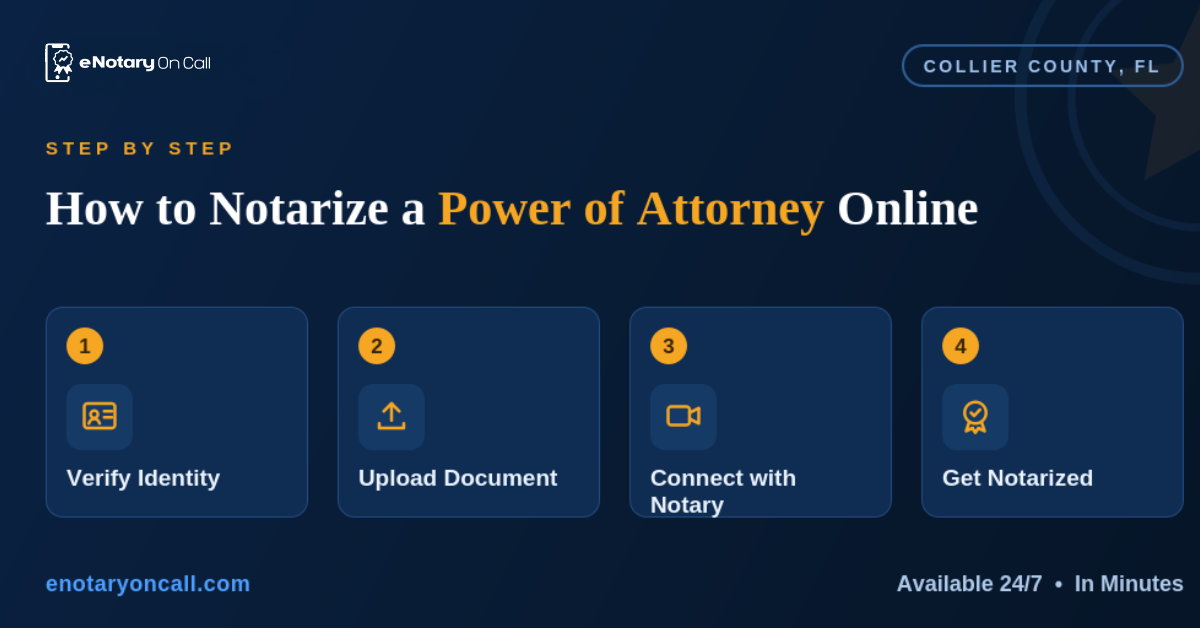
Step 1 – Review the Power of Attorney: Before scheduling your appointment, read the document carefully, confirm you’re using the correct version, complete all required information, and leave signature areas blank unless instructed otherwise.
Step 2 – Upload Your Document: Securely upload your Power of Attorney through the notarization platform. Before submitting it, verify that every page has been included, the document is complete, any required attachments have been added, and you’re uploading the final version.
Step 3 – Verify Your Identity: After uploading your Power of Attorney, you’ll complete the identity verification process before meeting with the online notary. You’ll generally need a valid government-issued photo ID, such as a driver’s license, passport, or state identification card.
Step 4 – Meet with the Online Notary: Once your identity has been verified, you’ll join a secure live audio-video session with a commissioned Florida online notary. During the appointment, the notary will generally verify your identity, review the Power of Attorney, confirm you’re signing willingly, witness your electronic signature, and complete the official notarial certificate.
Step 5 – Receive Your Executed Power of Attorney: After the notarization is complete, you’ll receive your finalized document electronically. Before considering the process complete, download a copy for your records, verify that all required signatures appear on the document, confirm the witness signatures (if required), check that the notarial certificate has been completed, and store both digital and printed copies in a secure location.
When Should You Update Your Power of Attorney?
Creating a POA isn’t necessarily a one-time event. There are several situations where reviewing or replacing your existing document is a good idea, including –
- You move to another state.
- Your chosen agent is no longer able to serve.
- You get married or divorced.
- Your financial circumstances change significantly.
- You purchase or sell major assets.
- Your estate planning documents are updated.
- You want to grant broader or more limited authority.
Reviewing your estate planning documents every few years helps ensure they continue to reflect your current wishes.
Why It Matters: An outdated Power of Attorney can create unnecessary complications at exactly the time your family needs clarity. Keeping the document current helps ensure your chosen representative has the authority you intend.
Final Thoughts
A Power of Attorney is one of the most important legal documents you’ll ever sign because it determines who can act on your behalf when you cannot, or when you simply need someone you trust to manage important affairs.
If you need to notarize a Power of Attorney Online in Collier County, Florida, eNotary On Call offers a secure, convenient way to complete eligible notarizations remotely. Whether you’re planning for the future, helping a family member, or finalizing your estate planning documents, taking the time to execute your Power of Attorney correctly helps ensure your wishes are protected when they matter most.
Frequently Asked Questions
1. Can I notarize a Power of Attorney online in Florida?
Yes. Many Powers of Attorney may be notarized using Florida’s Remote Online Notarization process. A commissioned Florida online notary can verify your identity, witness your signature through a secure live audio-video session, and complete the required notarial certificate.
2. Does every Power of Attorney require witnesses?
Many Florida Powers of Attorney require two witnesses in addition to notarization. The witness requirement exists because these documents confer significant legal authority and must be executed in accordance with state law.
3. Can I sign my Power of Attorney before meeting the online notary?
In most situations, you should not. When notarization is required, the principal’s signature is generally witnessed by the notary during the appointment. Signing beforehand may require the document to be executed again.
4. Can I revoke a Power of Attorney after it’s been signed?
Yes. In many situations, a competent principal may revoke a Power of Attorney. If you choose to revoke one, it’s important to notify your former agent and any organizations that may have relied on the previous document.
5. Why do Collier County residents choose eNotary On Call?
Residents throughout Collier County choose eNotary On Call for a convenient way to complete eligible Power of Attorney notarizations without unnecessary travel. Instead of searching for a traditional notary office, they can often complete the process remotely from home or another convenient location.