 by
by Losing someone you love is hard enough. Now imagine adding months of court paperwork on top of that grief, just to withdraw money from a bank account that was always going to be yours anyway. Sounds unfair, right? Here’s the good news: if your loved one left behind a modest estate, you may never have to set foot in a probate courtroom at all.
A small estate affidavit is the legal shortcut that lets families skip full probate and collect a deceased person’s assets in weeks instead of months. And here’s something most people don’t realize: more than half of U.S. adults, 56%, have zero estate planning documents in place, according to Trust & Will’s 2026 Estate Planning Report. That means millions of families are dealing with modest, undocumented estates every single year, and most of them qualify for a small estate affidavit without knowing it.
In this blog, we’ll break down exactly what a small estate affidavit is, how the rules differ in California, Texas, Illinois, and Florida, how it’s different from an affidavit of heirship or an affidavit of residency, and how you can notarize affidavit online in minutes instead of waiting weeks for a courthouse appointment.
What Is a Small Estate Affidavit?

A small estate affidavit is a sworn legal document that allows heirs or beneficiaries to collect a deceased person’s property, usually bank accounts, vehicles, or personal belongings, without opening a formal probate case.
Instead of asking a judge to appoint an executor and supervise months of proceedings, the rightful heir signs a notarized statement confirming who they are, what they’re owed, and that the estate falls under their state’s dollar limit. That signed affidavit is then handed directly to the bank, brokerage, or DMV, and by law, the institution has to release the asset.
Think of it as a legal express lane. Formal probate can take anywhere from 9 to 24 months and can eat up 3% to 7% of the entire estate in court costs, attorney fees, and executor compensation.
A small estate affidavit, by contrast, typically wraps up in six to ten weeks once the paperwork is filed and the waiting period has passed.
Every state sets its own dollar threshold, its own waiting period, and its own list of required signatures, so small doesn’t mean the same thing in every part of the country. Let’s look at how four of the most searched states, California, Texas, Illinois, and Florida, actually handle it.
Small Estate Affidavit by State: California, Texas, Illinois, and Florida
The following are:
1. Small Estate Affidavit California
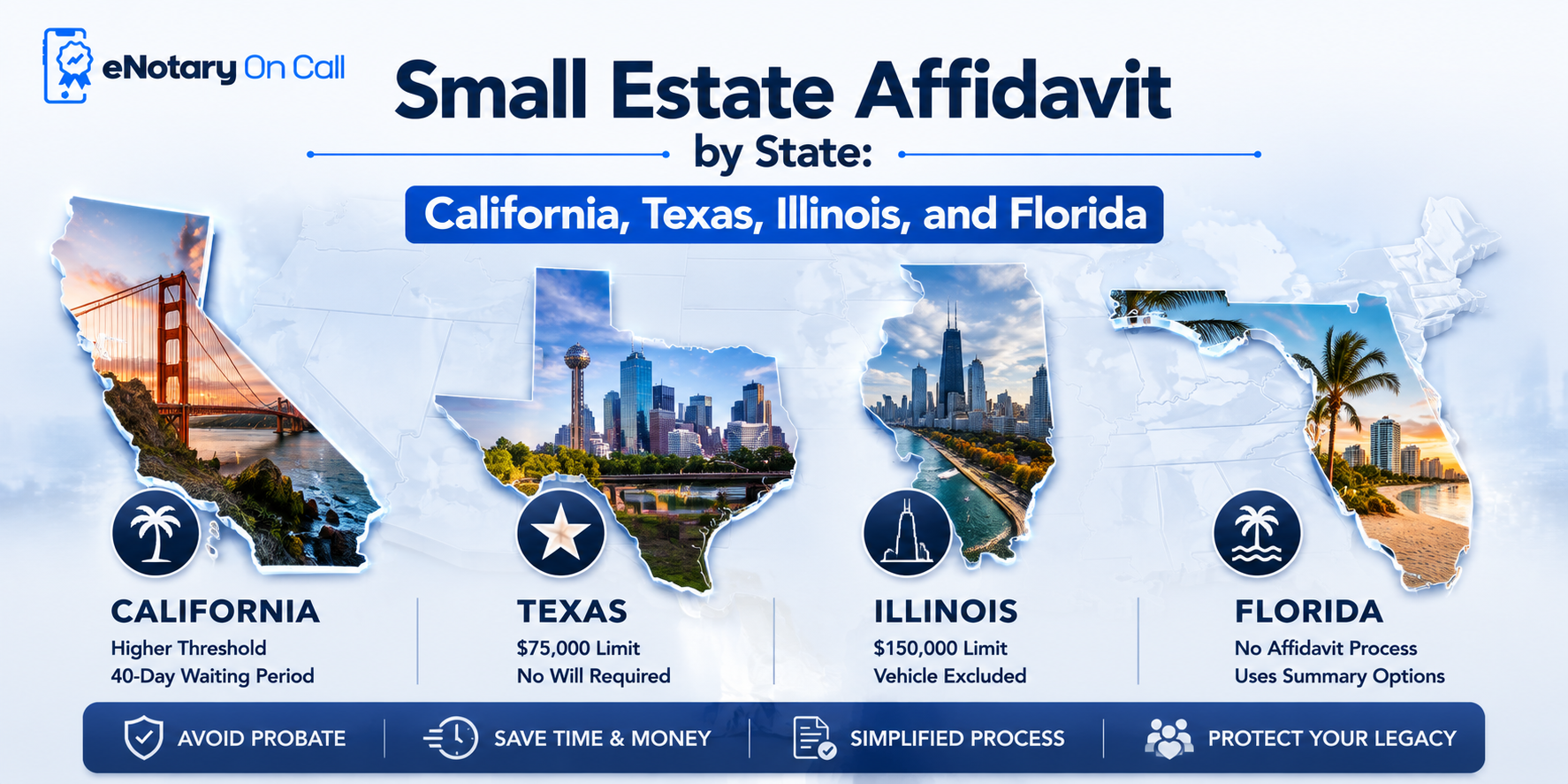
Under California Probate Code Section 13100, heirs can use a small estate affidavit to collect personal property, bank accounts, brokerage holdings, vehicles, and similar assets, without probate, as long as the total falls under the state’s threshold.
For deaths between April 1, 2025 and March 31, 2026, that limit sits at $208,850, rising to $239,700 for deaths on or after April 1, 2026, since California adjusts the figure for inflation every three years.
A few things trip families up in California:
- You must wait at least 40 days after the date of death before presenting the affidavit to any asset holder.
- The threshold is based on gross fair market value, not what’s left after debts, so a $200,000 condo with a $190,000 mortgage still counts at the full $200,000.
- The personal property affidavit cannot transfer real estate. Real property has its own separate paths: an Affidavit for Real Property of Small Value for properties under roughly $69,625, or a Petition to Determine Succession for a primary residence valued up to $750,000 under Assembly Bill 2016.
2. Small Estate Affidavit Texas
Texas takes a different approach. Under Texas Estates Code Chapter 205, a small estate affidavit texas filing is only available when the decedent died without a will, and the total value of non-exempt property is $75,000 or less.
The good news for Texas families is that the homestead, meaning the primary residence, and other exempt property don’t count toward that $75,000 cap at all, so a family could inherit a fully paid-off home and still qualify as long as the remaining bank accounts and personal belongings stay under the limit.
Texas also requires at least 30 days to pass after death, and unlike most states, it needs signatures from every heir plus two disinterested witnesses who knew the deceased but have no financial stake in the estate.
The completed affidavit is filed with the county probate court, not just handed to a bank, and filing fees typically run $300 to $400 depending on the county.
3. Illinois Small Estate Affidavit
The Illinois small estate affidavit just got a lot more useful. Public Act 104-0346 raised the threshold from $100,000 to $150,000 for deaths on or after August 15, 2025, and, notably, registered vehicles no longer count toward that limit at all.
That means a family with $140,000 in bank accounts and a $60,000 paid-off car can still use the affidavit, because the vehicle is excluded from the math entirely and transfers separately through the Secretary of State.
An affidavit of small estate in Illinois still can’t touch real estate, and the person signing it becomes personally responsible for paying the decedent’s debts and funeral costs before distributing anything to heirs.
Illinois also requires a 30-day waiting period after death, and notary fees for this kind of document are capped by state law at $5 in person or $25 for a remote online notarization.
4. Small Estate Affidavit Florida
Here’s a surprise a lot of people searching for small estate affidavit florida don’t expect: Florida doesn’t actually use an affidavit-based small estate process the way California, Texas, and Illinois do. Instead, Florida offers two separate simplified paths under Florida Statutes Chapter 735:
- Summary Administration for estates worth $75,000 or less in non-exempt assets (or any estate where the decedent has been deceased more than two years). This one can transfer both personal property and real estate.
- Disposition Without Administration for very small estates, generally used to reimburse funeral and final medical costs. As of July 1, 2026, the qualifying threshold for the intestate version of this process increased from $10,000 to $20,000 in nonexempt personal property.
Both paths still require filing a petition with the probate court, so small estate affidavit florida searchers should know they’re really looking for summary administration paperwork, and that paperwork still needs a licensed notary’s signature before it can be filed.
Small Estate Affidavit vs. Affidavit of Heirship vs. Affidavit of Residency

These three documents get confused constantly, but they solve completely different problems.
- A small estate affidavit transfers a deceased person’s personal property, like bank accounts, vehicles, or investment accounts, to their rightful heirs without formal probate.
- An affidavit of heirship is used mainly to establish who the legal heirs of a decedent are, and it’s the standard tool for clearing title to real estate when there’s no will, especially in states like Texas where the small estate affidavit typically can’t touch land or a house. It has to be signed by two disinterested witnesses who knew the family and is usually recorded with the county.
- An affidavit of residency has nothing to do with a death at all. It’s a sworn statement confirming where a living person actually lives, commonly required for school enrollment, DMV registration, voter registration, or proving domicile for tax purposes.
If you’re settling an estate, you may need more than one of these documents.
For example, a Texas family might need an affidavit of heirship to clear the title on a house and a small estate affidavit to release a bank account, and both documents need to be properly notarized before anyone will accept them.
How to Notarize a Small Estate Affidavit Online?
Every small estate affidavit, in every state, has one thing in common: it has to be signed under penalty of perjury in front of a notary before a bank, brokerage, or court will honor it.
That used to mean scheduling an appointment, taking time off work, and driving to a bank branch or a notary’s office with a folder full of paperwork. It doesn’t have to anymore.
With eNotary On Call, you can notarize affidavit online sessions from your couch, and the entire process is built around four simple steps.
Notarization in 4 Easy Steps
- Verify Identity – Confirm who you are using a government-issued ID and facial recognition, right from your phone or laptop.
- Upload Document – Upload the small estate affidavit, affidavit of heirship, or affidavit of residency you need notarized. PDFs, images, and most common file types are supported.
- Connect with a Notary – Join a secure, live video session with a certified notary who is available 24/7, so you’re never stuck waiting for a weekday appointment.
- Get Notarized – Receive your fully executed, court-admissible document in your inbox almost instantly, ready to hand to the bank, the court, or the DMV.
The whole session usually takes under five minutes from start to finish, and because eNotary On Call is MISMO-certified and SOC 2 Type II compliant, your documents and identity data stay protected the entire time.
Notarizing State-Specific Documents Online
Because remote online notarization is now permitted in every U.S. state to some degree, families no longer have to search for a notary near me when they’re pressed for time. If you need an online notary Texas session for a small estate affidavit that requires two witnesses, eNotary On Call’s live video sessions can accommodate multi-party signings so the affiant and both disinterested witnesses can complete everything together.
Likewise, an online notary Florida session works well for summary administration or disposition-without-administration paperwork that still needs a notarized signature before it heads to the probate clerk.
Whether you’re in California, Illinois, or anywhere else, connecting with a remote online notary means you’re not limited to your local notary’s office hours or your county’s in-person availability.
That matters most in exactly the situation a small estate affidavit is meant for: when a family is grieving, juggling funeral arrangements, and simply doesn’t have the bandwidth to chase down a courthouse appointment.
What to Include in Your Small Estate Affidavit Document?
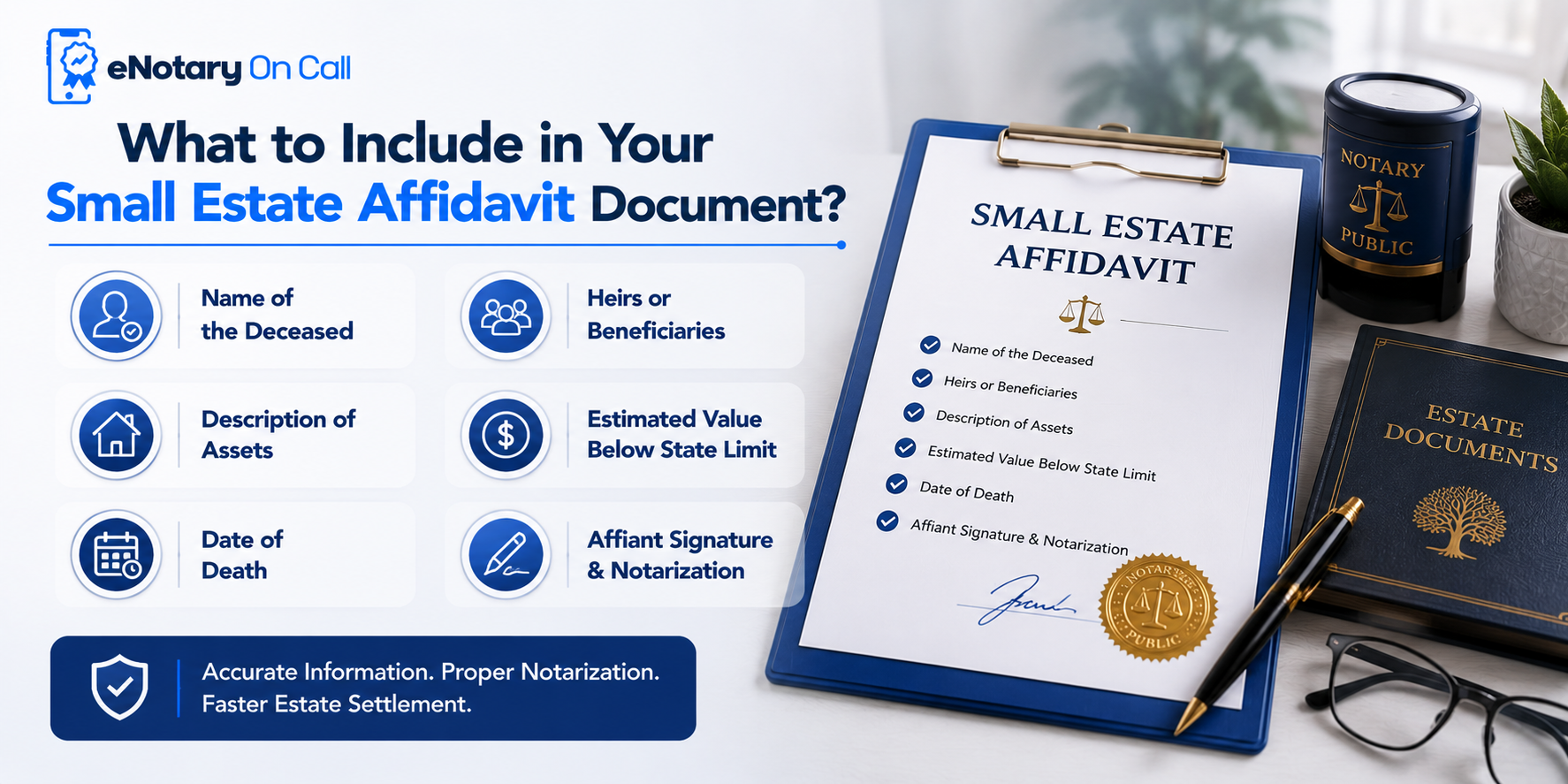
While the exact form varies by state, most small estate affidavit document requirements overlap heavily. Before you notarize anything, make sure your paperwork includes:
- The decedent’s full legal name and date of death
- A certified copy of the death certificate
- Confirmation that the required waiting period has passed (30 to 40 days in most states)
- A statement that no probate proceeding is open or pending
- A full list of the assets being claimed and their fair market value
- The names, addresses, and relationship of every heir entitled to the property
- A sworn statement that the total estate value falls within your state’s threshold
- Signatures from all required parties, which may include witnesses depending on the state
Getting even one of these details wrong is the single biggest reason banks reject an otherwise valid affidavit, so it’s worth double-checking your state’s specific form before your notary session.
Why Online Notarization Fits Small Estate Affidavits So Well?

The remote online notarization market isn’t a niche convenience anymore. Industry research projects the global RON market to top $10 billion by 2025, and by 2026 nearly every U.S. state has adopted some form of permanent RON legislation, with California, Texas, and Florida leading the way with comprehensive frameworks.
For families settling an estate, that shift matters in a very practical way: a small estate affidavit is time-sensitive, tied to statutory waiting periods, and often needed the moment a bank or the DMV asks for it.
Online notary services close that gap without forcing anyone to rearrange their week around a courthouse’s business hours.
Conclusion
Dealing with a loved one’s estate is already emotional. The paperwork shouldn’t make it worse. If the estate you’re settling falls under your state’s threshold, whether that’s $208,850 in California, $75,000 in Texas, $150,000 in Illinois, or the summary administration rules in Florida, a small estate affidavit can save your family months of court proceedings and thousands of dollars in fees.
The last step, getting that document properly notarized, no longer has to slow you down either. With eNotary On Call, you can complete the entire notarization from home, any hour of the day, and move forward with settling your loved one’s affairs without adding a courthouse trip to an already difficult time.
Disclaimer: This blog is for general informational purposes only and does not constitute legal advice. Estate laws vary by state and change over time. Please consult a licensed attorney or your local probate court for guidance specific to your situation.
FAQs
1. What is a small estate affidavit used for?
A small estate affidavit lets heirs collect a deceased person’s bank accounts, vehicles, and personal property directly from the institution holding them, without opening a formal probate case, as long as the estate’s value stays under the state’s threshold.
2. Can I notarize a small estate affidavit online?
Yes. Nearly every state now permits remote online notarization, so you can complete your small estate affidavit with a certified notary over live video instead of visiting an office in person.
3. How long does eNotary On Call’s notarization process take?
Most sessions are completed in under five minutes: verify your identity, upload the document, connect with a live notary, and receive your notarized file straight to your inbox.
4. Is eNotary On Call available 24/7?
Yes, eNotary On Call connects you with a certified notary any time of day or night, so urgent documents like a small estate affidavit don’t have to wait for regular business hours.
5. Do I need an in-person notary for a small estate affidavit with witnesses?
Not necessarily. eNotary On Call’s live video sessions can include multiple participants, so an affiant and required witnesses can complete a multi-signer document together in one online session.
6. Is an online notarization from eNotary On Call legally valid?
Yes. eNotary On Call is MISMO-certified and SOC 2 Type II compliant, and its notarizations are performed by licensed, commissioned notaries public, making the resulting document legally binding and court-admissible.
7. What documents besides a small estate affidavit can eNotary On Call notarize?
Affidavits of heirship, affidavits of residency, powers of attorney, quitclaim deeds, lien releases, and a wide range of other legal, real estate, and business documents.