 by
by Quick Answer: A Quitclaim Deed Form is used to transfer property ownership rights from one person to another without guaranteeing that the title is clear. You typically need to identify the grantor and grantee, include property details, sign the document correctly, notarize it where required, and file it with the appropriate local recording office to complete the transfer.
The paperwork included in the property transfer can be a little complicated. Many people assume transferring ownership is just a matter of signing a document and handing over the keys. But when a Quitclaim Deed Form comes into play, small mistakes can create delays, rejected filings, title confusion, and future legal headaches. That’s because a quitclaim deed works differently from other property transfer documents.
A Quitclaim deed generally transfers whatever ownership interest exists, without guaranteeing a clear title, unlike warranty deeds. So before signing anything, it’s important to understand –
- What a Quitclaim Deed Form actually does
- When you should use one
- How to complete it correctly
- Whether it needs notarization
- How to file it properly
So, let’s walk through step-by-step and explain how eNotary On Call can simplify the notarization process.
What is a Quitclaim Deed Form?
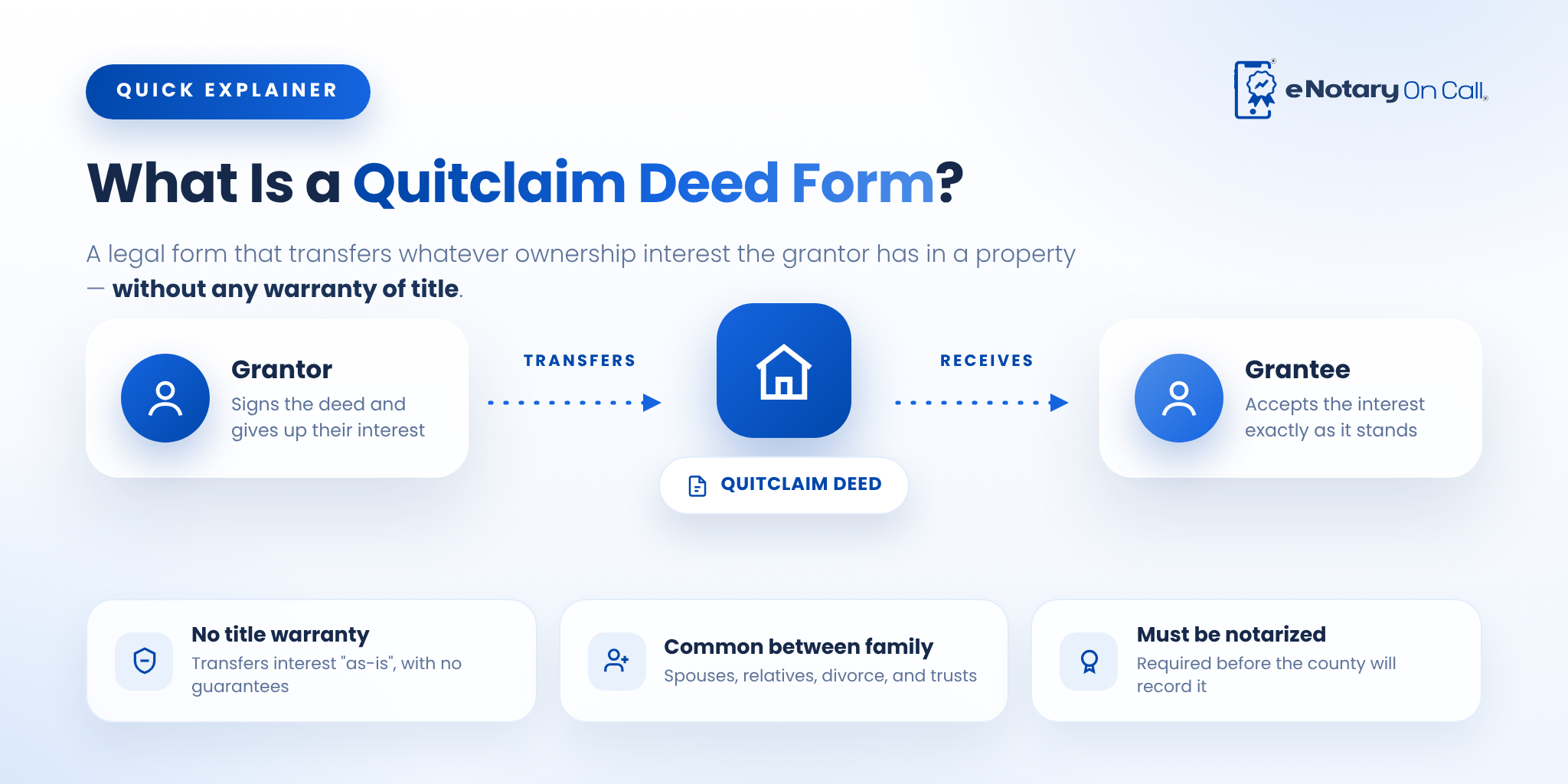
A Quitclaim Deed Form is a legal document used to transfer ownership interest in real estate from one person to another. The person transferring ownership is called the Grantor, and the person receiving ownership is called the Grantee. Unlike some other deed types, a quitclaim deed generally does not guarantee –
- Clear ownership
- Title quality
- Freedom from liens
- Ownership history
It only transfers whatever interest the grantor currently has.
When is a Quitclaim Deed Commonly Used?
Quitclaim deeds are often used in lower-risk situations where the parties already know and trust each other. Common examples include –
- Transfers between spouses
- Divorce settlements
- Family property transfers
- Estate planning
- Adding or removing someone from the title
- Correcting title errors
Why It Matters: Quitclaim deeds are generally about simplicity and convenience, not title protection.
When Should You NOT Use a Quitclaim Deed?
People often choose quitclaim deeds because they appear easier. But they are not always appropriate. Situations that may require additional protection include –
- Purchasing property from strangers
- Investment property purchases
- Commercial real estate transactions
- Complex ownership disputes
Key Insight: A different deed structure may be more appropriate if title protection is a concern.
What Information Must Be Included in a Quitclaim Deed Form?
A complete Quitclaim Deed Form usually includes several core sections.
- Grantor Information – It includes the full legal name, address, and ownership details.
- Grantee Information – It includes the full legal name, mailing address, and ownership designation. Property ownership records depend heavily on correct names.
- Property Description -This section should include the legal description, parcel information, and property address. Avoid relying only on street addresses.
- Transfer Language – The document should clearly explain the ownership transfer intent, parties involved, and effective transfer language.
- Signature Section– Include grantor signatures, required witness sections, and notary section. Do not sign before confirming execution requirements.
How to Complete a Quitclaim Deed Form
Step 1 – Obtain the Correct Form – Use a form that aligns with the property location, local recording standards, and state requirements. Using the wrong format may delay recording.
Step 2 – Enter Ownership Information Carefully – Review name spellings, ownership percentages, and marital designations. Small clerical errors can create title issues years later.
Step 3 – Insert Property Details – Verify legal description, parcel information, and existing deed details. Incorrect property information may invalidate the recording.
Step 4 – Review Tax and Recording Requirements – Some jurisdictions may require transfer disclosure, recording fees, and tax forms. Confirm requirements before signing.
Step 5 – Prepare for Notarization – Most quitclaim deeds require notarized signatures before recording. Do not pre-sign.
Does a Quitclaim Deed Form Need to Be Notarized?
One of the biggest doubts people have is whether they need notarization; the answer is yes, in many situations. Recording offices commonly expect notarized signatures. Notarization helps verify identity, reduce fraud, confirm voluntary execution, and improve acceptance.
Key Insight: A deed that is signed but not properly notarized may not be accepted for recording.
How to Notarize a Quitclaim Deed Form
Notarization is usually straightforward once completed.
Step 1 – Bring Identification – Prepare driver’s license, passport, and government-issued ID.
Step 2 – Meet With the Notary – The notary will confirm identity, witness signatures, and complete certification.
Step 3 – Receive the Notarized Document – Review name, dates, and notary details.
Why It Matters: Errors discovered after filing often require correction documents.
Can You Notarize a Quitclaim Deed Online?
In many situations, online notarization may be available.
With eNotary On Call, users can generally –
- Upload the completed deed
- Verify identity
- Meet with a commissioned notary
- Sign remotely
- Receive the completed notarized document
Pro Tip: Confirm that your local recording office accepts electronically notarized deeds before using online notarization.
How to File a Quitclaim Deed Form the Right Way
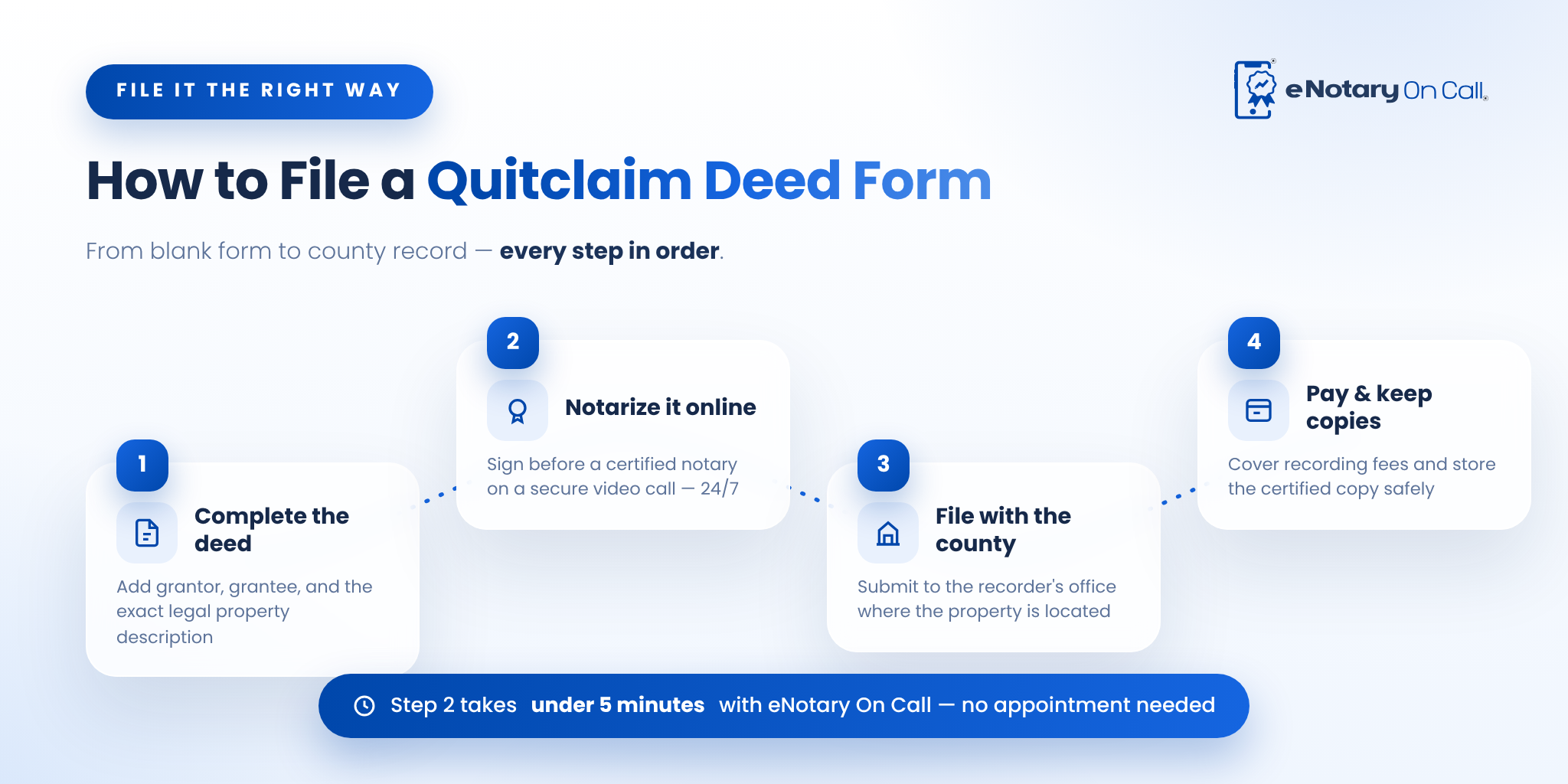
Completing and notarizing the document is not the final step. The deed usually must be recorded.
Step 1 – Prepare Supporting Documents – Depending on the location, you may need transfer forms, tax documentation, and supplemental disclosures.
Step 2 – Submit to the Recording Office – Typically the county recorder, Register of Deeds, and local land records office.
Step 3 – Pay Recording Fees – Fees vary by location.
Step 4 – Confirm Recording Completion – After filing, request confirmation and obtain recorded copies.
Key Insight: An unrecorded deed may not fully protect ownership interests.
Common Mistakes People Make With Quitclaim Deeds
These problems happen more often than expected.
- Using the Wrong Property Description
- Forgetting Notarization
- Assuming Transfer Removes Mortgage Liability
- Filing Incomplete Documents
- Believing Recording Happens Automatically
Property paperwork mistakes can remain hidden for years.
Why People Use eNotary On Call for Property Documents
Many people prefer eNotary On Call because it helps simplify execution. Benefits may include –
- Remote notarization
- Reduced scheduling delays
- Secure identity verification
- Convenient document completion
Key Insight: Property transactions already involve enough moving pieces; document signing should not become another obstacle.
Final Thoughts
A Quitclaim Deed Form may look simple, but property transfers rarely are. Completing the document accurately, notarizing it correctly, and filing it properly can make the difference between a smooth transfer and a future title problem.
Understanding the process upfront helps avoid unnecessary complications, whether you’re transferring property between family members, updating ownership after life changes, or correcting records. And completing the notarization step can become one of the easiest parts of the transaction with eNotary on Call.
Frequently Asked Questions
1. Does a Quitclaim Deed Form transfer full ownership?
Not necessarily. A Quitclaim Deed Form transfers whatever ownership interest the grantor currently holds, but it generally does not guarantee a clear title or ownership quality. That means the grantee receives rights subject to existing ownership conditions.
2. Does a Quitclaim Deed need to be notarized?
In many situations, yes. Recording offices frequently require notarized signatures before accepting the deed for recording. Notarization helps confirm identity and supports the validity of the transfer.
3. Can I file a Quitclaim Deed myself?
In many cases, yes. Property owners often prepare, notarize, and submit deeds directly to the appropriate recording office. However, additional requirements such as transfer forms or local filing rules may still apply.
4. Does filing a Quitclaim Deed remove someone from the mortgage?
Usually not. Property ownership and mortgage responsibility are different legal concepts. Removing ownership rights through a deed does not automatically remove someone’s loan obligations.
5. Can a Quitclaim Deed be notarized online?
In many situations, yes. Remote notarization may allow property documents to be completed without scheduling in-person appointments. Services like eNotary On Call can simplify notarization, although local recording acceptance should still be confirmed.

Anjali is a Senior Content Writer at eNotary On Call, specializing in online notarization, legal documentation, and compliance, helping readers navigate important processes with ease and confidence. Outside of work, Anjali enjoys traveling, cooking, and reading.