 by
by If your parents just told you they want to “put the house in your name,” stop them before they sign anything. That one sentence can mean two completely different legal documents, and picking the wrong one could cost your family thousands of dollars, trigger a Medicaid penalty, or hand your childhood home to your sibling’s creditors. So which is it: a lady bird deed or a quitclaim deed?
This is exactly why the lady bird deed vs quitclaim deed notarization decision trips up so many families in Florida, Texas, and Michigan every year. Both deeds move property out of your name. Only one of them actually avoids probate while letting you keep full control of your home for the rest of your life. Let’s settle this once and for all, state by state, dollar by dollar.
What Is a Lady Bird Deed?
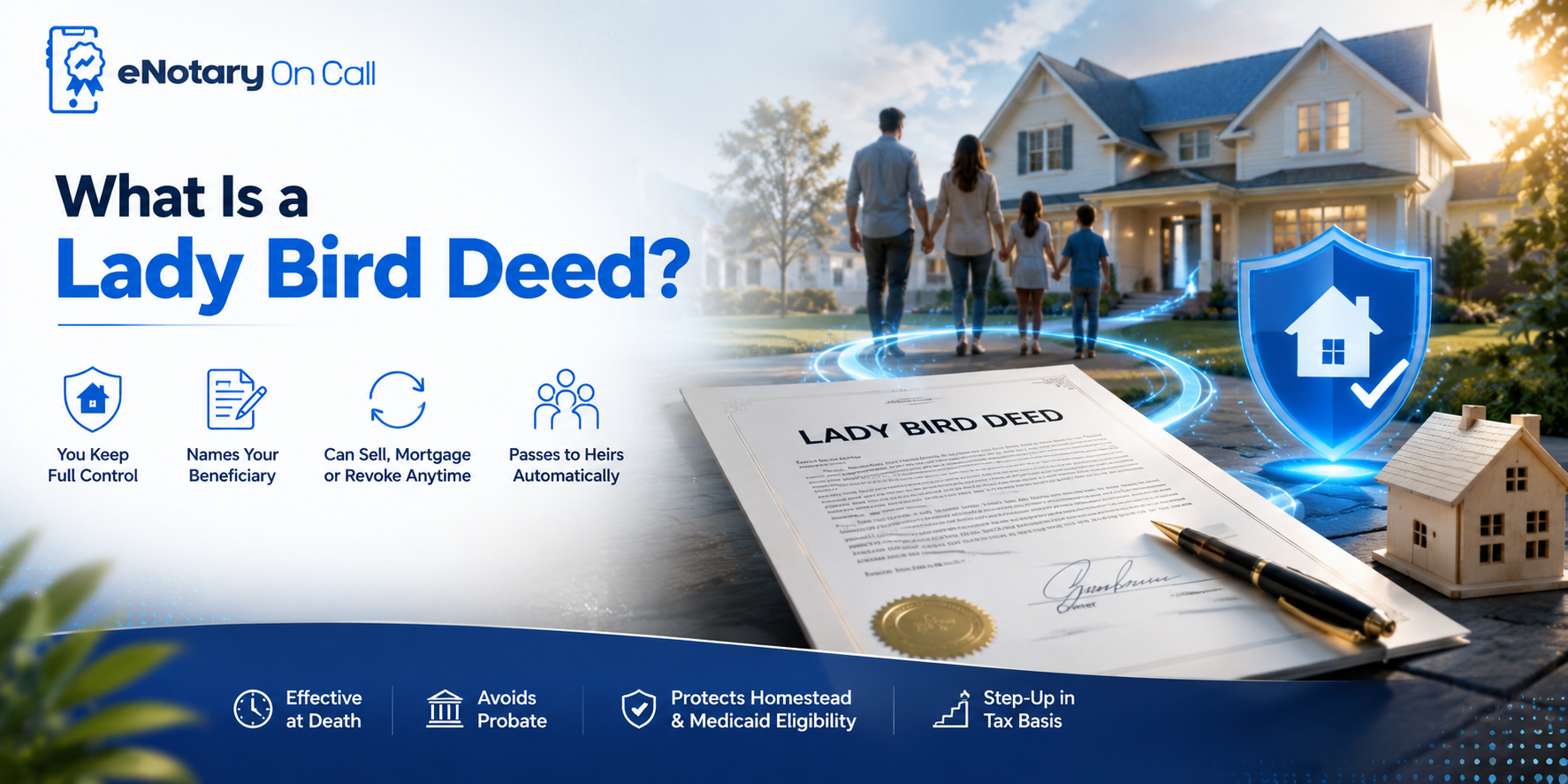
A lady bird deed is a special type of deed, also called an enhanced life estate deed, that lets a property owner name a beneficiary who automatically inherits the home at death, without probate. The owner keeps complete control while alive. They can sell the house, take out a mortgage, rent it out, or cancel the deed entirely, all without asking the beneficiary for permission.
The name comes from an old estate planning story tied to Lady Bird Johnson, though the deed itself is a creation of property law, not a government form.
Only five states regularly recognize it: Florida, Texas, Michigan, Vermont, and West Virginia. If you own property outside those states, this specific tool will not work for you, and you will need to look at a transfer on death deed or a living trust instead.
Here’s the part people miss: a lady bird deed is not a gift while you’re alive. Because the owner keeps the right to sell, mortgage, or revoke the deed, the transfer to your beneficiaries is considered incomplete until death.
That single detail is what protects the homestead exemption, keeps the deed off Medicaid’s five-year look-back radar, and gives your heirs a stepped-up tax basis the day you pass away.
What Is a Quitclaim Deed?
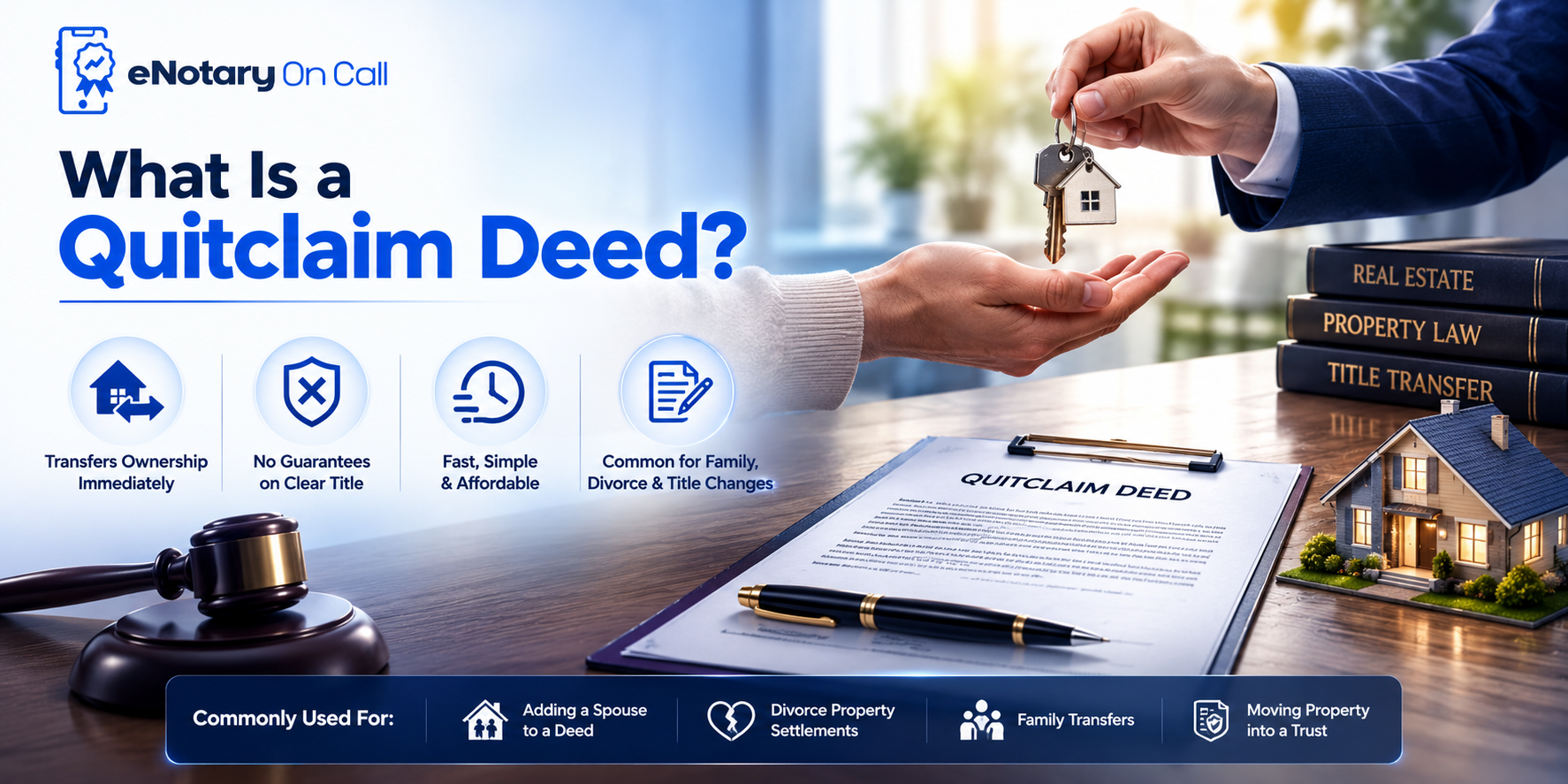
A quitclaim deed is a legal document that transfers whatever ownership interest the grantor currently holds in a property to another person, immediately, with zero guarantees about the title being clear. There is no life estate, no waiting for death, and no ongoing control for the person who signs it away.
The moment a quitclaim deed is signed, notarized, and recorded, the transfer is done. The original owner cannot take it back.
If they later change their mind about who should inherit the home, or if the new owner runs into debt, a lawsuit, or a divorce, the property is now exposed to those problems too, because it legally belongs to someone else.
That is exactly why families use a quitclaim deed for very different situations than a lady bird deed: correcting a name on a title, adding a spouse to a deed, transferring property during a divorce, or moving a house into a trust. It is fast and inexpensive, but it was never designed as a probate-avoidance tool, even though people often try to use it as one.
Lady Bird Deed vs Quitclaim Deed: The Core Difference!
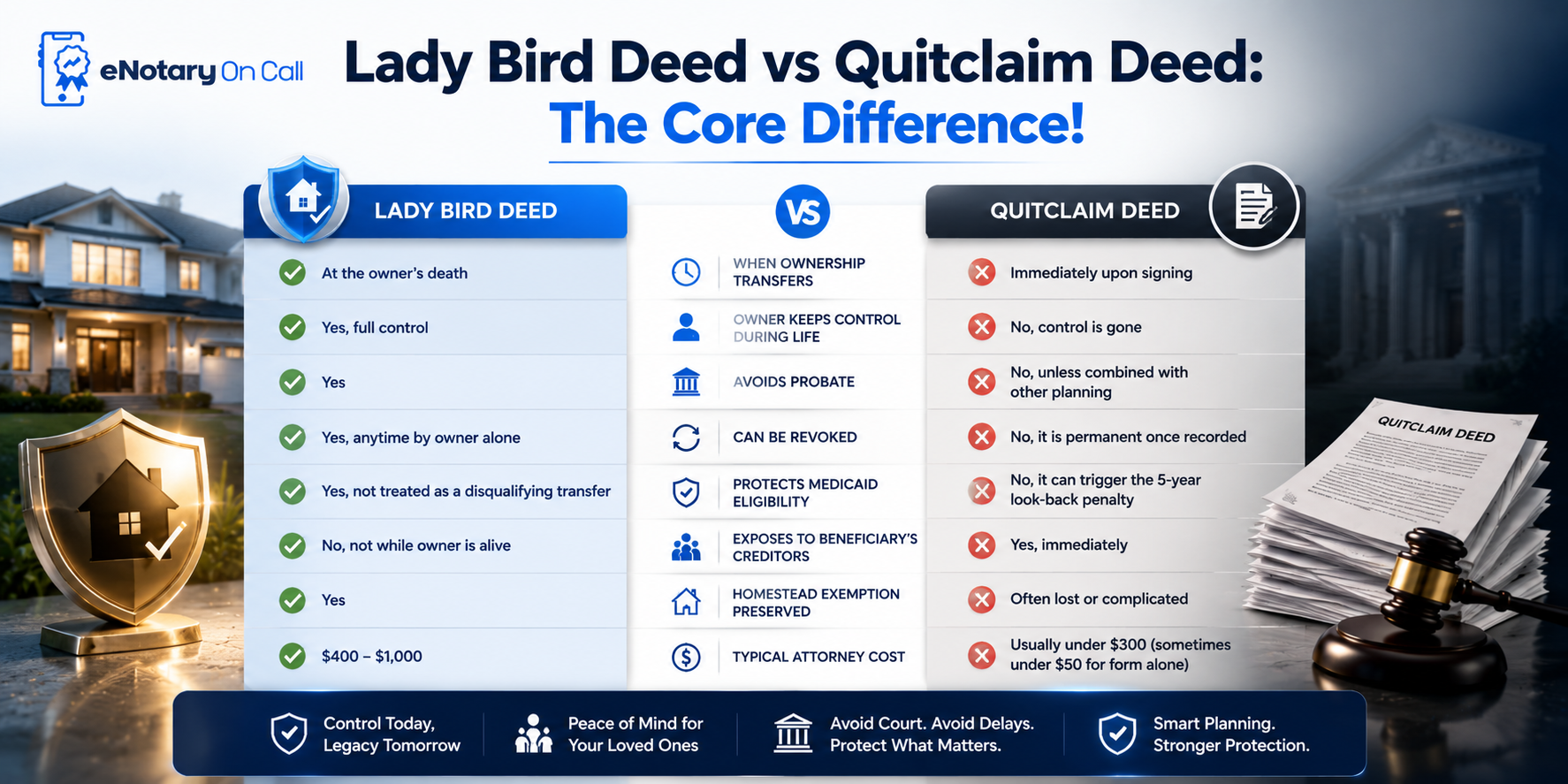
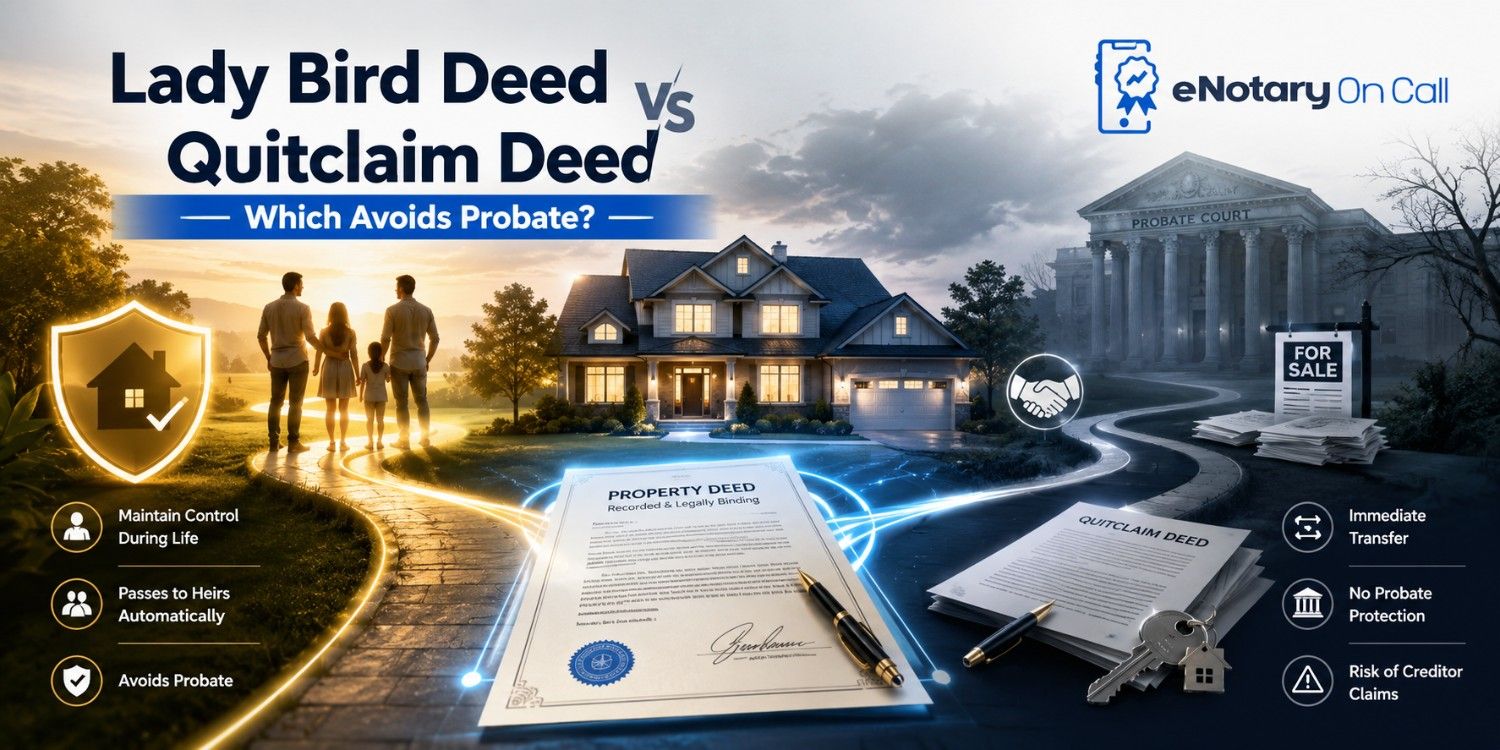
The entire lady bird deed vs quitclaim deed comparison comes down to one question: does control transfer now, or at death?
| Feature | Lady Bird Deed | Quitclaim Deed |
| When ownership transfers | At the owner’s death | Immediately upon signing |
| Owner keeps control during life | Yes, full control | No, control is gone |
| Avoids probate | Yes | No, unless combined with other planning |
| Can be revoked | Yes, anytime, by the owner alone | No, it is permanent once recorded |
| Protects Medicaid eligibility | Yes, not treated as a disqualifying transfer | No, it can trigger the 5-year look-back penalty |
| Exposes home to beneficiary’s creditors | No, not while owner is alive | Yes, immediately |
| Homestead exemption preserved | Yes | Often lost or complicated |
| Typical attorney cost | $400 to $1,000 | Usually under $300, sometimes under $50 for the form alone |
A quitclaim deed used to move property outside of probate seems cheap and simple on paper. The problem shows up later: once you quitclaim your home to your adult child, you legally need their permission to sell it, refinance it, or even change your mind.
If that child gets divorced, sued, or falls behind on debt, your house can get pulled into their legal mess while you are still living in it.
Does a Lady Bird Deed Avoid Probate?
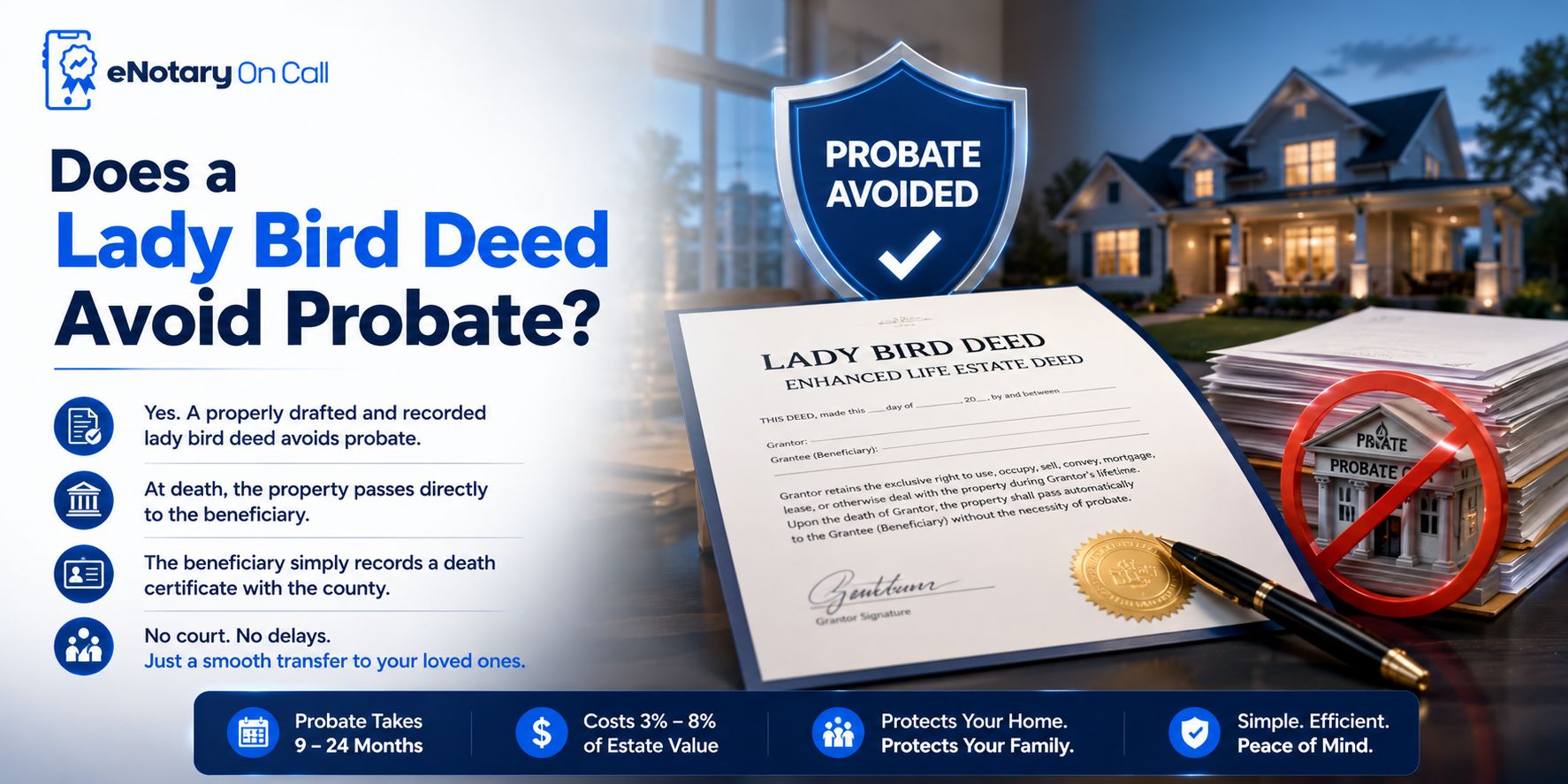
Yes. A properly drafted and recorded lady bird deed avoids probate because the property passes directly to the named beneficiary the moment the owner dies.
The beneficiary simply records a death certificate with the county, and the transfer is complete. There is no court filing, no judge, and no waiting period tied to probate court.
This matters more than most people realize. According to National Center for State Courts data, probate in the United States typically takes anywhere from 9 to 24 months to close, and the American Bar Association estimates the process eats up 3 to 8 percent of the total estate value in fees.
On a $400,000 home, that is potentially $12,000 to $32,000 gone before your family sees a dime, plus over a year of waiting. A lady bird deed sidesteps that entire timeline for the one asset that usually matters most: the family home.
Lady Bird Deed Florida: What Florida Families Should Know?
Florida is where the lady bird deed is used most heavily, and for good reason. Florida lady bird deed planning is common because Florida has no transfer-on-death deed statute for real estate, so the lady bird deed is the primary legal tool available to homeowners who want to skip probate on their house.
Interestingly, there is no single Florida statute that created the lady bird deeds in Florida framework. Its authority comes from over a century of Florida court decisions and Florida Bar title standards, and Florida title companies accept a properly drafted one without hesitation.
A valid lady bird deed Florida form needs six things to hold up under title examination: the grantor’s name, enhanced life estate language, named remainder beneficiaries, the full legal property description, homestead language when it applies, and correct execution and recording.
Florida homeowners lean on this deed for a few very specific reasons:
- It keeps the Save Our Homes property tax cap and homestead exemption intact, since the owner never technically gives up ownership while alive.
- It protects the home from Florida’s Medicaid estate recovery program after death, because the property never enters the probate estate.
- It gives beneficiaries a stepped-up tax basis at the date of death, which can wipe out capital gains tax if they sell the home soon after inheriting it.
- Attorney fees typically land between $400 and $1,000, a fraction of the $2,000 to $5,000 cost of setting up a revocable living trust for the same purpose.
One important caveat: Florida’s homestead laws restrict who you can leave your primary residence to if you have a surviving spouse or minor children, and no deed, lady bird or otherwise, can override that constitutional protection.
Lady Bird Deed Texas: How the Rules Differ?
Lady bird deed Texas planning works a little differently than Florida because Texas also has a statutory Transfer on Death Deed (TODD) under Texas Estates Code Chapter 114, which functions almost like a lady bird deed’s cousin. The two tools overlap, but they are not identical, and the differences matter.
A TODD in Texas must be recorded before death and can only be signed personally by the property owner. A lady bird deed Texas form, on the other hand, does not require recording to be valid, and it can be executed by an agent under a properly drafted power of attorney if the owner later loses capacity.
That single difference makes the lady bird deed the better option for families who wait too long to plan, since a TODD simply cannot be signed once someone loses the mental capacity to sign a contract.
There is also a creditor issue worth knowing. Under Texas Estates Code Section 114.106, a TODD-transferred property remains exposed to a two-year creditor clawback window after the owner’s death.
A lady bird deed carries the same general estate-creditor exposure, but because it has functioned under Texas common law and title practice for decades, title companies across the state are comfortable clearing title on it without the added friction some TODD transfers create at resale.
Texas homeowners also get to keep the same core lady bird deed benefits: full lifetime control, no Medicaid transfer penalty, and an automatic transfer that avoids the Texas probate courts in Harris, Dallas, Travis, and every other county.
Also Read – Quitclaim Deed vs Grant Deed: Key Differences You Need to Know
Lady Bird Deed Michigan: The Original Home of the Deed!
Michigan is actually where the lady bird deed strategy became widely known in modern estate planning, and lady bird deed Michigan transactions still follow the same core structure used in Florida and Texas: the owner keeps a life estate with full power to sell, mortgage, or revoke, while naming a remainder beneficiary who inherits automatically.
Michigan title insurers and probate courts have recognized this deed for decades, and it remains one of the most common probate-avoidance tools used by Michigan estate planning attorneys for a primary residence.
Quitclaim Deed Florida vs Quitclaim Deed California
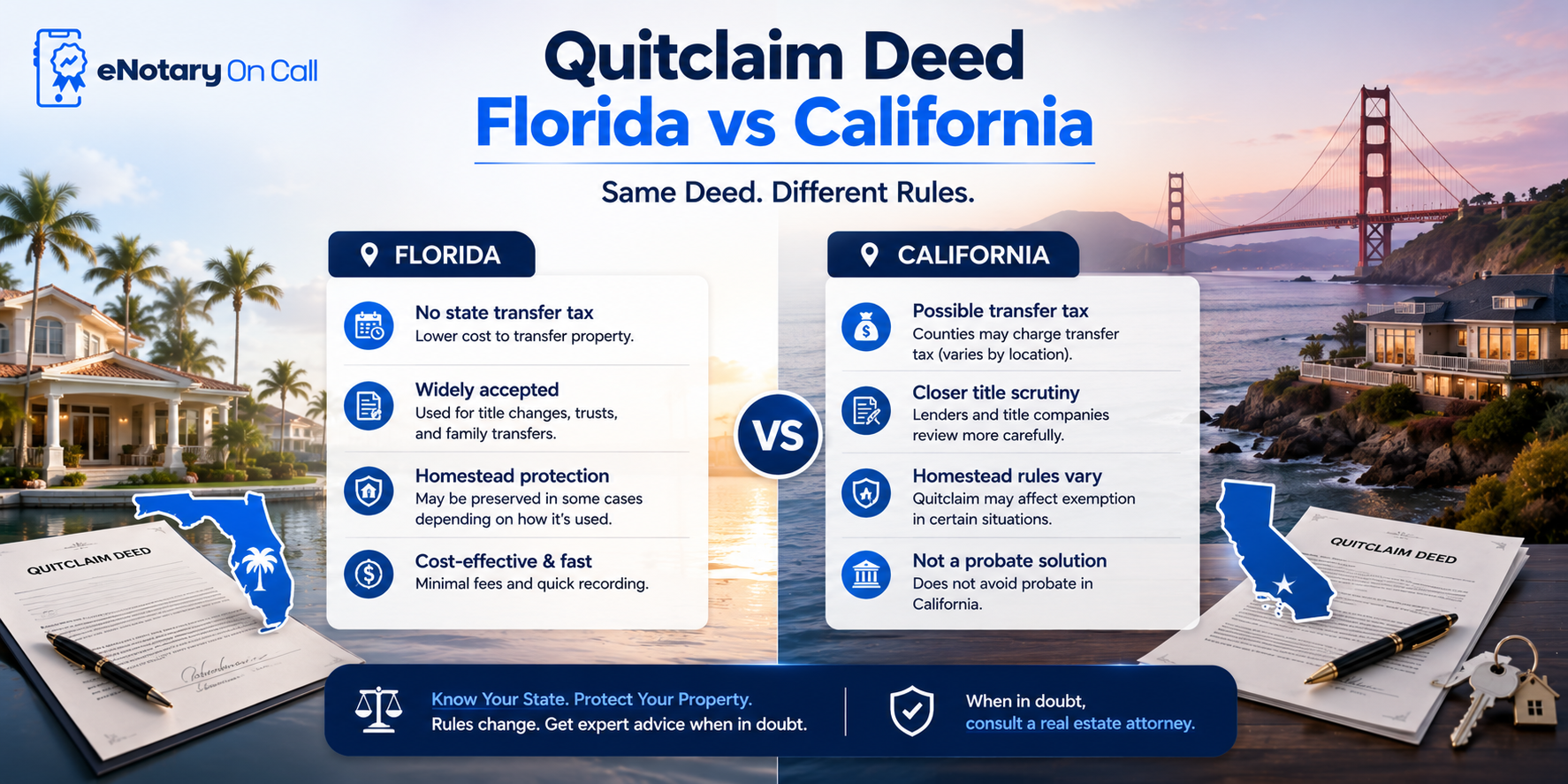
A quitclaim deed Florida transaction and a quitclaim deed California transaction share the same basic legal purpose, but the paperwork and requirements are not identical.
In Florida, a quitclaim deed must be signed in front of two witnesses and a notary public, and it must include the full legal property description along with the consideration paid, or a statement that it is a gift. Florida also charges documentary stamp taxes based on the property’s value, on top of county recording fees that typically run $10 to $70.
California requires a quitclaim deed to be notarized, but it does not require witnesses the way Florida does. California uses a standardized quitclaim deed form with its own formatting rules, plus a Preliminary Change of Ownership Report that must be filed alongside the deed.
California transfer tax generally runs about $1.10 per $1,000 of property value, though certain transfers between spouses are exempt.
In both states, a quitclaim deed offers zero title protection. The grantee accepts the property exactly as it stands, liens, disputes, and all.
That is why quitclaim deeds work best for low-risk transfers between people who already trust each other completely, like adding a spouse to a title or correcting a clerical error, and not for buying property from a stranger or trying to dodge probate on a family home.
Also Read – How a Quitclaim Deed Form Works in Property Transfers?
When a Quitclaim Deed Actually Makes Sense?
A quitclaim deed is not a bad document, it is simply the wrong tool for probate avoidance. It genuinely shines in situations like:
- Adding a new spouse to an existing property title after marriage.
- Transferring a spouse’s interest in a home during a divorce settlement.
- Moving property into a revocable living trust you already control.
- Fixing a clerical error or a misspelled name on an old deed.
- Removing a deceased co-owner’s name from title when combined with an affidavit.
If your actual goal is to skip probate court while still living in your home and controlling it, a lady bird deed almost always beats a quitclaim deed, because you are not permanently giving anything up today.
Also Read – Quitclaim Deed vs Warranty Deed: Which One Protects You?
How to Notarize Your Lady Bird Deed or Quitclaim Deed Online?
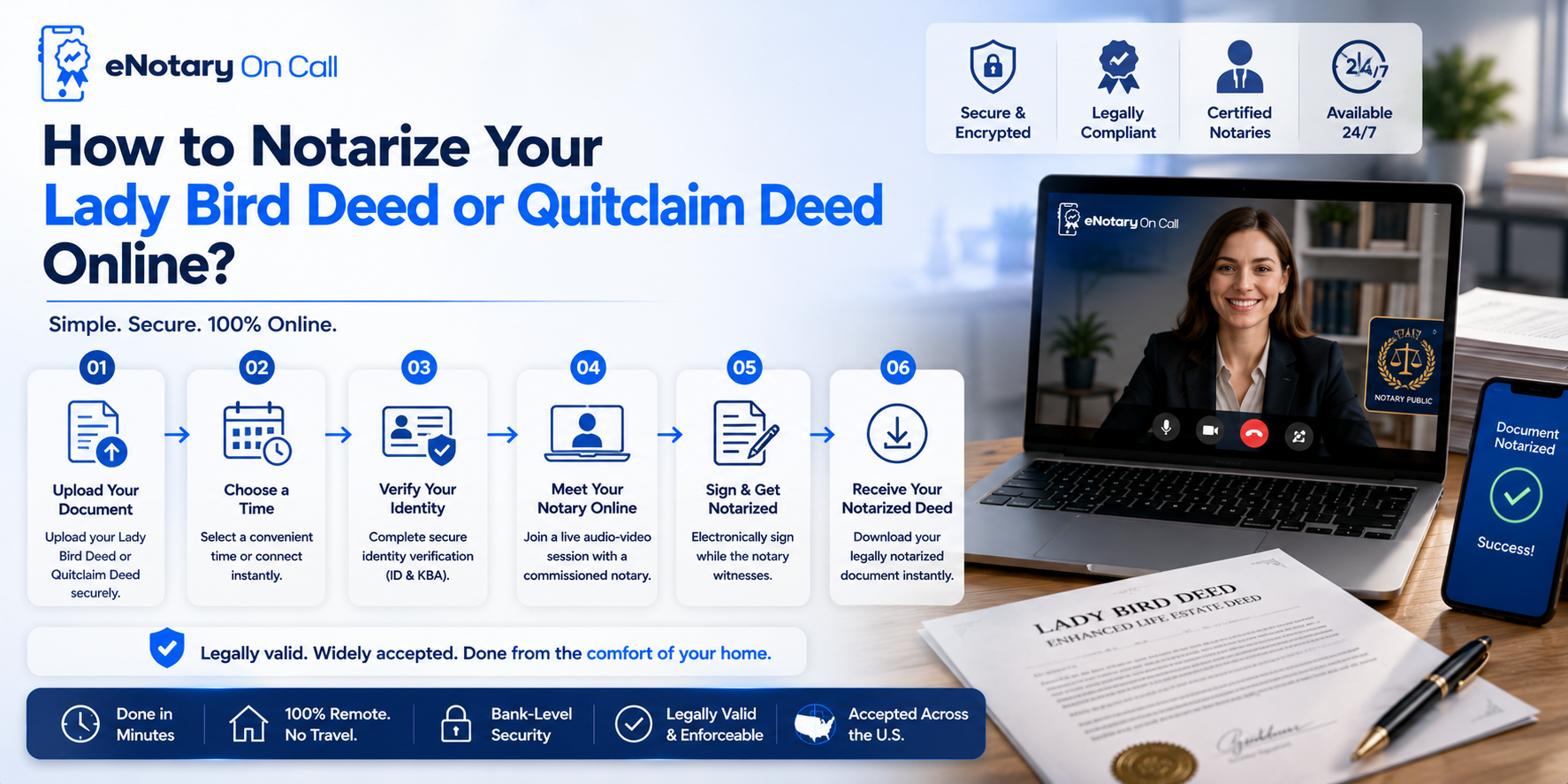
Whichever deed fits your situation, Florida, Texas, and Michigan all require notarization before the county will record it. Driving to a bank or a UPS store for this is no longer necessary.
With a remote online notary service like eNotary On Call, you can get your document notarized from your kitchen table, and the entire session usually wraps up in under 10 minutes.
Notarization in 4 Easy Steps
- Verify Identity – Confirm your identity using a government-issued ID and facial recognition, so the notary can legally certify who signed the document.
- Upload Document – Upload the lady bird deed, quitclaim deed, or any other document you need notarized. PDFs, images, and most standard formats are supported.
- Connect with Notary – Join a secure live video session with a certified notary, available 24/7, no appointment required.
- Get Notarized – Receive your fully executed, court-admissible document instantly in your inbox, ready to record with your county clerk.
This is also where online notary services save families real time during estate planning. Beyond deeds, you can notarize power of attorney online documents in the same session, which matters if you are setting up a durable power of attorney alongside a lady bird deed so an agent can manage your affairs if you ever lose capacity.
And if your family situation calls for a straightforward property transfer instead, you can notarize quitclaim deed online paperwork just as easily, without hunting for a notary near me appointment that fits your schedule.

Conclusion
The lady bird deed vs quitclaim deed decision really isn’t close once you understand what each document actually does.
A quitclaim deed hands over your property today, permanently, with your beneficiary’s creditors and life circumstances suddenly tied to your home. A lady bird deed lets you keep the keys, the mortgage, the homestead exemption, and every ounce of control until the day you no longer need any of it, at which point your family skips probate entirely.
If you’re weighing a Florida lady bird deed, a lady bird deed Texas form, or a straightforward property transfer in Michigan or California, talk to a local estate planning attorney about which document fits your family’s goals.
Once your deed is ready to sign, skip the drive to a notary’s office. eNotary On Call lets you complete identity verification, document upload, and a live notary session in one sitting, 24/7, so your deed is ready to record the same day.
FAQs
1. Is eNotary On Call available in Florida, Texas, and Michigan?
Yes, eNotary On Call connects signers with commissioned notaries who can handle remote online notarization for residents in Florida, Texas, Michigan, and most other states, subject to each state’s specific RON laws.
2. How long does it take to notarize a deed with eNotary On Call?
Most sessions are completed in under 10 minutes from identity verification to receiving your fully executed document.
3. Can I notarize a lady bird deed online?
Yes, as long as your state permits remote online notarization for real estate deeds, you can complete the entire signing and notarization process through a secure live video session.
4. Is an online notarization from eNotary On Call legally valid for county recording?
Yes. eNotary On Call is MISMO certified and SOC 2 Type II compliant, and the notarized documents it produces are accepted for county recording where remote online notarization is legally permitted.
5. Do I need an appointment to use eNotary On Call?
No. eNotary On Call operates 24/7, so you can connect with a certified notary anytime, without scheduling ahead.
6. What is a lady bird deed?
A lady bird deed is an enhanced life estate deed that lets a homeowner name a beneficiary to inherit real estate automatically at death, without probate, while the owner keeps full control to sell, mortgage, or cancel the deed during their lifetime.
7. What is a quitclaim deed?
A quitclaim deed transfers whatever ownership interest the current owner has in a property to another person immediately, with no guarantees about the title being free of liens or claims.
8. Can I use a lady bird deed if I live outside Florida, Texas, or Michigan?
Only Florida, Texas, Michigan, Vermont, and West Virginia regularly recognize lady bird deeds. If you live elsewhere, ask an estate planning attorney about a transfer on death deed or a revocable living trust instead.
9. Does a quitclaim deed protect my home from Medicaid estate recovery?
No. A quitclaim deed is treated as a completed gift, which can trigger Medicaid’s five-year look-back penalty and disqualify you from benefits, unlike a lady bird deed.
10. Can I revoke a lady bird deed after I sign it?
Yes. The owner can revoke or change a lady bird deed at any time during their life, without needing the beneficiary’s permission or signature.
11. Is a quitclaim deed cheaper than a lady bird deed?
Yes, on paper. A basic quitclaim deed form can cost under $50 in filing fees, compared to $400 to $1,000 in attorney fees for a lady bird deed. But the quitclaim deed gives up control immediately, which often costs families far more later.
12. Do both deeds need to be notarized?
Yes. Florida, Texas, and Michigan all require a notary public to witness the signing before the county will accept either deed for recording.