

 by
by Quick Answer: A residency affidavit is a sworn legal document confirming where you live. To fill it out correctly, you need your full legal name, current address, length of residency, a valid ID, and in most cases, a notary’s signature. Keep reading for the complete step-by-step breakdown.
You finally tracked down the form. Now you’re staring at it wondering – did I fill this out right? Do I need a notary? What happens if I get it wrong?
These are the exact questions we hear every day at eNotary On Call – and they come up across every type of affidavit, not just residency ones. And they make sense – a residency affidavit is a legal document, and one small mistake can get it rejected by a school, a DMV, a court, or a government agency.
The good news? Filling one out correctly is simpler than it looks – as long as you know what each field actually means and what happens next. This guide walks you through every step, covers the most common mistakes people make, and tells you exactly when and how to get your affidavit of residency notarized – including how to do it online in under 10 minutes.
What Is an Affidavit of Residency?
An affidavit of residency – also called an affidavit of residence or proof of residence affidavit – is a legal declaration that confirms your current home address. When you sign it, you are swearing under oath that the information is true and accurate.
How Is It Different from a Utility Bill or Lease?
It differs from a utility bill or lease agreement because it is a sworn statement – meaning it carries legal weight. Providing false information on an affidavit of residency can be considered perjury in most states.
What Are the Different Names for This Document?
You will typically see it referred to in three ways:
- Affidavit of residency – most common term used nationally
- Affidavit of residence – used interchangeably, same document
- Proof of residence affidavit – often used by schools and government agencies
Regardless of what it is called on the form you have in front of you, the document serves the same purpose: officially confirming where you live.
When Do You Actually Need One?
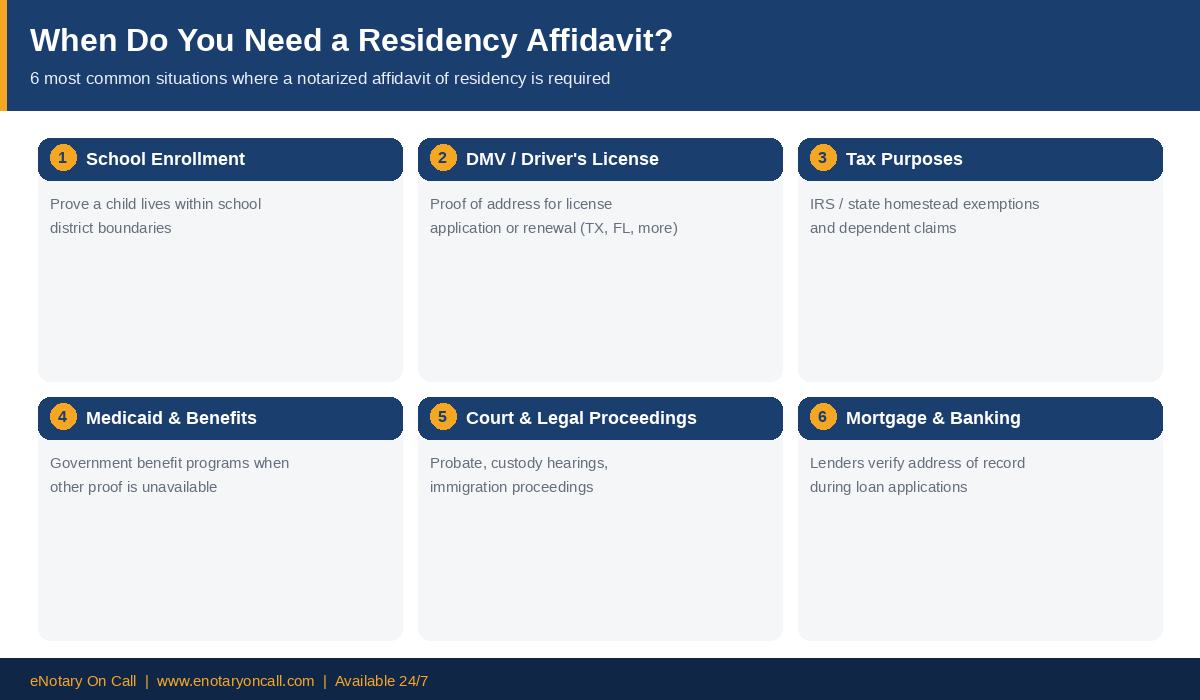
A residency affidavit comes up more often than most people expect. Here are the most common situations:
For example,
1. School Enrollment: Many public school districts require a notarized affidavit of residency to prove a child lives within district boundaries – especially when a utility bill or lease is in someone else’s name.
2. DMV and Driver’s License: Several states, including Texas and Florida, accept a residency affidavit as proof of address when applying for or renewing a driver’s license or state ID. The Texas residency affidavit (Form VTR-141) is one of the most frequently requested documents at Texas DPS offices.
3. Tax Purposes: The IRS and state tax authorities may request proof of residency to confirm your primary residence – especially relevant for homestead exemptions, dependent claims, or state tax filings.
4. Medicaid and Government Benefits: Many benefit programs require applicants to prove where they live. A notarized affidavit of residency is often the most accepted form of documentation when other proof is unavailable.
5. Court and Legal Proceedings: Probate cases, custody hearings, and immigration proceedings frequently require an affidavit of residence as part of the documentation package.
6. Mortgage and Banking: Lenders and financial institutions may request one during the loan application process to verify your address of record.
What Information Goes on an Affidavit of Residency Form?
Before you fill out the residency affidavit paperwork, it helps to know exactly what fields you will encounter. Most affidavit of residency forms include the following:
- Full legal name – exactly as it appears on your government-issued ID
- Current residential address – street, city, state, ZIP code
- Length of residency – how long you have lived at that address
- Purpose of the affidavit – why you need it (school, DMV, tax, etc.)
- Relationship declaration – if filing on behalf of someone else
- Declarant signature line – where you sign under oath
- Notary block – where the notary signs, stamps, and records the date
Some state-specific forms include additional fields. An Arizona residency affidavit, for example, may include a checkbox for the type of identification presented. Always use the form required by the requesting organization.
How to Fill Out a Residency Affidavit – Step by Step
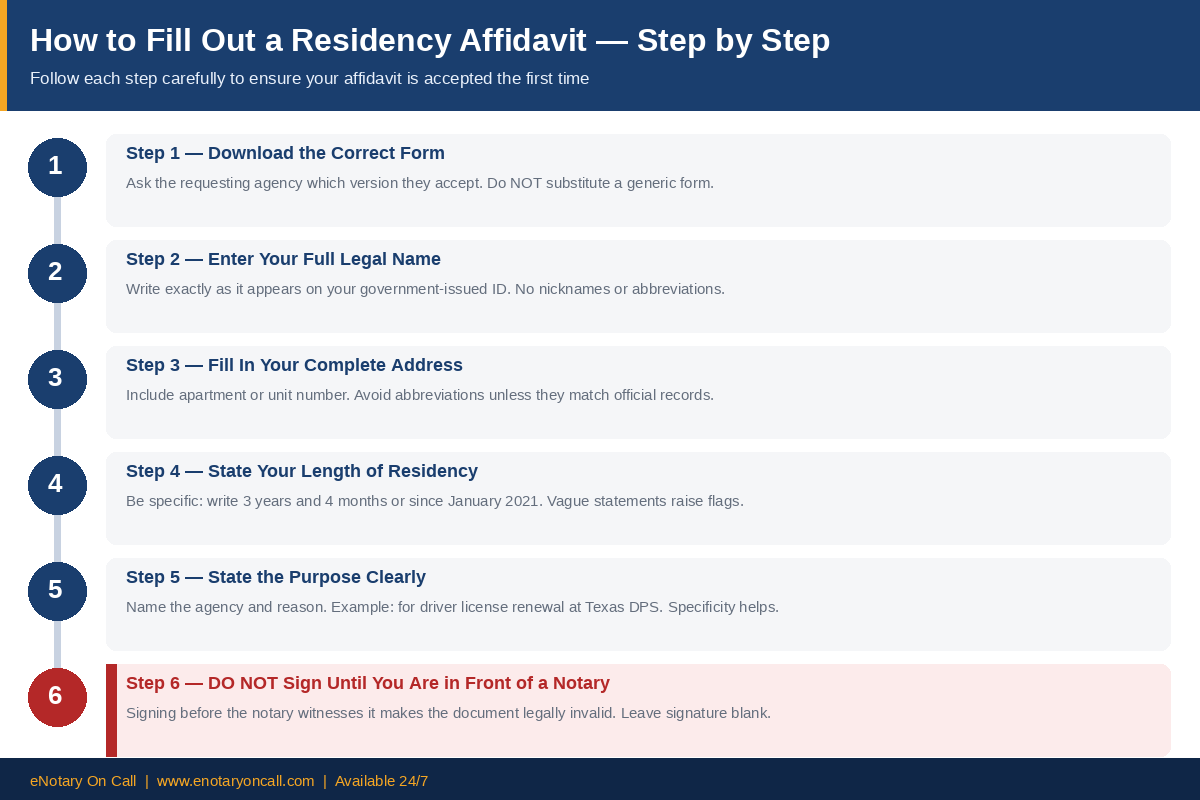
Step 1 – Download or Obtain the Correct Form
Do not guess which form to use. Ask the requesting agency which version they accept. Using the wrong form is the #1 reason these documents get rejected.
Step 2 – Enter Your Full Legal Name
Write your name exactly as it appears on your driver’s license, passport, or state ID. No nicknames, no abbreviations.
Step 3 – Fill in Your Complete Residential Address
Write your full address, including apartment or unit number if applicable. The address must match what the requesting agency has on file.
Step 4 – State Your Length of Residency
Be specific. Write “3 years and 4 months” or “since January 2021” – not “a few years.” Vague statements raise flags during review.
Step 5 – State the Purpose Clearly
If the form includes a purpose field, be direct: “This affidavit is being submitted to Agency for the purpose of establishing proof of residency for reason” Specificity builds credibility.
Step 6 – Do Not Sign Until You Are in Front of a Notary
This is critical. An affidavit of residency must be signed in the presence of a commissioned notary public. If you sign before the notary witnesses it, the document is legally invalid.
Common Mistakes That Get Affidavits Rejected
In our experience notarizing thousands of documents, these are the errors we see most often:
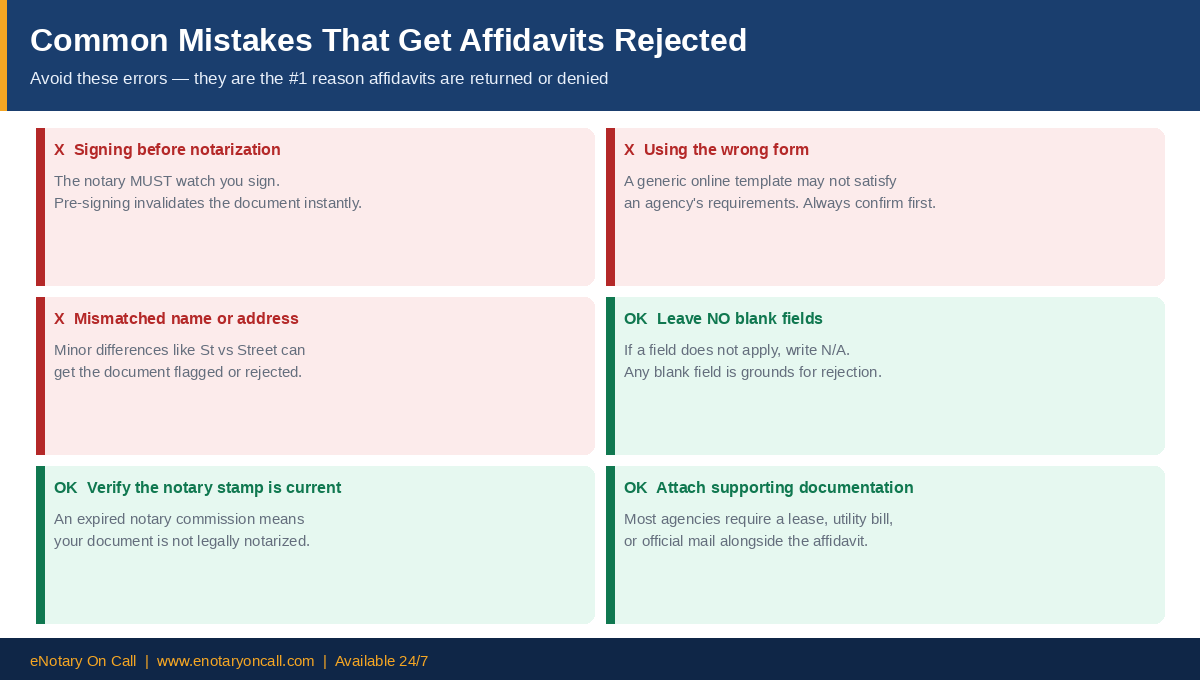
1. Signing before notarization – The notary must watch you sign. Always.
2. Using the wrong form – A generic affidavit of residence example found online may not satisfy a specific agency’s requirements.
3. Mismatched name or address – If your affidavit says “123 Main St” but your ID says “123 Main Street,” some agencies will flag it.
4. Leaving fields blank – Any blank field can be grounds for rejection. Write “N/A” if a field does not apply.
5. No supporting documentation – Many agencies require you to attach a supporting document alongside the affidavit. Check requirements before submitting.
Does Your Affidavit of Residency Need to Be Notarized?
In most cases, yes. A notarized affidavit of residency is required by state DMVs, public school districts, courts, government benefit programs, and most mortgage lenders.
Why notarization matters: Notarization verifies your identity, confirms you signed willingly, and gives the document legal standing. Without it, an affidavit of residency is just a piece of paper. If you’re not sure whether your specific situation requires a jurat or an acknowledgement, this guide breaks down exactly what type of notarization you need. “How to Notarize an Affidavit Online?”
How to Get Your Residency Affidavit Notarized Online
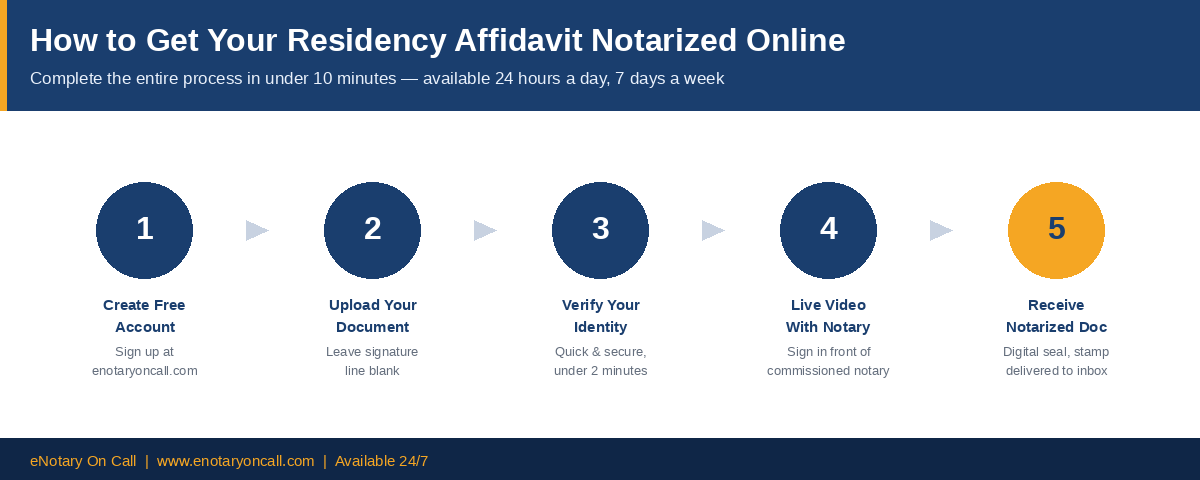
You do not need to find a UPS Store, drive to a bank, or schedule an appointment days in advance. eNotary On Call notarizes your affidavit of residency online – from your phone or computer – 24 hours a day, 7 days a week.
- Create your free account at eNotary On Call
- Upload your completed affidavit – leave the signature line blank
- Verify your identity & KBA Verification – quick, secure, under 2 minutes, and answer a few questions for KBA Verification
- Connect live with a commissioned notary – available immediately, any time
- Sign in front of the notary via live video – they witness your signature in real time
- Receive your notarized document – digitally stamped and legally valid, which can be downloaded immediately.
“The entire process takes less than 10 minutes. Need it done on a weekend or late at night? Our notaries are available 24/7 – including Sundays.”
State-Specific Notes on Residency Affidavits
Let’s take a look at the state-specific notes for the Residency Affidavits
1. Texas Residency Affidavit: Texas DPS accepts Form VTR-141 as proof of address for driver’s license applications. It must be notarized. Texas recognizes remote online notarization (RON), so a document notarized via eNotary On Call is fully valid. If you need to notarize other Texas legal documents online, here’s how out-of-state notarization works as well.
2. Florida Residency Affidavit: Florida DMV and courts accept a notarized affidavit of residency when standard proof is unavailable. Florida recognizes RON statewide.
3. California Residency Affidavit: California accepts notarized affidavits for various residency purposes. Medical has specific declaration requirements – confirm format with the agency.
4. Ohio Residency Affidavit: Ohio school districts frequently require a notarized affidavit of residency for enrollment or intradistrict transfers. Ohio allows RON.
5. Arizona Residency Affidavit: Arizona MVD accepts an affidavit alongside one supporting document. Arizona allows RON, making eNotary On Call fully compliant.
Get Your Affidavit of Residency Notarized Now – It’s Free to Sign Up
Frequently Asked Questions
1. Can I write my own affidavit of residency?
Yes – as long as it includes all required elements: your legal name, address, declaration language, and notary block. Using a state-issued form is always safer.
2. Who can sign as a witness on a residency affidavit?
This depends on the state and agency. Some forms require only the applicant’s signature, witnessed by a notary. Others may require a second declarant, such as a landlord or family member, to co-sign. If your affidavit specifically requires two witnesses, here’s what you need to know about finding a notary who provides them
3. How long is a notarized affidavit of residency valid?
Most agencies treat it as valid for 30 to 90 days from the date of notarization. Always check the recency requirement with the requesting organization.
4. Can I use an online notarized affidavit for a Texas DMV visit?
Yes. Texas recognizes remote online notarization. A document notarized through eNotary On Call is legally valid for Texas DPS purposes.
5. What is the difference between an affidavit of residency and proof of residency?
Proof of residency covers any document confirming your address – a bill, lease, or bank statement. An affidavit of residency is a specific, sworn legal document used when standard proof is not accepted. It carries more legal weight because it is signed under oath and notarized.
6. Is a handwritten affidavit of residency valid?
In some jurisdictions, yes – if it contains all required information and is properly notarized. Typed affidavits are generally preferred by agencies.
Final Thoughts
Filling out a residency affidavit does not have to be stressful. Follow the steps above, avoid the common mistakes, and remember – do not sign until you are in front of a notary.
The part that used to slow people down – finding a notary is now the fastest part of the process. eNotary On Call has commissioned notaries available around the clock.
Sign Up Free and Notarize in Minutes – eNotary On Call
No appointments. No waiting. Available 24/7.
References
- Texas DPS – Residency Affidavit Form VTR-141
- Florida DHSMV – Proof of Residency Requirements
- California DMV – Residency Documentation
- National Notary Association – Remote Online Notarization
- Cornell Law LII – Affidavit