 by
by You just wired your entire life savings to buy a home. Now imagine getting a call from your bank an hour later asking why you sent $180,000 to an account nobody on your closing team recognizes. Your stomach drops. Your hands go cold. And just like that, your down payment is gone, probably forever.
This isn’t a scare tactic. It happens to real buyers, real sellers, and real families every single week across the United States. Wire fraud in real estate has quietly become one of the most expensive and least talked about crimes in the property industry, and closings, the very moment when the biggest chunk of money changes hands, are ground zero for it.
In this blog, we’re breaking down what wire fraud actually is, how it plays out in real transactions, and how remote online notarization is quietly rewriting the rules of a safer closing.
What Is Wire Fraud?
What is wire fraud? In plain English, wire fraud is any scheme where a criminal uses electronic communication, email, phone, text, or wire transfer systems, to trick a victim into sending money or sensitive information under false pretenses.
It’s a federal crime in the United States under 18 U.S.C. Section 1343, and in real estate, it almost always follows the same pattern: impersonate someone the victim trusts, then redirect a payment to a criminal-controlled bank account.
Here’s the part that catches most homebuyers off guard. Wire fraud rarely involves hacking into a bank. It involves hacking into trust. A criminal watches your email inbox, learns your closing date, learns your closing agent’s name, and sends you a message that looks completely legitimate, right down to the letterhead and the signature block.
Wire Fraud Examples in Real Estate You Need to Know!
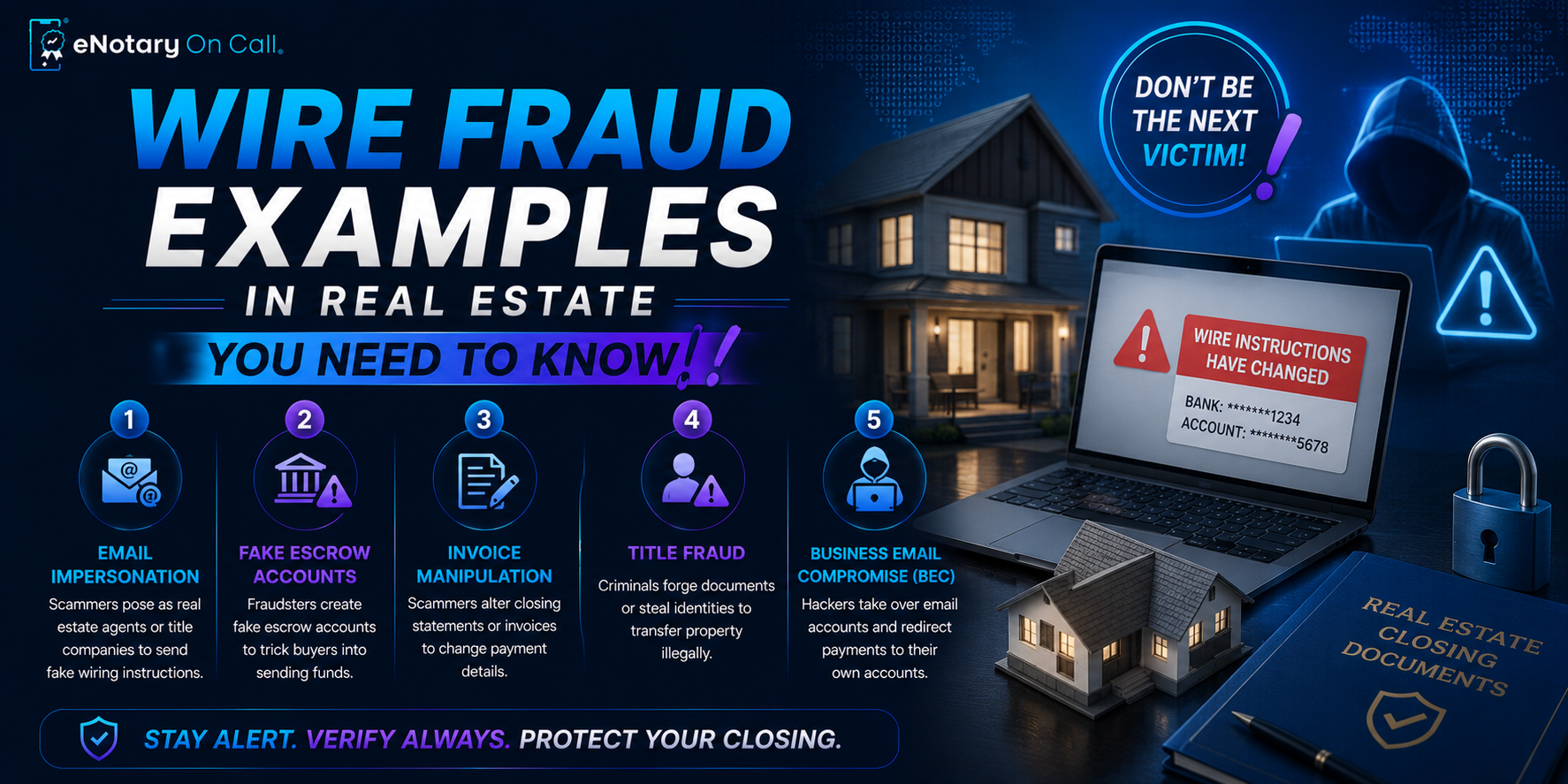
If you’re wondering what wire fraud examples actually look like in a real transaction, here are the patterns that show up again and again in FBI case files and title industry reports.
1. The Spoofed Closing Email
A buyer receives an email that appears to come from their title company or real estate closing attorney, containing updated wiring instructions right before closing.
The email address looks almost identical to the real one, sometimes off by a single letter.
2. The Compromised Inbox
Criminals gain access to a real estate agent’s or attorney’s actual email account, then quietly monitor conversations for weeks.
When a closing date is confirmed, they insert themselves into the thread with fraudulent instructions, timed perfectly.
3. The Urgent Phone Follow Up
After sending a fake wire instruction email, the scammer calls the victim pretending to be from the title company, creating a false sense of urgency to push the wire through before anyone double-checks.
4. The Fake Title Company Website
Fraudsters clone a legitimate title company’s website and use it to confirm fraudulent wiring details when a suspicious buyer tries to verify.
One IC3 case involved a Missouri senior citizen closing on a property. The victim received a compromised email from what looked like their title company, complete with wiring instructions for more than $1.3 million. The transaction was flagged only because the recovery team acted within hours.
Just How Big Is Wire Fraud in Real Estate?
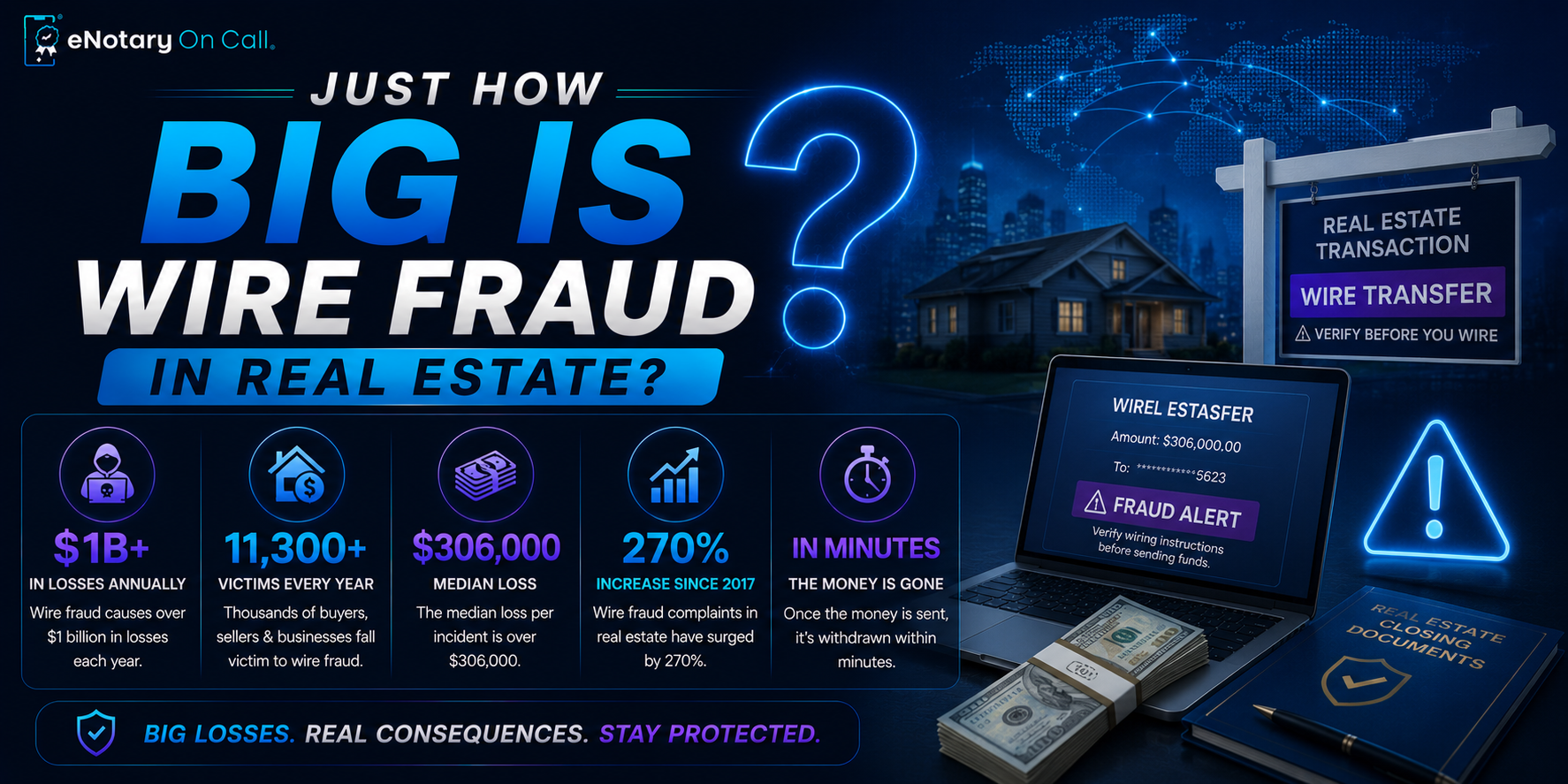
The numbers are not small, and they are not slowing down.
According to the FBI’s Internet Crime Complaint Center (IC3), Americans reported a record $275 million in real estate-related fraud losses in 2025, up from roughly $173 million in 2024 and about $145 million in 2023. That is nearly double in just two years.
IC3 reported more than $20.8 billion in total losses in 2025, a 26% jump from 2024, with an average reported loss of $20,699 per complaint. Business Email Compromise, the exact scheme behind most real estate wire fraud, remains one of the most financially damaging categories the FBI tracks.
Here’s the part that should really give you pause: victims typically have only about 24 hours, sometimes as little as 12, to freeze a fraudulent wire before it disappears into an untraceable account.
Once that window closes, recovery becomes extremely difficult. Speed is the criminal’s biggest weapon, and it’s also exactly what remote online notary Florida is designed to slow down.
How to Prevent Wire Fraud in Real Estate?
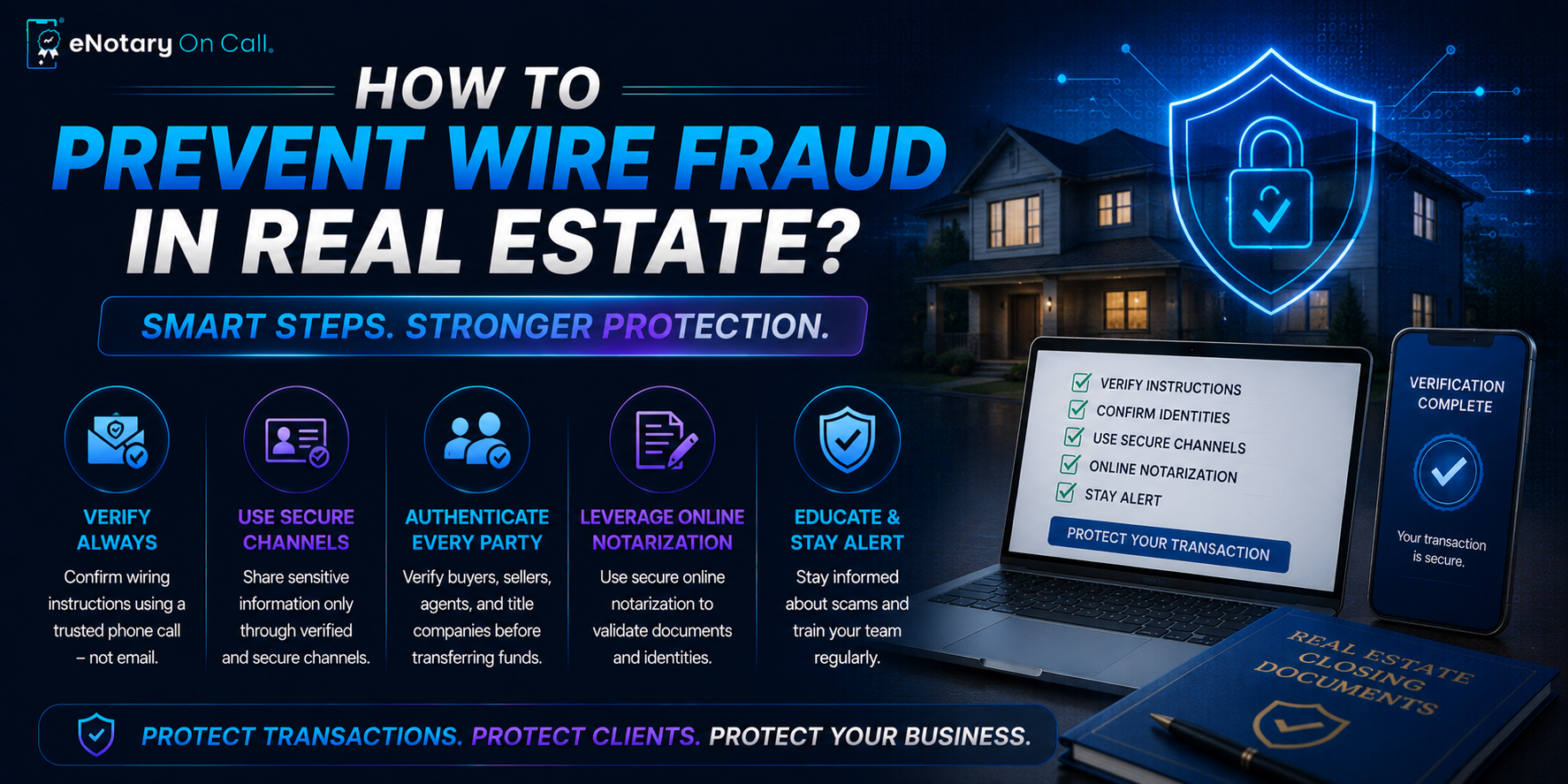
Before we talk about technology, let’s talk basics, because how to prevent wire fraud in real estate starts with habits, not just tools.
- Never trust wiring instructions received only by email. Call your title company or real estate closing attorney using a phone number you looked up independently, not one provided in the email itself.
- Confirm any change to wiring instructions verbally, every single time, no exceptions, even if the email looks perfectly normal.
- Send a small test transfer of $1 or less before wiring large sums, if your bank allows it.
- Be suspicious of any last-minute urgency. Real closings rarely require you to wire money within the hour.
- Ask your real estate closing attorney near me or title company what fraud verification steps they have in place before you sign anything.
These habits matter, but they rely entirely on human vigilance, and humans get tired, distracted, and rushed, especially during a stressful closing week. That’s exactly where technology needs to pick up the slack.
How Remote Online Notarization Actually Stops Wire Fraud?
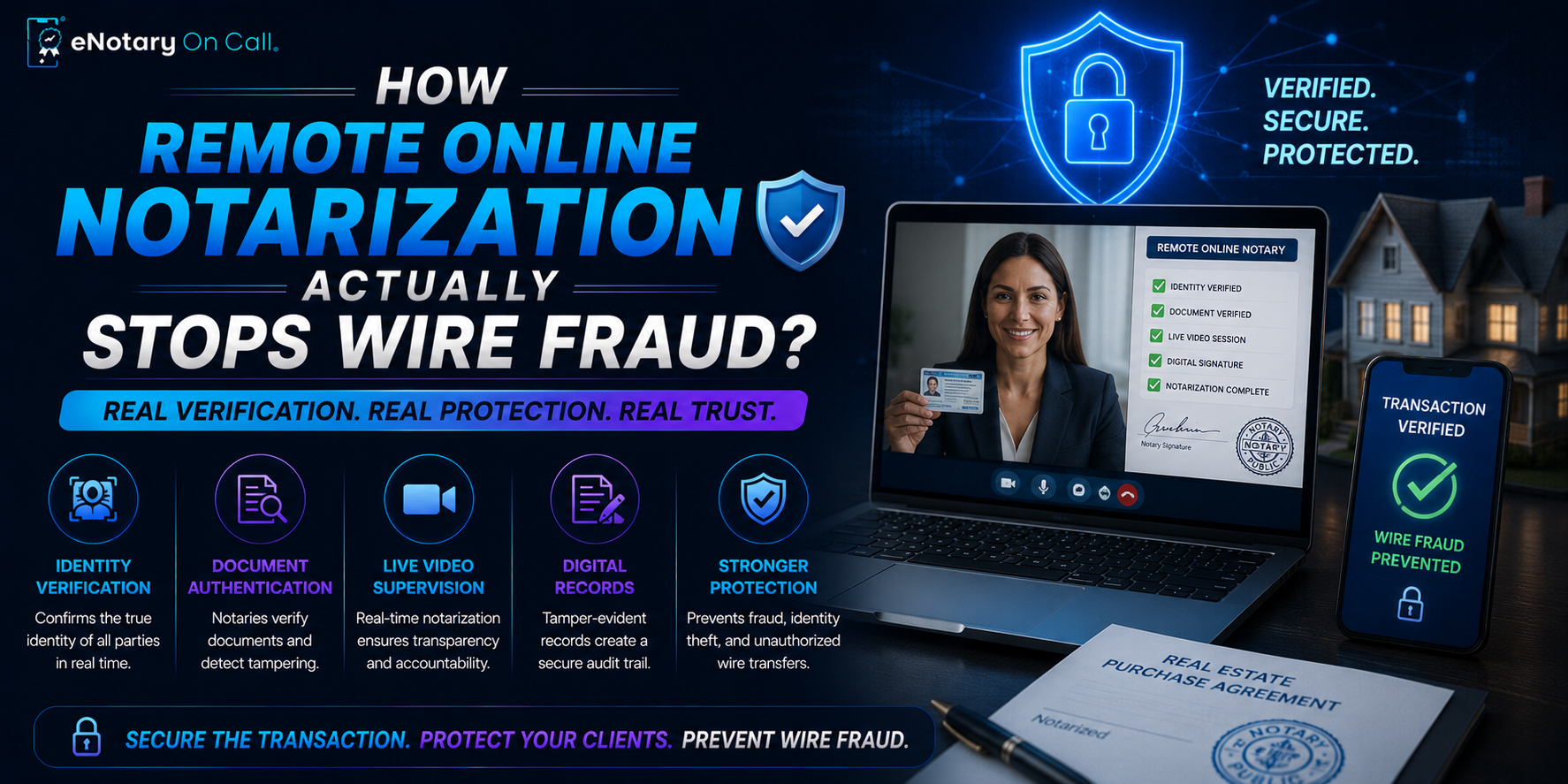
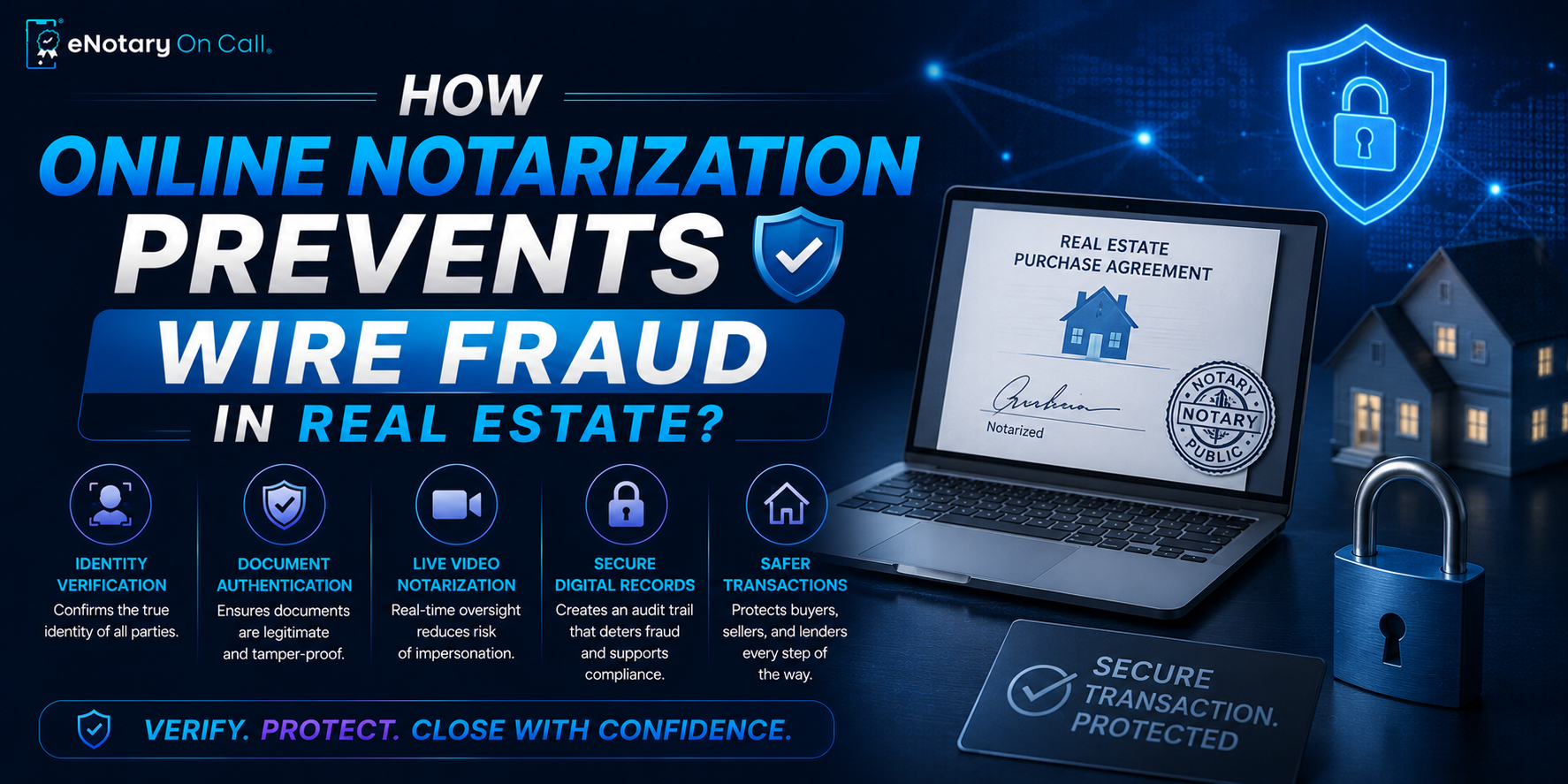
This is where things get genuinely interesting. Remote online notary technology wasn’t originally built as a fraud-fighting tool, it was built for convenience. But its side effect has turned out to be one of the strongest defenses against real estate wire fraud available today. Here’s how.
1. Every Signer Is Verified, Not Just Trusted
Traditional in-person notarization relies on a notary glancing at a driver’s license. A remote online notary session goes several steps further.
Before anyone signs a single document, the platform runs credential analysis on the government ID, biometric facial matching, and Knowledge-Based Authentication (KBA), a live quiz built from public and private records that only the real person could reliably pass.
A scammer sitting behind a stolen identity gets stopped right here, long before any document, let alone any wire, is involved.
2. Every Session Is Recorded and Time-Stamped
A licensed remote online notary doesn’t just witness a signature, they record the entire audio-video session and store it as a permanent, tamper-evident audit trail.
If a dispute or a fraud claim ever surfaces later, there is a verifiable record of exactly who signed, when, and under what circumstances. Criminals thrive in ambiguity. Recorded sessions remove it.
3. Documents Move Through Encrypted Channels, Not Inboxes
Most real estate wire fraud starts with a compromised or spoofed email. Online notary services eliminate that weak link by moving signed documents through encrypted platforms with secure cloud storage instead of unprotected email attachments.
That single shift closes off the most common entry point fraudsters use.
4. The Closing Timeline Gets Harder to Manipulate
Fraud thrives on rushed decisions. Scammers create fake urgency to get victims to wire funds before they can verify anything.
A structured remote online notary session, with scheduled appointments, identity checks, and a recorded process, naturally slows down the moment enough for buyers, sellers, and attorneys to catch red flags before money moves.
5. Tamper-Proof Digital Seals Replace Easily Forged Signatures
Digital notarial certificates use encrypted, tamper-evident seals. Unlike a wet-ink signature or a physical stamp that can be photocopied or forged, a digital seal is cryptographically tied to that specific document. Any attempt to alter it after signing is immediately detectable.
RON platforms like eNotary On Call build every one of these protections directly into the notarization workflow, using MISMO-certified technology, SOC 2 Type II compliant infrastructure, biometric identity verification, and encrypted cloud storage of every session for years after closing.
That’s not a marketing checklist, it’s exactly the kind of layered verification the FBI and title insurers point to when they talk about reducing real estate cyberfraud.
The Role of Your Real Estate Closing Attorney
Technology alone isn’t the whole answer. A good real estate closing attorney remains your first line of defense because they know your specific transaction, your timeline, and your title company’s actual procedures.
If you’re searching for a real estate closing attorney near me, look for one who explicitly discusses wire fraud verification steps as part of their real estate closing services, not as an afterthought.
The strongest closings pair a knowledgeable attorney with a verified remote online notary platform. The attorney manages the legal and contractual side of your real estate closing, while the online notary platform locks down identity verification, document integrity, and session recording.
Online Notary Florida vs. Online Notary Texas: What Changes State to State?
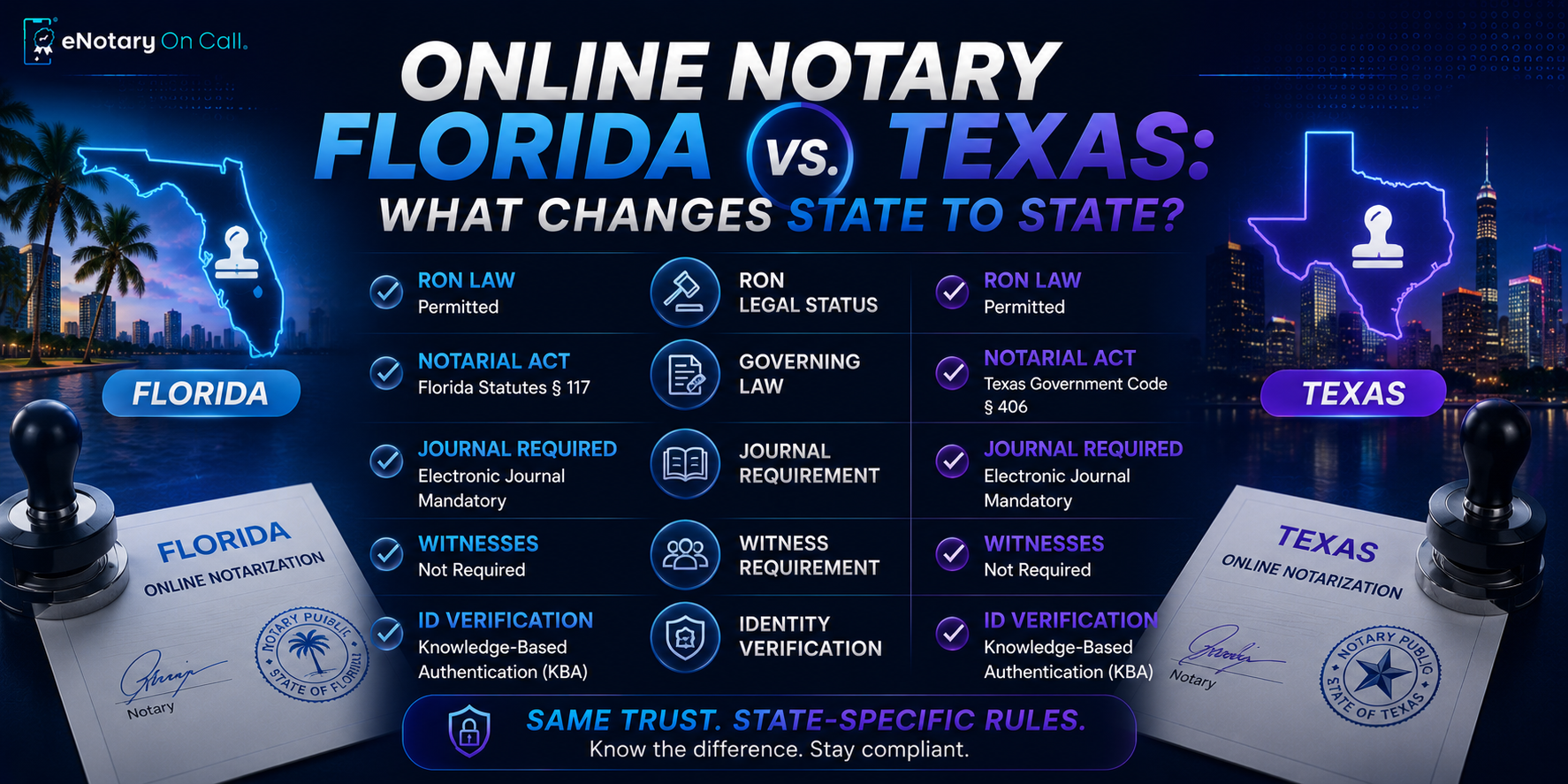
Remote online notarization is legal across most of the country, but the rules aren’t identical everywhere, and that matters if you’re closing across state lines.
Online notary Florida was one of the earliest adopters of RON law in the country, and Florida-notarized documents are recognized nationwide because of the Full Faith and Credit Clause of the U.S. Constitution. Florida sessions must include identity proofing, credential analysis, and a recorded audio-video call, exactly the layered verification that helps prevent wire fraud.
Online notary Texas operates under Senate Bill 2128, which authorizes remote online notarization statewide, from Houston and Dallas to Austin and San Antonio. Texas notaries are required to use similar audio-video and identity verification standards, and Texas-notarized real estate documents are legally valid for closings across the state and beyond.
If you’re closing in a state where in-person notarization is still required, such as California, most reputable platforms can still connect you with a licensed notary from a state that allows remote sessions, so your transaction doesn’t get stuck waiting on an in-person appointment.
Beyond the Closing Table: Wills, Trusts, and Deeds
Wire fraud protection doesn’t stop at the closing table. Some of the most sensitive documents in a person’s life also move through notarization, and they deserve the same level of protection.
You can now notarize will and trust online, which matters enormously for estate planning, since these documents determine who inherits property and assets.
A recorded, identity-verified session provides a much stronger legal record than an in-person signing with no documentation of the signer’s mental clarity or genuine consent, something that frequently gets challenged in probate disputes.
Similarly, buyers and sellers often need to notarize quitclaim deed online during property transfers between family members, divorce settlements, or corrections to a title.
Because quitclaim deeds transfer ownership without the protections of a warranty deed, verifying the signer’s true identity through biometric and KBA checks adds a meaningful layer of security against fraudulent title transfers, which is itself a growing category of real estate crime.
What to Look for in Online Notary Services and Closing Services?
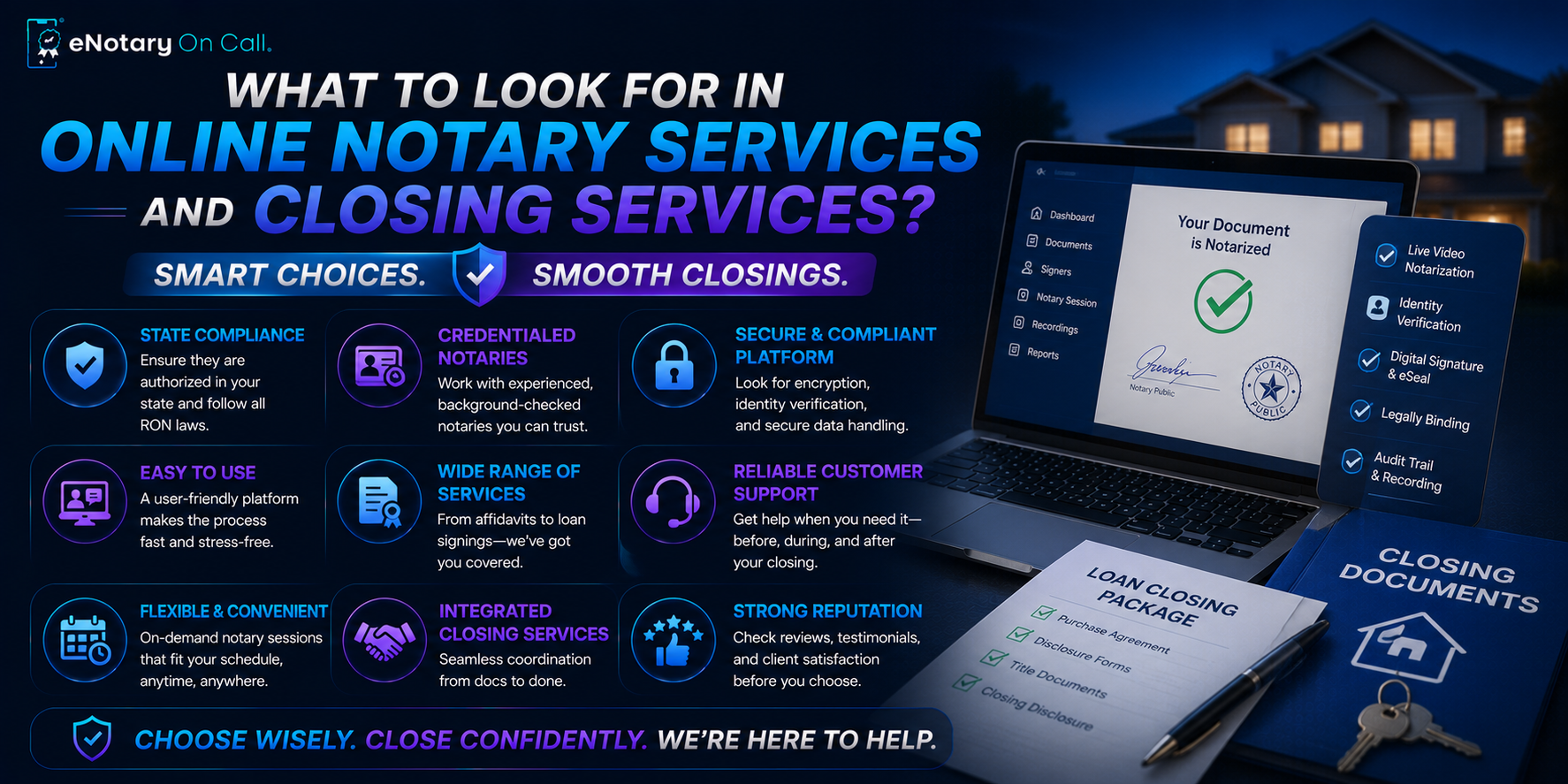
Not every platform offering online notary services is built the same way, and the differences directly affect your fraud protection. When evaluating real estate closing services or a standalone remote online notary provider, check for:
- MISMO certification, the mortgage industry’s own security and interoperability standard
- SOC 2 Type II compliance, which confirms independently audited data security controls
- Multi-layered identity verification, including biometric ID checks and KBA, not just a visual ID scan
- Encrypted, long-term cloud storage of session recordings, typically five to seven years
- 24/7 availability, so you’re never rushed into skipping a step just to meet a deadline
- A live human support team you can actually reach if something looks off mid-session
eNotary On Call checks every one of these boxes, connecting signers with certified notaries across states like Florida and Texas, backed by IdenTrust-partnered digital certificates, encrypted AWS, Azure, and Google Cloud storage, and session records retained for up to seven years.
For a buyer or seller trying to close safely, that combination of speed and verified security is exactly what modern wire fraud prevention looks like in practice.
Conclusion
Wire fraud in real estate isn’t going away on its own, criminals are getting more sophisticated, not less, and the dollar amounts stolen keep climbing year over year. But the closing process itself doesn’t have to be the weak link anymore.
Between verified identity checks, recorded sessions, encrypted document delivery, and a real estate closing attorney who takes fraud seriously, buyers and sellers today have more protection available than ever before, if they choose to use it.
The single best decision you can make before your next closing is simple: work with a real estate closing attorney you trust, and pair that with a remote online notary platform built on real security certifications, not just convenience marketing.
Ready to close your next transaction with verified, fraud-resistant notarization?
Book your session with eNotary On Call and get a certified notary in minutes, backed by identity verification, encrypted records, and 24/7 support.
FAQs
1. Is remote online notarization actually legal for real estate closings?
Yes. Most U.S. states, including Florida and Texas, have passed RON laws permitting remote online notarization for real estate documents, and those notarized documents are recognized across state lines under the Full Faith and Credit Clause.
2. How does eNotary On Call verify a signer’s identity before a real estate closing?
eNotary On Call uses biometric ID verification, credential analysis, and Knowledge-Based Authentication (KBA) during a live audio-video session, so a fraudster attempting to impersonate a buyer or seller is stopped before any document gets signed.
3. Can I use eNotary On Call to notarize documents in states other than Florida and Texas?
Yes, eNotary On Call connects signers nationwide with certified online notaries across multiple states, and even helps residents of states like California access a notary from another state where remote notarization is permitted.
4. Does eNotary On Call keep a record of my notarization session?
Yes. Every session is recorded and securely stored on encrypted cloud infrastructure for up to seven years, giving you a verifiable audit trail if a dispute or fraud claim ever comes up later.
5. How much does it cost to notarize a real estate document online with eNotary On Call?
Pricing typically starts around $25 per document, with an additional $10 for each extra notary seal or signature, though exact costs can vary by document type and state.
6. Can eNotary On Call help notarize a will, trust, or quitclaim deed?
Yes, eNotary On Call supports online notarization for wills, trusts, quitclaim deeds, powers of attorney, and a wide range of real estate and estate-planning documents.
7. Is online notarization safer than an in-person notary for large real estate wires?
In several ways, yes. It adds biometric verification, recorded sessions, and encrypted document delivery, layers a traditional in-person signing simply doesn’t include.
8. Do I still need a real estate closing attorney if I use a remote online notary?
Yes. A remote online notary verifies identity and witnesses signing, but your attorney handles contract review, title issues, and legal guidance specific to your transaction.